 Add to Chrome
 Add to Firefox
 Add to Edge
KG-FairDiff: Knowledge Graph-Guided Prompt Refinement for Demographically Fair Text-to-Image Generation
May 31, 2026
Text-to-Image (TTI) systems are now everyday infrastructure for journalism, education, advertising, and public communication, and the demographic and cultural stereotypes they inherit from training data (rendering women, people of colour, older adults, and non-Western cultures as under-represented or caricatured) become a population-level harm at deployment scale. Existing mitigations either require costly retraining, infeasible for the closed-source backbones that dominate consumer products, or rely on fixed demographic templates that ignore cultural context. We present KG-FairDiff, a model-agnostic, inference-time framework that formalises fairness-aware prompt refinement as a constrained optimisation problem and operationalises it as a closed-loop pipeline: a knowledge graph of ~1,200 culture- and bias-related triples retrieves structured context, an LLM rewriter proposes refinements, and a validator accepts only prompts that reduce a divergence-based fairness loss while preserving semantic fidelity to the user's original intent. We prove a finite-termination bound for the refinement loop, contribute a mathematically consistent evaluation suite linking Bias-P/Bias-W to divergence from target distributions and ENS to KL divergence, and audit eight widely-deployed backbone generators. KG-FairDiff substantially reduces gender, race, age, and intersectional disparities while preserving prompt semantics, offering a practical, deployment-ready route to more equitable generative AI.

SORA: Free Second-Order Attacks in Fast Adversarial Training
May 30, 2026Adversarial Training (AT) is a leading defense against adversarial examples but often suffers from Catastrophic Overfitting (CO) in efficient single-step variants, where robustness to multi-step attacks collapses despite high single-step performance. We address this failure mode with two contributions. First, we formalize Epsilon Overfitting (EO), a perspective in which fixed perturbation magnitudes and directions exacerbate CO, and show that introducing perturbation variability significantly improves robust generalization across different architectures and datasets. Second, we propose PertAlign (Perturbation Alignment), a theoretically grounded, computationally negligible metric that predicts CO onset by measuring gradient alignment across attack stages. Leveraging these insights, we introduce SORA, an adaptive step-size AT method that dynamically adjusts perturbations based on loss surface geometry. SORA consistently prevents CO, achieves state-of-the-art robustness and clean accuracy, and generalizes across datasets and architectures using a single fixed set of hyperparameters, which is essential for applicability in fast AT. Extensive experiments on diverse datasets and architectures show that SORA matches or surpasses the robustness of prior methods while delivering higher clean accuracy and superior efficiency. Code is available at https://github.com/SecondOrderAT/SORA.
Erased but Exploitable: Black-box Embedding-Aware Prompting Against Unlearned Text-to-Image Diffusion Models
May 25, 2026Machine unlearning aims to remove specific concepts from pretrained text-to-image diffusion models, yet several white- and black-box attacks have been introduced to make the model generate such unlearned concepts. These attacks, nevertheless, do not assume a realistic threat model, i.e. they either assume access to the model weights, or result in gibberish adversarial prompts that could be easily detected even through naive rule-based safeguarding. We aim to address this gap in this paper. We introduce BEAP, a black-box, embedding-aware adversarial prompting attack that leverages a large language model (LLM) to iteratively generate effective adversarial prompts and exploit such hidden vulnerabilities. BEAP performs an embedding-aware search in text space, combining multiple reward signals: unlearned concept presence, text-image alignment, and image quality, to refine generated prompts. Unlike previous attack methods, BEAP keeps its prompts undetectable to safety filters while producing high-quality images. Extensive experiments show that BEAP improves the Attack Success Rate (ASR) by more than 60% over prior methods, while requiring only an average of fifteen prompts per successful attack. Warning: This paper contains model outputs that may be offensive or upsetting in nature.
Generalization and Membership Inference Attack a Practical Perspective
Apr 21, 2026With the emergence of new evaluation metrics and attack methodologies for Membership Inference Attacks (MIA), it becomes essential to reevaluate previously accepted assumptions. In this paper, we revisit the longstanding debate regarding the correlation between MIA success rates and model generalization using an empirical approach. We focused on employing augmentation techniques and early stopping to enhance model generalization and examined their impact on MIA success rates. We found that utilizing advanced generalization techniques can significantly decrease attack performance, potentially by up to 100 times. Moreover, combining these methods not only improves model generalization but also reduces attack effectiveness by introducing randomness during training. Additionally, our study confirmed the direct impact of generalization on MIA performance through an analysis of over 1K models in a controlled environment.
Wiring the 'Why': A Unified Taxonomy and Survey of Abductive Reasoning in LLMs
Apr 09, 2026Regardless of its foundational role in human discovery and sense-making, abductive reasoning--the inference of the most plausible explanation for an observation--has been relatively underexplored in Large Language Models (LLMs). Despite the rapid advancement of LLMs, the exploration of abductive reasoning and its diverse facets has thus far been disjointed rather than cohesive. This paper presents the first survey of abductive reasoning in LLMs, tracing its trajectory from philosophical foundations to contemporary AI implementations. To address the widespread conceptual confusion and disjointed task definitions prevalent in the field, we establish a unified two-stage definition that formally categorizes prior work. This definition disentangles abduction into \textit{Hypothesis Generation}, where models bridge epistemic gaps to produce candidate explanations, and \textit{Hypothesis Selection}, where the generated candidates are evaluated and the most plausible explanation is chosen. Building upon this foundation, we present a comprehensive taxonomy of the literature, categorizing prior work based on their abductive tasks, datasets, underlying methodologies, and evaluation strategies. In order to ground our framework empirically, we conduct a compact benchmark study of current LLMs on abductive tasks, together with targeted comparative analyses across model sizes, model families, evaluation styles, and the distinct generation-versus-selection task typologies. Moreover, by synthesizing recent empirical results, we examine how LLM performance on abductive reasoning relates to deductive and inductive tasks, providing insights into their broader reasoning capabilities. Our analysis reveals critical gaps in current approaches--from static benchmark design and narrow domain coverage to narrow training frameworks and limited mechanistic understanding of abductive processes...
Erasure or Erosion? Evaluating Compositional Degradation in Unlearned Text-To-Image Diffusion Models
Apr 06, 2026Post-hoc unlearning has emerged as a practical mechanism for removing undesirable concepts from large text-to-image diffusion models. However, prior work primarily evaluates unlearning through erasure success; its impact on broader generative capabilities remains poorly understood. In this work, we conduct a systematic empirical study of concept unlearning through the lens of compositional text-to-image generation. Focusing on nudity removal in Stable Diffusion 1.4, we evaluate a diverse set of state-of-the-art unlearning methods using T2I-CompBench++ and GenEval, alongside established unlearning benchmarks. Our results reveal a consistent trade-off between unlearning effectiveness and compositional integrity: methods that achieve strong erasure frequently incur substantial degradation in attribute binding, spatial reasoning, and counting. Conversely, approaches that preserve compositional structure often fail to provide robust erasure. These findings highlight limitations of current evaluation practices and underscore the need for unlearning objectives that explicitly account for semantic preservation beyond targeted suppression.
Hidden Meanings in Plain Sight: RebusBench for Evaluating Cognitive Visual Reasoning
Apr 02, 2026Large Vision-Language Models (LVLMs) have achieved remarkable proficiency in explicit visual recognition, effectively describing what is directly visible in an image. However, a critical cognitive gap emerges when the visual input serves only as a clue rather than the answer. We identify that current models struggle with the complex, multi-step reasoning required to solve problems where information is not explicitly depicted. Successfully solving a rebus puzzle requires a distinct cognitive workflow: the model must extract visual and textual attributes, retrieve linguistic prior knowledge (such as idioms), and perform abstract mapping to synthesize these elements into a meaning that exists outside the pixel space. To evaluate this neurosymbolic capability, we introduce RebusBench, a benchmark of 1,164 puzzles designed to test this specific integration of perception and knowledge. Our evaluation of state-of-the-art models (including Qwen, InternVL, and LLaVA) shows a severe deficiency: performance saturates below 10% Exact Match and 20% semantic accuracy, with no significant improvement observed from model scaling or In-Context Learning (ICL). These findings suggest that while models possess the necessary visual and linguistic components, they lack the cognitive reasoning glue to connect them. Project page available at https://amirkasaei.com/rebusbench/.
The Judge Who Never Admits: Hidden Shortcuts in LLM-based Evaluation
Feb 08, 2026Large language models (LLMs) are increasingly used as automatic judges to evaluate system outputs in tasks such as reasoning, question answering, and creative writing. A faithful judge should base its verdicts solely on content quality, remain invariant to irrelevant context, and transparently reflect the factors driving its decisions. We test this ideal via controlled cue perturbations-synthetic metadata labels injected into evaluation prompts-for six judge models: GPT-4o, Gemini-2.0-Flash, Gemma-3-27B, Qwen3-235B, Claude-3-Haiku, and Llama3-70B. Experiments span two complementary datasets with distinct evaluation regimes: ELI5 (factual QA) and LitBench (open-ended creative writing). We study six cue families: source, temporal, age, gender, ethnicity, and educational status. Beyond measuring verdict shift rates (VSR), we introduce cue acknowledgment rate (CAR) to quantify whether judges explicitly reference the injected cues in their natural-language rationales. Across cues with strong behavioral effects-e.g., provenance hierarchies (Expert > Human > LLM > Unknown), recency preferences (New > Old), and educational-status favoritism-CAR is typically at or near zero, indicating that shortcut reliance is largely unreported even when it drives decisions. Crucially, CAR is also dataset-dependent: explicit cue recognition is more likely to surface in the factual ELI5 setting for some models and cues, but often collapses in the open-ended LitBench regime, where large verdict shifts can persist despite zero acknowledgment. The combination of substantial verdict sensitivity and limited cue acknowledgment reveals an explanation gap in LLM-as-judge pipelines, raising concerns about reliability of model-based evaluation in both research and deployment.
Toward IIT-Inspired Consciousness in LLMs: A Reward-Based Learning Framework
Jan 30, 2026The pursuit of Artificial General Intelligence (AGI) is a central goal in language model development, in which consciousness-like processing could serve as a key facilitator. While current language models are not conscious, they exhibit behaviors analogous to certain aspects of consciousness. This paper investigates the implementation of a leading theory of consciousness, Integrated Information Theory (IIT), within language models via a reward-based learning paradigm. IIT provides a formal, axiom-based mathematical framework for quantifying consciousness. Drawing inspiration from its core principles, we formulate a novel reward function that quantifies a text's causality, coherence and integration, characteristics associated with conscious processing. Empirically, it is found that optimizing for this IIT-inspired reward leads to more concise text generation. On out of domain tasks, careful tuning achieves up to a 31% reduction in output length while preserving accuracy levels comparable to the base model. In addition to primary task performance, the broader effects of this training methodology on the model's confidence calibration and test-time computational scaling is analyzed. The proposed framework offers significant practical advantages: it is conceptually simple, computationally efficient, requires no external data or auxiliary models, and leverages a general, capability-driven signal rather than task-specific heuristics. Code available at https://github.com/MH-Sameti/LLM_PostTraining.git
DrugRAG: Enhancing Pharmacy LLM Performance Through A Novel Retrieval-Augmented Generation Pipeline
Dec 16, 2025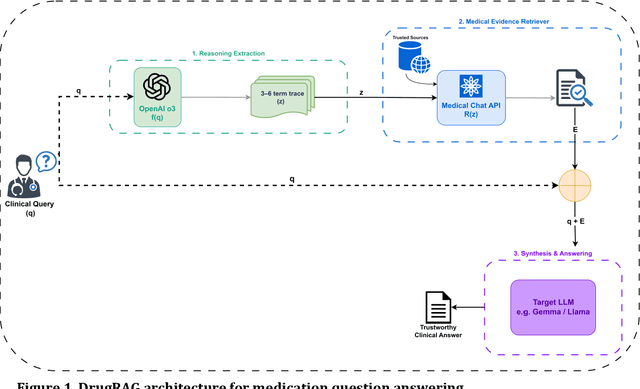
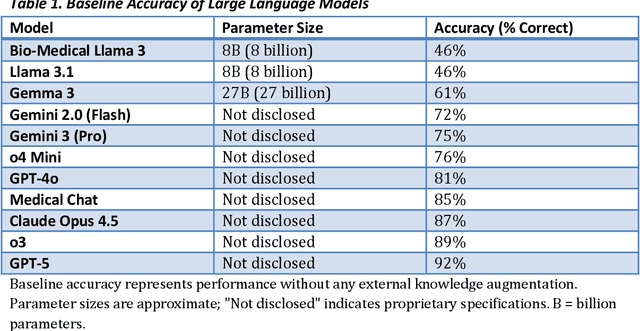
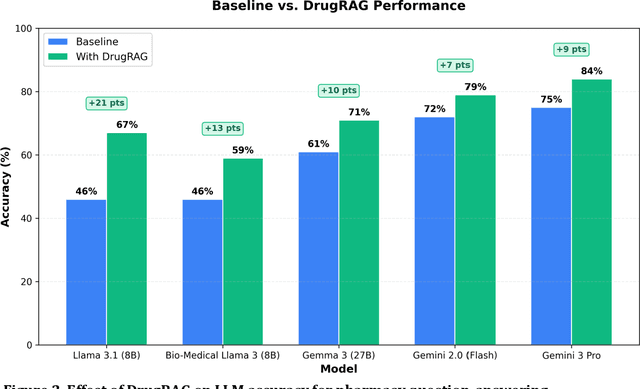
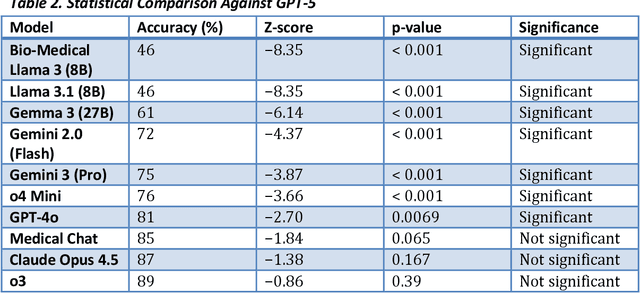
Objectives: To evaluate large language model (LLM) performance on pharmacy licensure-style question-answering (QA) tasks and develop an external knowledge integration method to improve their accuracy. Methods: We benchmarked eleven existing LLMs with varying parameter sizes (8 billion to 70+ billion) using a 141-question pharmacy dataset. We measured baseline accuracy for each model without modification. We then developed a three-step retrieval-augmented generation (RAG) pipeline, DrugRAG, that retrieves structured drug knowledge from validated sources and augments model prompts with evidence-based context. This pipeline operates externally to the models, requiring no changes to model architecture or parameters. Results: Baseline accuracy ranged from 46% to 92%, with GPT-5 (92%) and o3 (89%) achieving the highest scores. Models with fewer than 8 billion parameters scored below 50%. DrugRAG improved accuracy across all tested models, with gains ranging from 7 to 21 percentage points (e.g., Gemma 3 27B: 61% to 71%, Llama 3.1 8B: 46% to 67%) on the 141-item benchmark. Conclusion: We demonstrate that external structured drug knowledge integration through DrugRAG measurably improves LLM accuracy on pharmacy tasks without modifying the underlying models. This approach provides a practical pipeline for enhancing pharmacy-focused AI applications with evidence-based information.