 Add to Chrome
 Add to Firefox
 Add to Edge
Causal Attribution via Activation Patching
Mar 13, 2026
Attribution methods for Vision Transformers (ViTs) aim to identify image regions that influence model predictions, but producing faithful and well-localized attributions remains challenging. Existing gradient-based and perturbation-based techniques often fail to isolate the causal contribution of internal representations associated with individual image patches. The key challenge is that class-relevant evidence is formed through interactions between patch tokens across layers, and input-level perturbations can be poor proxies for patch importance, since they may fail to reconstruct the internal evidence actually used by the model. We propose Causal Attribution via Activation Patching (CAAP), which estimates the contribution of individual image patches to the ViT's prediction by directly intervening on internal activations rather than using learned masks or synthetic perturbation patterns. For each patch, CAAP inserts the corresponding source-image activations into a neutral target context over an intermediate range of layers and uses the resulting target-class score as the attribution signal. The resulting attribution map reflects the causal effect of patch-associated internal representations on the model's prediction. The causal intervention serves as a principled measure of patch influence by capturing class-relevant evidence after initial representation formation, while avoiding late-layer global mixing that can reduce spatial specificity. Across multiple ViT backbones and standard metrics, CAAP significantly outperforms existing methods and produces more faithful and localized attributions.

Mechanistic Interpretability of Large-Scale Counting in LLMs through a System-2 Strategy
Jan 06, 2026Large language models (LLMs), despite strong performance on complex mathematical problems, exhibit systematic limitations in counting tasks. This issue arises from architectural limits of transformers, where counting is performed across layers, leading to degraded precision for larger counting problems due to depth constraints. To address this limitation, we propose a simple test-time strategy inspired by System-2 cognitive processes that decomposes large counting tasks into smaller, independent sub-problems that the model can reliably solve. We evaluate this approach using observational and causal mediation analyses to understand the underlying mechanism of this System-2-like strategy. Our mechanistic analysis identifies key components: latent counts are computed and stored in the final item representations of each part, transferred to intermediate steps via dedicated attention heads, and aggregated in the final stage to produce the total count. Experimental results demonstrate that this strategy enables LLMs to surpass architectural limitations and achieve high accuracy on large-scale counting tasks. This work provides mechanistic insight into System-2 counting in LLMs and presents a generalizable approach for improving and understanding their reasoning behavior.
CLIP Under the Microscope: A Fine-Grained Analysis of Multi-Object Representation
Feb 27, 2025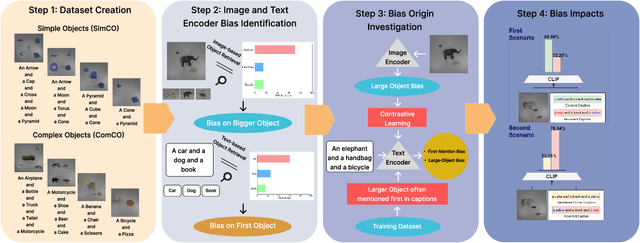
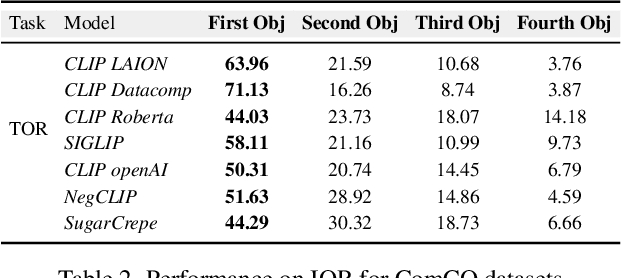
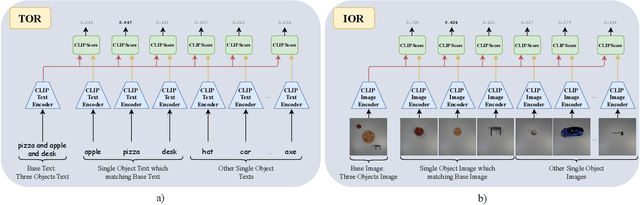
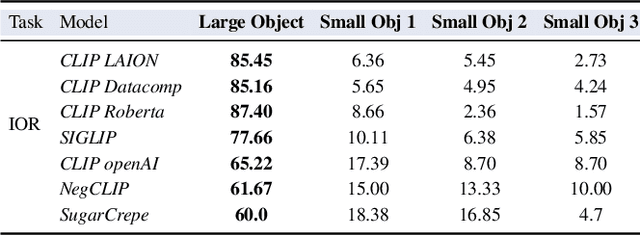
Contrastive Language-Image Pre-training (CLIP) models excel in zero-shot classification, yet face challenges in complex multi-object scenarios. This study offers a comprehensive analysis of CLIP's limitations in these contexts using a specialized dataset, ComCO, designed to evaluate CLIP's encoders in diverse multi-object scenarios. Our findings reveal significant biases: the text encoder prioritizes first-mentioned objects, and the image encoder favors larger objects. Through retrieval and classification tasks, we quantify these biases across multiple CLIP variants and trace their origins to CLIP's training process, supported by analyses of the LAION dataset and training progression. Our image-text matching experiments show substantial performance drops when object size or token order changes, underscoring CLIP's instability with rephrased but semantically similar captions. Extending this to longer captions and text-to-image models like Stable Diffusion, we demonstrate how prompt order influences object prominence in generated images. For more details and access to our dataset and analysis code, visit our project repository: https://clip-analysis.github.io.
Analyzing CLIP's Performance Limitations in Multi-Object Scenarios: A Controlled High-Resolution Study
Feb 27, 2025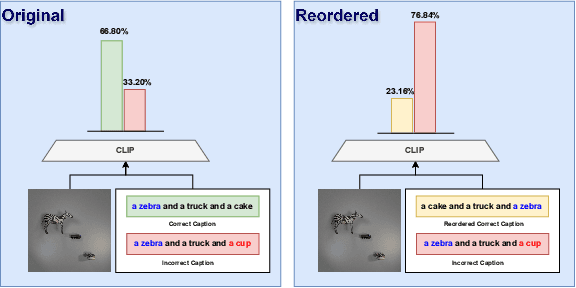
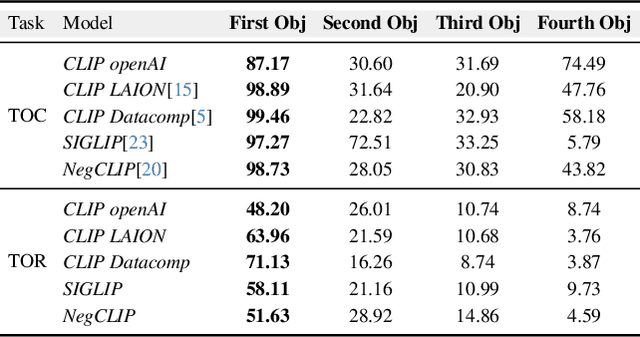
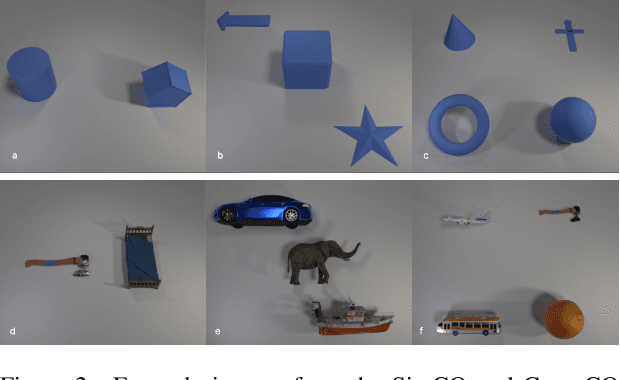
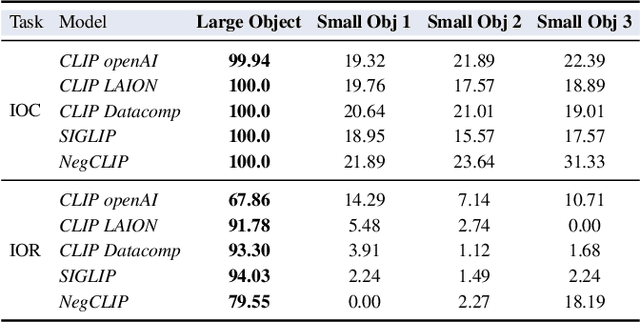
Contrastive Language-Image Pre-training (CLIP) models have demonstrated remarkable performance in zero-shot classification tasks, yet their efficacy in handling complex multi-object scenarios remains challenging. This study presents a comprehensive analysis of CLIP's performance limitations in multi-object contexts through controlled experiments. We introduce two custom datasets, SimCO and CompCO, to evaluate CLIP's image and text encoders in various multi-object configurations. Our findings reveal significant biases in both encoders: the image encoder favors larger objects, while the text encoder prioritizes objects mentioned first in descriptions. We hypothesize these biases originate from CLIP's training process and provide evidence through analyses of the COCO dataset and CLIP's training progression. Additionally, we extend our investigation to Stable Diffusion models, revealing that biases in the CLIP text encoder significantly impact text-to-image generation tasks. Our experiments demonstrate how these biases affect CLIP's performance in image-caption matching and generation tasks, particularly when manipulating object sizes and their order in captions. This work contributes valuable insights into CLIP's behavior in complex visual environments and highlights areas for improvement in future vision-language models.
Attention Overlap Is Responsible for The Entity Missing Problem in Text-to-image Diffusion Models!
Oct 28, 2024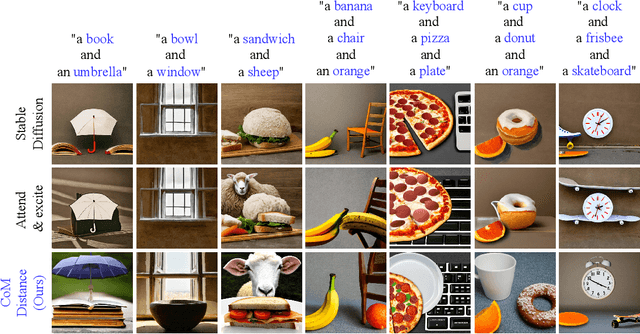
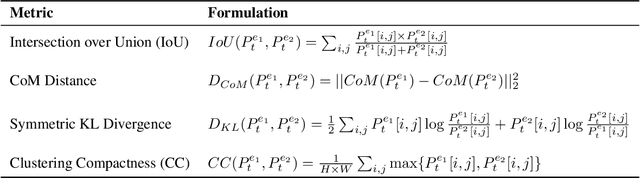
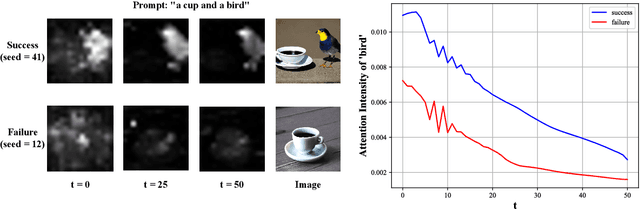
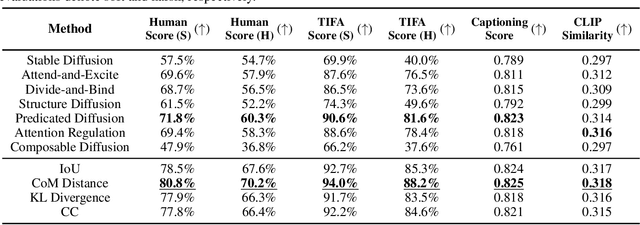
Text-to-image diffusion models, such as Stable Diffusion and DALL-E, are capable of generating high-quality, diverse, and realistic images from textual prompts. However, they sometimes struggle to accurately depict specific entities described in prompts, a limitation known as the entity missing problem in compositional generation. While prior studies suggested that adjusting cross-attention maps during the denoising process could alleviate this problem, they did not systematically investigate which objective functions could best address it. This study examines three potential causes of the entity-missing problem, focusing on cross-attention dynamics: (1) insufficient attention intensity for certain entities, (2) overly broad attention spread, and (3) excessive overlap between attention maps of different entities. We found that reducing overlap in attention maps between entities can effectively minimize the rate of entity missing. Specifically, we hypothesize that tokens related to specific entities compete for attention on certain image regions during the denoising process, which can lead to divided attention across tokens and prevent accurate representation of each entity. To address this issue, we introduced four loss functions, Intersection over Union (IoU), center-of-mass (CoM) distance, Kullback-Leibler (KL) divergence, and clustering compactness (CC) to regulate attention overlap during denoising steps without the need for retraining. Experimental results across a wide variety of benchmarks reveal that these proposed training-free methods significantly improve compositional accuracy, outperforming previous approaches in visual question answering (VQA), captioning scores, CLIP similarity, and human evaluations. Notably, these methods improved human evaluation scores by 9% over the best baseline, demonstrating substantial improvements in compositional alignment.