 Add to Chrome
 Add to Firefox
 Add to Edge
Persian MusicGen: A Large-Scale Dataset and Culturally-Aware Generative Model for Persian Music
May 14, 2026
Persian music, with its unique tonalities, modal systems (Dastgah), and rhythmic structures, presents significant challenges for music generation models trained primarily on Western music. We address this gap by curating the first large-scale dataset of Persian songs, comprising over 900 hours high-quality audio samples across diverse sub-genres, including pop, traditional, and contemporary styles. This dataset captures the rich melodic and cultural diversity of Persian music and serves as the foundation for fine-tuning MusicGen, a state-of-the-art generative music model. We adapt MusicGen to this domain and evaluate its performance by utilizing subjective and objective metrics. To assess the semantic alignment between generated music and intended style tags, we report the proportion of relevant tags accurately reflected in the generated outputs. Our results demonstrate that the fine-tuned model produces compositions that more align with Persian stylistic conventions. This work introduces a new resource for generative music research and illustrates the adaptability of music generation models to underrepresented cultural and linguistic contexts.

HaloProbe: Bayesian Detection and Mitigation of Object Hallucinations in Vision-Language Models
Apr 07, 2026Large vision-language models can produce object hallucinations in image descriptions, highlighting the need for effective detection and mitigation strategies. Prior work commonly relies on the model's attention weights on visual tokens as a detection signal. We reveal that coarse-grained attention-based analysis is unreliable due to hidden confounders, specifically token position and object repetition in a description. This leads to Simpson's paradox: the attention trends reverse or disappear when statistics are aggregated. Based on this observation, we introduce HaloProbe, a Bayesian framework that factorizes external description statistics and internal decoding signals to estimate token-level hallucination probabilities. HaloProbe uses balanced training to isolate internal evidence and combines it with learned prior over external features to recover the true posterior. While intervention-based mitigation methods often degrade utility or fluency by modifying models' internals, we use HaloProbe as an external scoring signal for non-invasive mitigation. Our experiments show that HaloProbe-guided decoding reduces hallucinations more effectively than state-of-the-art intervention-based methods while preserving utility.
Hidden Meanings in Plain Sight: RebusBench for Evaluating Cognitive Visual Reasoning
Apr 02, 2026Large Vision-Language Models (LVLMs) have achieved remarkable proficiency in explicit visual recognition, effectively describing what is directly visible in an image. However, a critical cognitive gap emerges when the visual input serves only as a clue rather than the answer. We identify that current models struggle with the complex, multi-step reasoning required to solve problems where information is not explicitly depicted. Successfully solving a rebus puzzle requires a distinct cognitive workflow: the model must extract visual and textual attributes, retrieve linguistic prior knowledge (such as idioms), and perform abstract mapping to synthesize these elements into a meaning that exists outside the pixel space. To evaluate this neurosymbolic capability, we introduce RebusBench, a benchmark of 1,164 puzzles designed to test this specific integration of perception and knowledge. Our evaluation of state-of-the-art models (including Qwen, InternVL, and LLaVA) shows a severe deficiency: performance saturates below 10% Exact Match and 20% semantic accuracy, with no significant improvement observed from model scaling or In-Context Learning (ICL). These findings suggest that while models possess the necessary visual and linguistic components, they lack the cognitive reasoning glue to connect them. Project page available at https://amirkasaei.com/rebusbench/.
Causal Attribution via Activation Patching
Mar 13, 2026Attribution methods for Vision Transformers (ViTs) aim to identify image regions that influence model predictions, but producing faithful and well-localized attributions remains challenging. Existing gradient-based and perturbation-based techniques often fail to isolate the causal contribution of internal representations associated with individual image patches. The key challenge is that class-relevant evidence is formed through interactions between patch tokens across layers, and input-level perturbations can be poor proxies for patch importance, since they may fail to reconstruct the internal evidence actually used by the model. We propose Causal Attribution via Activation Patching (CAAP), which estimates the contribution of individual image patches to the ViT's prediction by directly intervening on internal activations rather than using learned masks or synthetic perturbation patterns. For each patch, CAAP inserts the corresponding source-image activations into a neutral target context over an intermediate range of layers and uses the resulting target-class score as the attribution signal. The resulting attribution map reflects the causal effect of patch-associated internal representations on the model's prediction. The causal intervention serves as a principled measure of patch influence by capturing class-relevant evidence after initial representation formation, while avoiding late-layer global mixing that can reduce spatial specificity. Across multiple ViT backbones and standard metrics, CAAP significantly outperforms existing methods and produces more faithful and localized attributions.
The Judge Who Never Admits: Hidden Shortcuts in LLM-based Evaluation
Feb 08, 2026Large language models (LLMs) are increasingly used as automatic judges to evaluate system outputs in tasks such as reasoning, question answering, and creative writing. A faithful judge should base its verdicts solely on content quality, remain invariant to irrelevant context, and transparently reflect the factors driving its decisions. We test this ideal via controlled cue perturbations-synthetic metadata labels injected into evaluation prompts-for six judge models: GPT-4o, Gemini-2.0-Flash, Gemma-3-27B, Qwen3-235B, Claude-3-Haiku, and Llama3-70B. Experiments span two complementary datasets with distinct evaluation regimes: ELI5 (factual QA) and LitBench (open-ended creative writing). We study six cue families: source, temporal, age, gender, ethnicity, and educational status. Beyond measuring verdict shift rates (VSR), we introduce cue acknowledgment rate (CAR) to quantify whether judges explicitly reference the injected cues in their natural-language rationales. Across cues with strong behavioral effects-e.g., provenance hierarchies (Expert > Human > LLM > Unknown), recency preferences (New > Old), and educational-status favoritism-CAR is typically at or near zero, indicating that shortcut reliance is largely unreported even when it drives decisions. Crucially, CAR is also dataset-dependent: explicit cue recognition is more likely to surface in the factual ELI5 setting for some models and cues, but often collapses in the open-ended LitBench regime, where large verdict shifts can persist despite zero acknowledgment. The combination of substantial verdict sensitivity and limited cue acknowledgment reveals an explanation gap in LLM-as-judge pipelines, raising concerns about reliability of model-based evaluation in both research and deployment.
Efficient Adversarial Attacks on High-dimensional Offline Bandits
Feb 02, 2026Bandit algorithms have recently emerged as a powerful tool for evaluating machine learning models, including generative image models and large language models, by efficiently identifying top-performing candidates without exhaustive comparisons. These methods typically rely on a reward model, often distributed with public weights on platforms such as Hugging Face, to provide feedback to the bandit. While online evaluation is expensive and requires repeated trials, offline evaluation with logged data has become an attractive alternative. However, the adversarial robustness of offline bandit evaluation remains largely unexplored, particularly when an attacker perturbs the reward model (rather than the training data) prior to bandit training. In this work, we fill this gap by investigating, both theoretically and empirically, the vulnerability of offline bandit training to adversarial manipulations of the reward model. We introduce a novel threat model in which an attacker exploits offline data in high-dimensional settings to hijack the bandit's behavior. Starting with linear reward functions and extending to nonlinear models such as ReLU neural networks, we study attacks on two Hugging Face evaluators used for generative model assessment: one measuring aesthetic quality and the other assessing compositional alignment. Our results show that even small, imperceptible perturbations to the reward model's weights can drastically alter the bandit's behavior. From a theoretical perspective, we prove a striking high-dimensional effect: as input dimensionality increases, the perturbation norm required for a successful attack decreases, making modern applications such as image evaluation especially vulnerable. Extensive experiments confirm that naive random perturbations are ineffective, whereas carefully targeted perturbations achieve near-perfect attack success rates ...
SUSD: Structured Unsupervised Skill Discovery through State Factorization
Feb 02, 2026Unsupervised Skill Discovery (USD) aims to autonomously learn a diverse set of skills without relying on extrinsic rewards. One of the most common USD approaches is to maximize the Mutual Information (MI) between skill latent variables and states. However, MI-based methods tend to favor simple, static skills due to their invariance properties, limiting the discovery of dynamic, task-relevant behaviors. Distance-Maximizing Skill Discovery (DSD) promotes more dynamic skills by leveraging state-space distances, yet still fall short in encouraging comprehensive skill sets that engage all controllable factors or entities in the environment. In this work, we introduce SUSD, a novel framework that harnesses the compositional structure of environments by factorizing the state space into independent components (e.g., objects or controllable entities). SUSD allocates distinct skill variables to different factors, enabling more fine-grained control on the skill discovery process. A dynamic model also tracks learning across factors, adaptively steering the agent's focus toward underexplored factors. This structured approach not only promotes the discovery of richer and more diverse skills, but also yields a factorized skill representation that enables fine-grained and disentangled control over individual entities which facilitates efficient training of compositional downstream tasks via Hierarchical Reinforcement Learning (HRL). Our experimental results across three environments, with factors ranging from 1 to 10, demonstrate that our method can discover diverse and complex skills without supervision, significantly outperforming existing unsupervised skill discovery methods in factorized and complex environments. Code is publicly available at: https://github.com/hadi-hosseini/SUSD.
Mechanistic Interpretability of Large-Scale Counting in LLMs through a System-2 Strategy
Jan 06, 2026Large language models (LLMs), despite strong performance on complex mathematical problems, exhibit systematic limitations in counting tasks. This issue arises from architectural limits of transformers, where counting is performed across layers, leading to degraded precision for larger counting problems due to depth constraints. To address this limitation, we propose a simple test-time strategy inspired by System-2 cognitive processes that decomposes large counting tasks into smaller, independent sub-problems that the model can reliably solve. We evaluate this approach using observational and causal mediation analyses to understand the underlying mechanism of this System-2-like strategy. Our mechanistic analysis identifies key components: latent counts are computed and stored in the final item representations of each part, transferred to intermediate steps via dedicated attention heads, and aggregated in the final stage to produce the total count. Experimental results demonstrate that this strategy enables LLMs to surpass architectural limitations and achieve high accuracy on large-scale counting tasks. This work provides mechanistic insight into System-2 counting in LLMs and presents a generalizable approach for improving and understanding their reasoning behavior.
Infinity and Beyond: Compositional Alignment in VAR and Diffusion T2I Models
Dec 12, 2025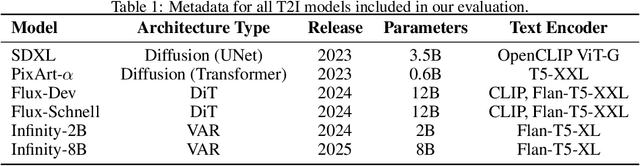
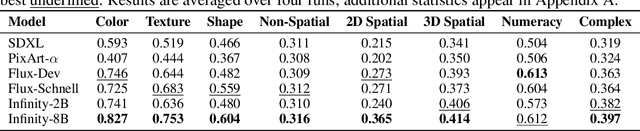
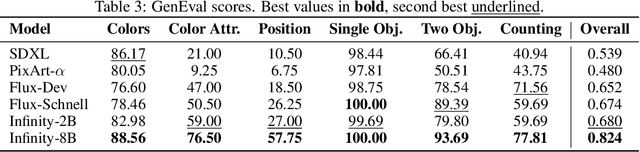
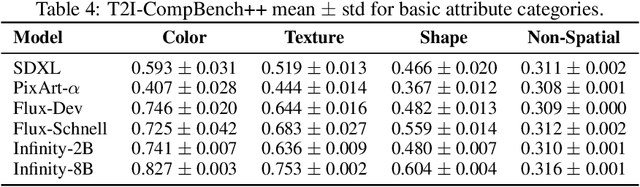
Achieving compositional alignment between textual descriptions and generated images - covering objects, attributes, and spatial relationships - remains a core challenge for modern text-to-image (T2I) models. Although diffusion-based architectures have been widely studied, the compositional behavior of emerging Visual Autoregressive (VAR) models is still largely unexamined. We benchmark six diverse T2I systems - SDXL, PixArt-$α$, Flux-Dev, Flux-Schnell, Infinity-2B, and Infinity-8B - across the full T2I-CompBench++ and GenEval suites, evaluating alignment in color and attribute binding, spatial relations, numeracy, and complex multi-object prompts. Across both benchmarks, Infinity-8B achieves the strongest overall compositional alignment, while Infinity-2B also matches or exceeds larger diffusion models in several categories, highlighting favorable efficiency-performance trade-offs. In contrast, SDXL and PixArt-$α$ show persistent weaknesses in attribute-sensitive and spatial tasks. These results provide the first systematic comparison of VAR and diffusion approaches to compositional alignment and establish unified baselines for the future development of the T2I model.
Limits and Gains of Test-Time Scaling in Vision-Language Reasoning
Dec 11, 2025Test-time scaling (TTS) has emerged as a powerful paradigm for improving the reasoning ability of Large Language Models (LLMs) by allocating additional computation at inference, yet its application to multimodal systems such as Vision-Language Models (VLMs) remains underexplored. In this work, we present a systematic empirical study of inference time reasoning methods applied across both open-source and closed-source VLMs on different benchmarks. Our results reveal that while closed-source models consistently benefit from structured reasoning and iterative Self-Refinement, open-source VLMs show inconsistent behavior: external verification provides the most reliable gains, whereas iterative refinement often degrades performance. We further find that the effectiveness of TTS is dataset-dependent, yielding clear improvements on multi-step reasoning tasks but offering only limited gains on perception-focused benchmarks. These findings demonstrate that TTS is not a universal solution and must be tailored to both model capabilities and task characteristics, motivating future work on adaptive TTS strategies and multimodal reward models.