 Add to Chrome
 Add to Firefox
 Add to Edge
Evidence-Linked Radiology Reporting: A Human-Supervised Reference Architecture for Structured Imaging Intelligence
May 24, 2026
Radiology reports remain the primary mechanism by which imaging findings are communicated to clinical teams. However, much of the structured information behind these reports, including measurements, image evidence, prior comparisons, lesion identity, uncertainty, and terminology, often remains trapped in free text or fragmented across picture archiving and communication systems, radiology information systems, reporting workstations, worksheets, advanced visualization tools, and electronic health records. This paper proposes a human-supervised, evidence-linked reference architecture for structured radiology reporting. The framework combines exam-specific templates, speech-to-structure processing, measurement and segmentation capture, controlled AI-assisted drafting, and standards-based interoperability using DICOM, DICOM Structured Reporting, DICOM Segmentation, HL7 FHIR, RadLex, SNOMED CT, LOINC, and UCUM. The system is positioned not as an autonomous report generator, but as a structured intelligence layer for enterprise imaging that supports reviewed reporting, longitudinal comparison, clinical data reuse, governance, and integration with PACS, RIS, EHR, analytics, and registry workflows. The paper also discusses modality-specific deployment considerations, clinical safety risks, validation requirements, cybersecurity, privacy, quality management, and regulatory boundaries for AI-assisted radiology reporting systems.

EHRSummarizer: A Privacy-Aware, FHIR-Native Architecture for Structured Clinical Summarization of Electronic Health Records
Jan 04, 2026Clinicians routinely navigate fragmented electronic health record (EHR) interfaces to assemble a coherent picture of a patient's problems, medications, recent encounters, and longitudinal trends. This work describes EHRSummarizer, a privacy-aware, FHIR-native reference architecture that retrieves a targeted set of high-yield FHIR R4 resources, normalizes them into a consistent clinical context package, and produces structured summaries intended to support structured chart review. The system can be configured for data minimization, stateless processing, and flexible deployment, including local inference within an organization's trust boundary. To mitigate the risk of unsupported or unsafe behavior, the summarization stage is constrained to evidence present in the retrieved context package, is intended to indicate missing or unavailable domains where feasible, and avoids diagnostic or treatment recommendations. Prototype demonstrations on synthetic and test FHIR environments illustrate end-to-end behavior and output formats; however, this manuscript does not report clinical outcomes or controlled workflow studies. We outline an evaluation plan centered on faithfulness, omission risk, temporal correctness, usability, and operational monitoring to guide future institutional assessments.
DrugRAG: Enhancing Pharmacy LLM Performance Through A Novel Retrieval-Augmented Generation Pipeline
Dec 16, 2025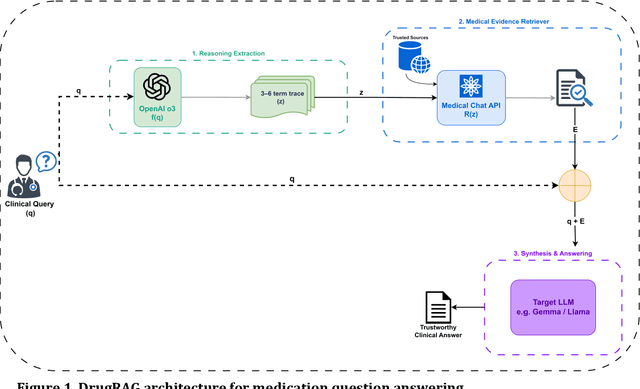
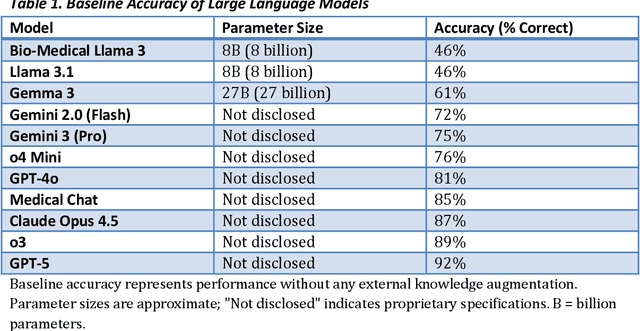
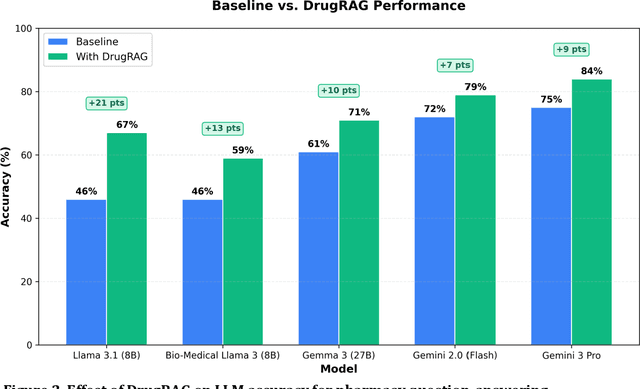
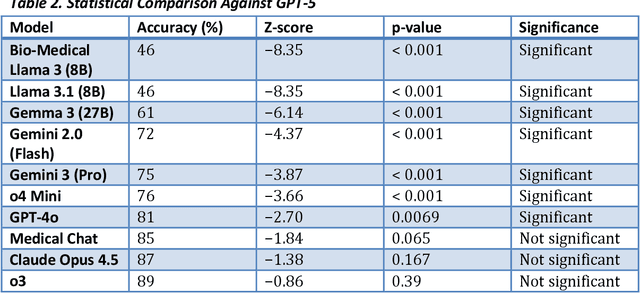
Objectives: To evaluate large language model (LLM) performance on pharmacy licensure-style question-answering (QA) tasks and develop an external knowledge integration method to improve their accuracy. Methods: We benchmarked eleven existing LLMs with varying parameter sizes (8 billion to 70+ billion) using a 141-question pharmacy dataset. We measured baseline accuracy for each model without modification. We then developed a three-step retrieval-augmented generation (RAG) pipeline, DrugRAG, that retrieves structured drug knowledge from validated sources and augments model prompts with evidence-based context. This pipeline operates externally to the models, requiring no changes to model architecture or parameters. Results: Baseline accuracy ranged from 46% to 92%, with GPT-5 (92%) and o3 (89%) achieving the highest scores. Models with fewer than 8 billion parameters scored below 50%. DrugRAG improved accuracy across all tested models, with gains ranging from 7 to 21 percentage points (e.g., Gemma 3 27B: 61% to 71%, Llama 3.1 8B: 46% to 67%) on the 141-item benchmark. Conclusion: We demonstrate that external structured drug knowledge integration through DrugRAG measurably improves LLM accuracy on pharmacy tasks without modifying the underlying models. This approach provides a practical pipeline for enhancing pharmacy-focused AI applications with evidence-based information.