 Add to Chrome
 Add to Firefox
 Add to Edge
PsychoAgent: An Affect-Sensitive Cognitive Architecture for Conflict-Aware Memory in LLM Agents
Aug 07, 2026
Human-like cognition does not select past experience by topical similarity alone: affective significance and unresolved conflict also shape what becomes accessible. We present PsychoAgent, a cognitive architecture for LLM agents that separates factual and affective memory and integrates both through a conflict-aware executive controller. Affective memories are first filtered by semantic relevance and then re-ranked by salience, preserving topical fit while allowing emotionally important traces to enter the prompt. Across three controlled conflict scenarios, the full architecture retrieved more conflict-critical memories than semantic-affective and single-memory RAG baselines (0.933 vs. 0.500 and 0.667), with a small semantic-similarity cost. Five blinded raters evaluated 27 outputs. After within-rater standardization, the full architecture had the highest overall mean (+0.22 SD), but corrected pairwise differences were not significant. A three-day illustrative trace further shows persistent affect, offline memory recombination, and selective memory reweighting. The findings support affect-sensitive retrieval as an inspectable mechanism for modeling human-like conflict effects in LLM agents.

KG-FairDiff: Knowledge Graph-Guided Prompt Refinement for Demographically Fair Text-to-Image Generation
May 31, 2026Text-to-Image (TTI) systems are now everyday infrastructure for journalism, education, advertising, and public communication, and the demographic and cultural stereotypes they inherit from training data (rendering women, people of colour, older adults, and non-Western cultures as under-represented or caricatured) become a population-level harm at deployment scale. Existing mitigations either require costly retraining, infeasible for the closed-source backbones that dominate consumer products, or rely on fixed demographic templates that ignore cultural context. We present KG-FairDiff, a model-agnostic, inference-time framework that formalises fairness-aware prompt refinement as a constrained optimisation problem and operationalises it as a closed-loop pipeline: a knowledge graph of ~1,200 culture- and bias-related triples retrieves structured context, an LLM rewriter proposes refinements, and a validator accepts only prompts that reduce a divergence-based fairness loss while preserving semantic fidelity to the user's original intent. We prove a finite-termination bound for the refinement loop, contribute a mathematically consistent evaluation suite linking Bias-P/Bias-W to divergence from target distributions and ENS to KL divergence, and audit eight widely-deployed backbone generators. KG-FairDiff substantially reduces gender, race, age, and intersectional disparities while preserving prompt semantics, offering a practical, deployment-ready route to more equitable generative AI.
DrugRAG: Enhancing Pharmacy LLM Performance Through A Novel Retrieval-Augmented Generation Pipeline
Dec 16, 2025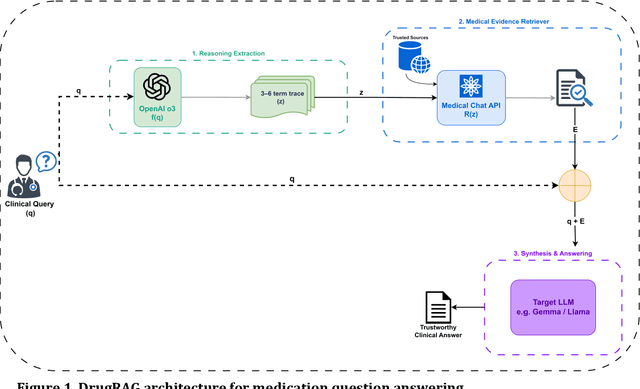
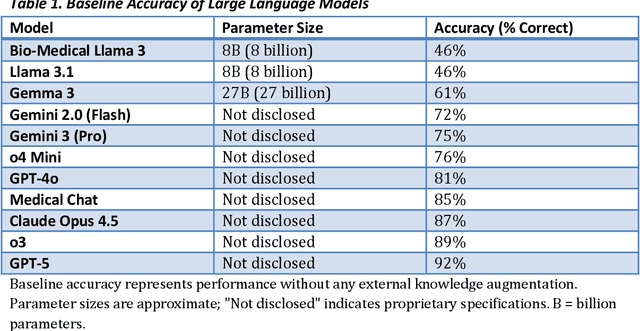
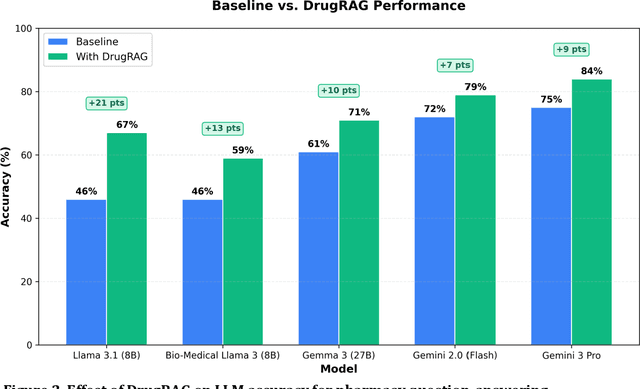
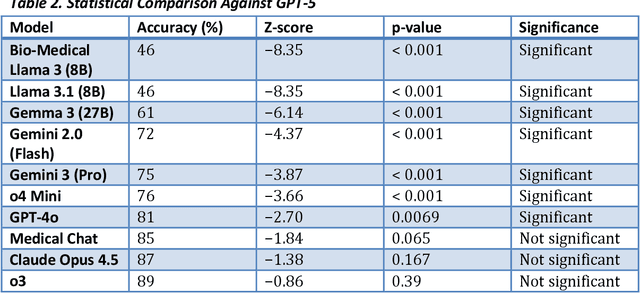
Objectives: To evaluate large language model (LLM) performance on pharmacy licensure-style question-answering (QA) tasks and develop an external knowledge integration method to improve their accuracy. Methods: We benchmarked eleven existing LLMs with varying parameter sizes (8 billion to 70+ billion) using a 141-question pharmacy dataset. We measured baseline accuracy for each model without modification. We then developed a three-step retrieval-augmented generation (RAG) pipeline, DrugRAG, that retrieves structured drug knowledge from validated sources and augments model prompts with evidence-based context. This pipeline operates externally to the models, requiring no changes to model architecture or parameters. Results: Baseline accuracy ranged from 46% to 92%, with GPT-5 (92%) and o3 (89%) achieving the highest scores. Models with fewer than 8 billion parameters scored below 50%. DrugRAG improved accuracy across all tested models, with gains ranging from 7 to 21 percentage points (e.g., Gemma 3 27B: 61% to 71%, Llama 3.1 8B: 46% to 67%) on the 141-item benchmark. Conclusion: We demonstrate that external structured drug knowledge integration through DrugRAG measurably improves LLM accuracy on pharmacy tasks without modifying the underlying models. This approach provides a practical pipeline for enhancing pharmacy-focused AI applications with evidence-based information.