 Add to Chrome
 Add to Firefox
 Add to Edge
Align-RAG: Alignment Is All You Need for TSFM In-Context Learning
Aug 06, 2026
Retrieval-augmented forecasting promises to adapt frozen Time Series Foundation Models (TSFMs) to new domains without fine-tuning, but recent methods typically rely on learned fusion modules, i.e., trained adapters that merge retrieved examples into the backbone's forecast, based on the assumption that frozen backbones cannot dynamically incorporate retrieved context on their own. We show this assumption is unnecessary. We introduce Align-RAG, a training-free method that applies a closed-form per-pair amplitude rescaling and integer-lag phase shift to retrieved past-future windows before they enter a frozen backbone's context. With no learned parameters, Align-RAG outperforms the state-of-the-art trained retrieval adapter on a frozen Chronos-Bolt on all seven datasets of the standard benchmark (avg -3.75% MSE), showing that the gains previously attributed to learned fusion are recoverable without any training. Align-RAG further improves zero-shot MSE on four additional frozen TSFMs with various architectures by 2.5% to 13.7% per backbone with no per-backbone tuning. To probe why alignment helps, we compare the frozen backbone's prediction shift under aligned demonstrations to the closed-form ridge prediction shift on the same pairs. We find that aligned demonstrations induce prediction shifts that track a closed-form ridge predictor on the same pairs, with a future-shuffle control ruling out a futures-averaging account. Together, these results indicate that frozen TSFMs already support dynamic in-context use of retrievals, and that closed-form alignment should be the default baseline for retrieval-augmented forecasting before any fusion module is trained. Code available at: https://github.com/masadi-99/align-rag

Adaptive Inference: Theoretical Limits and Unexplored Opportunities
Feb 06, 2024This paper introduces the first theoretical framework for quantifying the efficiency and performance gain opportunity size of adaptive inference algorithms. We provide new approximate and exact bounds for the achievable efficiency and performance gains, supported by empirical evidence demonstrating the potential for 10-100x efficiency improvements in both Computer Vision and Natural Language Processing tasks without incurring any performance penalties. Additionally, we offer insights on improving achievable efficiency gains through the optimal selection and design of adaptive inference state spaces.
Sense, Predict, Adapt, Repeat: A Blueprint for Design of New Adaptive AI-Centric Sensing Systems
Dec 11, 2023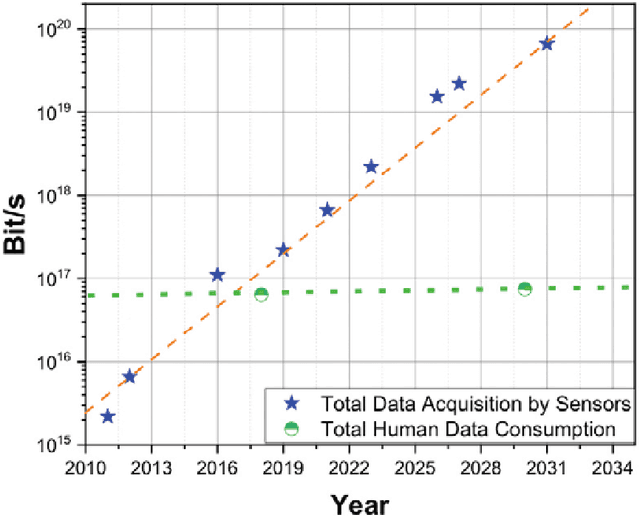
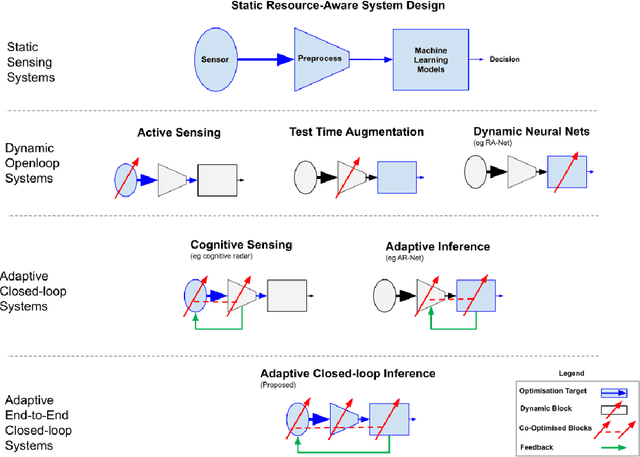
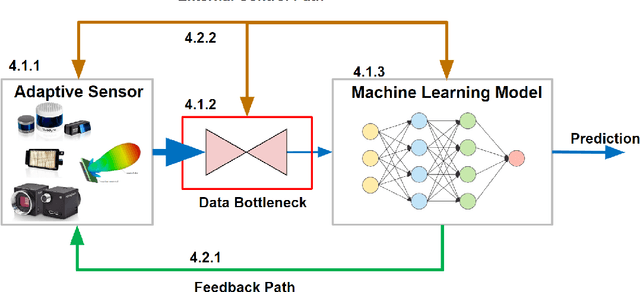
As Moore's Law loses momentum, improving size, performance, and efficiency of processors has become increasingly challenging, ending the era of predictable improvements in hardware performance. Meanwhile, the widespread incorporation of high-definition sensors in consumer devices and autonomous technologies has fueled a significant upsurge in sensory data. Current global trends reveal that the volume of generated data already exceeds human consumption capacity, making AI algorithms the primary consumers of data worldwide. To address this, a novel approach to designing AI-centric sensing systems is needed that can bridge the gap between the increasing capabilities of high-definition sensors and the limitations of AI processors. This paper provides an overview of efficient sensing and perception methods in both AI and sensing domains, emphasizing the necessity of co-designing AI algorithms and sensing systems for dynamic perception. The proposed approach involves a framework for designing and analyzing dynamic AI-in-the-loop sensing systems, suggesting a fundamentally new method for designing adaptive sensing systems through inference-time AI-to-sensor feedback and end-to-end efficiency and performance optimization.