 Add to Chrome
 Add to Firefox
 Add to Edge
Align-RAG: Alignment Is All You Need for TSFM In-Context Learning
Aug 06, 2026
Retrieval-augmented forecasting promises to adapt frozen Time Series Foundation Models (TSFMs) to new domains without fine-tuning, but recent methods typically rely on learned fusion modules, i.e., trained adapters that merge retrieved examples into the backbone's forecast, based on the assumption that frozen backbones cannot dynamically incorporate retrieved context on their own. We show this assumption is unnecessary. We introduce Align-RAG, a training-free method that applies a closed-form per-pair amplitude rescaling and integer-lag phase shift to retrieved past-future windows before they enter a frozen backbone's context. With no learned parameters, Align-RAG outperforms the state-of-the-art trained retrieval adapter on a frozen Chronos-Bolt on all seven datasets of the standard benchmark (avg -3.75% MSE), showing that the gains previously attributed to learned fusion are recoverable without any training. Align-RAG further improves zero-shot MSE on four additional frozen TSFMs with various architectures by 2.5% to 13.7% per backbone with no per-backbone tuning. To probe why alignment helps, we compare the frozen backbone's prediction shift under aligned demonstrations to the closed-form ridge prediction shift on the same pairs. We find that aligned demonstrations induce prediction shifts that track a closed-form ridge predictor on the same pairs, with a future-shuffle control ruling out a futures-averaging account. Together, these results indicate that frozen TSFMs already support dynamic in-context use of retrievals, and that closed-form alignment should be the default baseline for retrieval-augmented forecasting before any fusion module is trained. Code available at: https://github.com/masadi-99/align-rag

SetLexSem Challenge: Using Set Operations to Evaluate the Lexical and Semantic Robustness of Language Models
Nov 11, 2024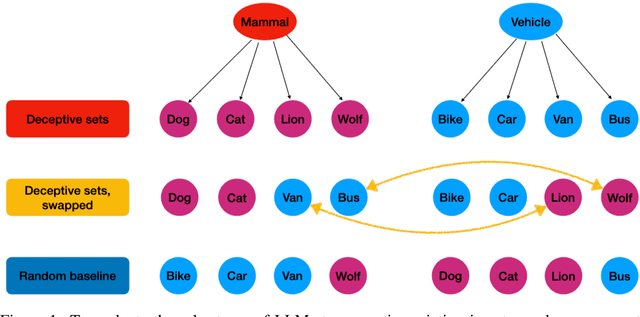
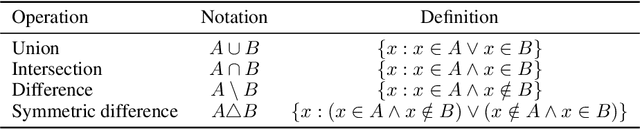
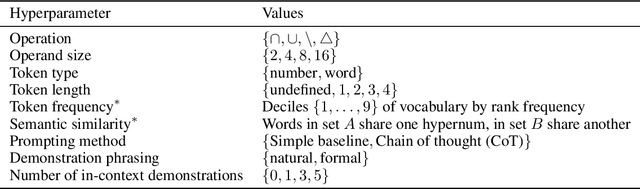
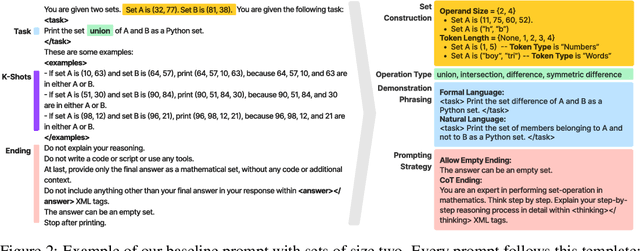
Set theory is foundational to mathematics and, when sets are finite, to reasoning about the world. An intelligent system should perform set operations consistently, regardless of superficial variations in the operands. Initially designed for semantically-oriented NLP tasks, large language models (LLMs) are now being evaluated on algorithmic tasks. Because sets are comprised of arbitrary symbols (e.g. numbers, words), they provide an opportunity to test, systematically, the invariance of LLMs' algorithmic abilities under simple lexical or semantic variations. To this end, we present the SetLexSem Challenge, a synthetic benchmark that evaluates the performance of LLMs on set operations. SetLexSem assesses the robustness of LLMs' instruction-following abilities under various conditions, focusing on the set operations and the nature and construction of the set members. Evaluating seven LLMs with SetLexSem, we find that they exhibit poor robustness to variation in both operation and operands. We show -- via the framework's systematic sampling of set members along lexical and semantic dimensions -- that LLMs are not only not robust to variation along these dimensions but demonstrate unique failure modes in particular, easy-to-create semantic groupings of "deceptive" sets. We find that rigorously measuring language model robustness to variation in frequency and length is challenging and present an analysis that measures them independently. The code for reproducing the results of this paper, and for generating the SetLexSem Challenge dataset, is available at \href{https://github.com/amazon-science/SetLexSem-Challenge}{https://github.com/amazon-science/SetLexSem-Challenge}.
Clinical Applications of Plantar Pressure Measurement
Jan 09, 2024Plantar pressure measurements can provide valuable insight into various health characteristics in patients. In this study, we describe different plantar pressure devices available on the market and their clinical relevance. Current devices are either platform-based or wearable and consist of a variety of sensor technologies: resistive, capacitive, piezoelectric, and optical. The measurements collected from any of these sensors can be utilized for a range of clinical applications including patients with diabetes, trauma, deformity and cerebral palsy, stroke, cervical myelopathy, ankle instability, sports injuries, and Parkinsons disease. However, the proper technology should be selected based on the clinical need and the type of tests being performed on the device. In this review we provide the reader with a simple overview of the existing technologies their advantages and disadvantages and provide application examples for each. Moreover, we suggest new areas in orthopaedic that plantar pressure mapping technology can be utilized for increased quality of care.