 Add to Chrome
 Add to Firefox
 Add to Edge
MACReD: A Multi-Agent Collaborative Reasoning Framework for Reaction Diagram Parsing
May 27, 2026
Parsing chemical reaction diagrams from scientific literature is challenging due to heterogeneous layouts, intertwined visual elements, and the difficulty of integrating recognition and reasoning. Existing vision-language models advance multimodal understanding but still fail on complex diagrams, struggling to maintain spatial coherence and to integrate multidimensional information during reasoning. To address these issues, we propose MACReD, a hierarchical multi-agent framework that coordinates specialized agents for molecular perception, arrow understanding, text extraction, and reaction reconstruction within a unified VLM-guided architecture. The planning and perception layers use flexible, fine-grained detection to handle visual complexity, while the reasoning layer uses a multigraph fusion mechanism to integrate heterogeneous cues and enforce chemically consistent global reasoning. Experiments on the RxnScribe benchmark show that MACReD achieves state-of-the-art performance, with F1 scores of 75.2% and 84.6% under hard and soft match criteria, outperforming the RxnScribe baseline, which obtains 69.1% and 80.0%, respectively. These results demonstrate the robustness of MACReD across diverse diagram layouts, including multi-step and tree-structured reactions.

CooperLLM: Cloud-Edge-End Cooperative Federated Fine-tuning for LLMs via ZOO-based Gradient Correction
Jan 19, 2026Large Language Models (LLMs) perform well on many NLP tasks, but fine-tuning them on resource-constrained mobile devices is challenging due to high memory and computation costs, despite growing demands for privacy-preserving personalization. Federated Learning (FL) enables local-data training, yet existing methods either rely on memory-intensive backpropagation or use zeroth-order optimization (ZOO), which avoids backward passes but suffers from slow convergence and degraded accuracy. We propose CooperLLM, a cloud-assisted edge-end cooperative federated fine-tuning framework that combines ZOO on mobile devices with cloud-guided gradient rectification. Mobile clients perform lightweight ZOO updates on private data, while the cloud fine-tunes on auxiliary public data using backpropagation and injects guided perturbations to rectify local updates, improving convergence and accuracy without violating privacy. To address system bottlenecks, CooperLLM introduces pipeline scheduling and adaptive compression to overlap computation and communication and reduce memory usage. Experiments on multiple Transformer models and datasets show that CooperLLM reduces on-device memory by up to $86.4\%$, accelerates convergence by $8.8 \times$, and improves accuracy by up to 10 percentage points over state-of-the-art ZOO-based baselines.
AutoP2C: An LLM-Based Agent Framework for Code Repository Generation from Multimodal Content in Academic Papers
Apr 28, 2025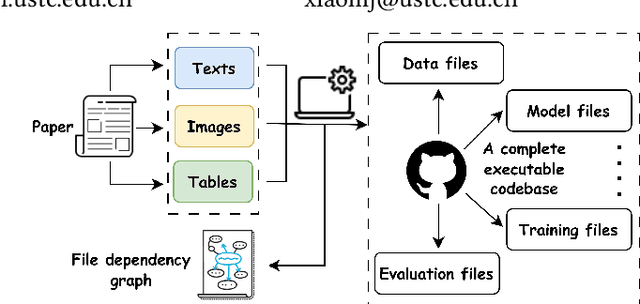
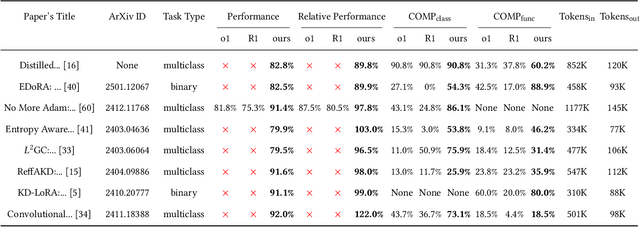
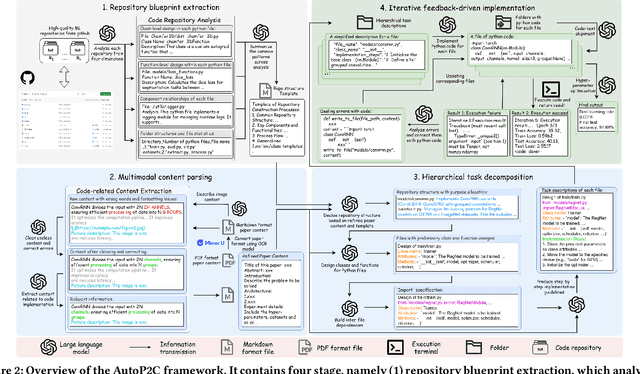
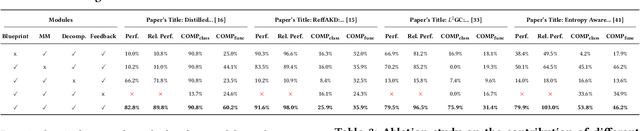
Machine Learning (ML) research is spread through academic papers featuring rich multimodal content, including text, diagrams, and tabular results. However, translating these multimodal elements into executable code remains a challenging and time-consuming process that requires substantial ML expertise. We introduce ``Paper-to-Code'' (P2C), a novel task that transforms the multimodal content of scientific publications into fully executable code repositories, which extends beyond the existing formulation of code generation that merely converts textual descriptions into isolated code snippets. To automate the P2C process, we propose AutoP2C, a multi-agent framework based on large language models that processes both textual and visual content from research papers to generate complete code repositories. Specifically, AutoP2C contains four stages: (1) repository blueprint extraction from established codebases, (2) multimodal content parsing that integrates information from text, equations, and figures, (3) hierarchical task decomposition for structured code generation, and (4) iterative feedback-driven debugging to ensure functionality and performance. Evaluation on a benchmark of eight research papers demonstrates the effectiveness of AutoP2C, which can successfully generate executable code repositories for all eight papers, while OpenAI-o1 or DeepSeek-R1 can only produce runnable code for one paper. The code is available at https://github.com/shoushouyu/Automated-Paper-to-Code.