 Add to Chrome
 Add to Firefox
 Add to Edge
Aerial IRS Deployment-Aided Secure Computation Offloading Against DISCO Jamming Attacks
Apr 12, 2026
With the rapid growth of Multi-access Edge Computing (MEC), secure and efficient computation offloading from user equipment (UEs) to edge access points (APs) is critical. However, DISCO intelligent reflective surface-based fully-passive jammers (DIRS-based FPJs) use random time-varying phase shifts to launch DISCO jamming attacks, disrupting offloading performance. This paper leverages an aerial intelligent reflective surface (AIRS) to enable secure computation offloading against DISCO jamming by jointly optimizing offloading ratios, AIRS phase shifts, and deployment. A two-timescale (2Ts) framework is proposed to address the optimization challenge caused by the distinct update frequencies of different strategies. Specifically, AIRS deployment is adjusted on a long timescale to boost antijamming capability due to the impracticality of frequent physical adjustment, while offloading ratios and phase shifts are optimized on a short timescale to adapt to DIRS-jammed dynamic channel conditions. We propose a dual-agent deep reinforcement learning (DRL)-based AIRS deployment-aided secure computation offloading (DDADSO) scheme to maximize the secure offloading utility under DISCO jamming. Simulation results verify that the proposed DDADSO scheme outperforms benchmark schemes, demonstrating the effectiveness of AIRS deployment in improving offloading performance against DISCO jamming attacks.

Bistatic Integrated Sensing and Communication in the Presence of a Disco Reconfigurable Intelligent Surface: Disruption, Enhancement, or Both?
Apr 11, 2026Integrated sensing and communication (ISAC) is widely regarded as one of the key enabling technologies for future sixth-generation (6G) wireless communication systems. In this work, we investigate a bistatic ISAC system in the presence of a disco reconfigurable intelligent surface (DRIS), whose random and time-varying reflection coefficients emulate a "disco ball." The introduction of the DRIS breaks the underlying assumption in existing ISAC systems that the sensing and communication channels remain static or quasi-static within the channel coherence time. We first develop a bistatic system model incorporating the DRIS and characterize all involved wireless channels. Then, an ISAC waveform design that balances sensing and communication performance is proposed by formulating a Pareto optimization problem, where the trade-off is controlled through a tunable factor. Communication and sensing performance in the bistatic ISAC system are quantified by the signal-to-interference-plus-noise ratio (SINR) and the Cramer-Rao lower bound (CRLB), respectively. To quantify the impact of the DRIS on the bistatic ISAC system, we derive the statistical characteristics of DRIS-induced active channel aging (ACA) channels for communications and the cascaded DRIS-based sensing channel. Then, we establish a theoretical lower bound on the SINR and closed-form CRLB expressions in the presence of a DRIS. The analysis reveals several distinctive properties of the DRIS in bistatic ISAC systems. In particular, the DRIS degrades communication performance significantly due to the introduction of ACA interference. In contrast, with respect to sensing performance, the DRIS decreases the estimation accuracy of the angle of departure (AoD) while concurrently enhancing that of the angle of arrival (AoA). Numerical results validate the derived theoretical analysis and confirm these DRIS-induced behaviors.
Comparative Performance Analysis of Different Hybrid NOMA Schemes
Sep 18, 2025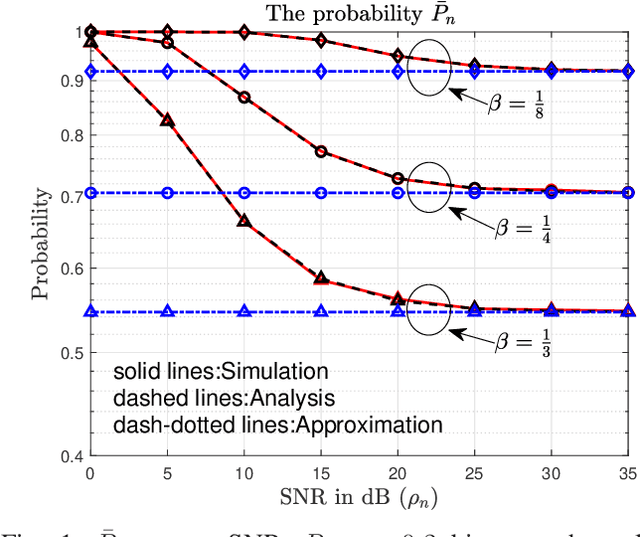
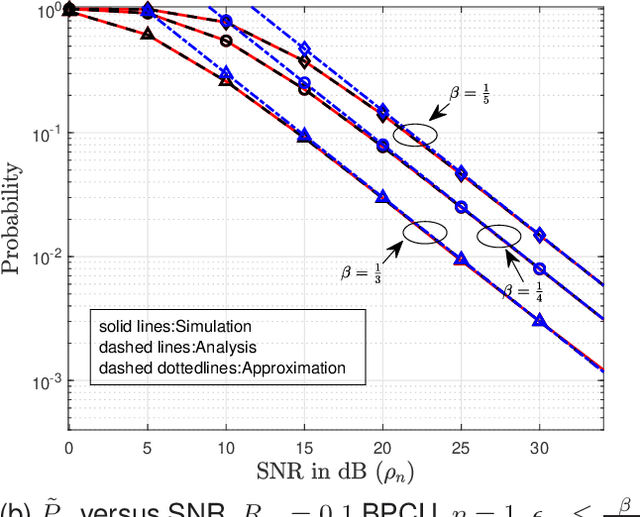
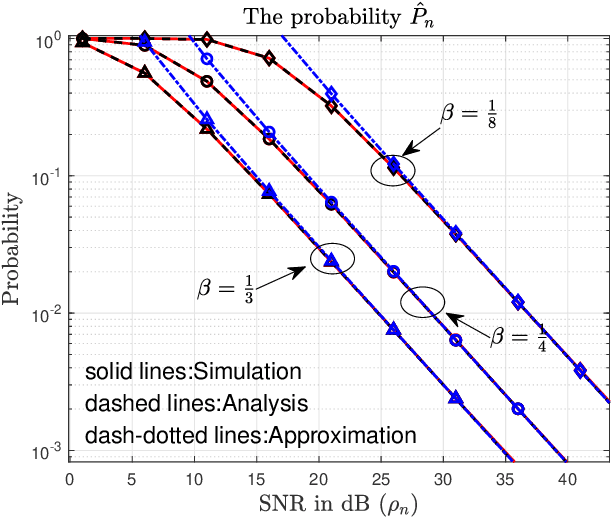
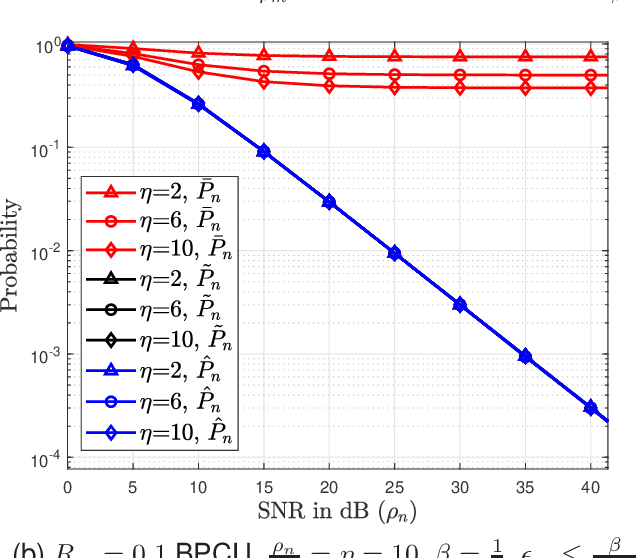
Hybrid non-orthogonal multiple access (H-NOMA), which combines the advantages of pure NOMA and conventional OMA organically, has emerged as a highly promising multiple access technology for future wireless networks. Recent studies have proposed various H-NOMA systems by employing different successive interference cancellation (SIC) methods for the NOMA transmission phase. However, existing analyses typically assume a fixed channel gain order between paired users, despite the fact that channel coefficients follow random distribution, leading to their magnitude relationships inherently stochastic and time varying. This paper analyzes the performance of three H-NOMA schemes under stochastic channel gain ordering: a) fixed order SIC (FSIC) aided H-NOMA scheme; b) hybrid SIC with non-power adaptation (HSIC-NPA) aided H-NOMA scheme; c) hybrid SIC with power adaptation (HSIC-PA) aided H-NOMA scheme. Theoretical analysis derives closed-form expressions for the probability that H-NOMA schemes underperform conventional OMA. Asymptotic results in the high signal-to-noise ratio (SNR) regime are also developed. Simulation results validate our analysis and demonstrate the performance of H-NOMA schemes across different SNR scenarios, providing a theoretical foundation for the deployment of H-NOMA in next-generation wireless systems.
Hybrid Architectures for Distributed Machine Learning in Heterogeneous Wireless Networks
Jun 04, 2022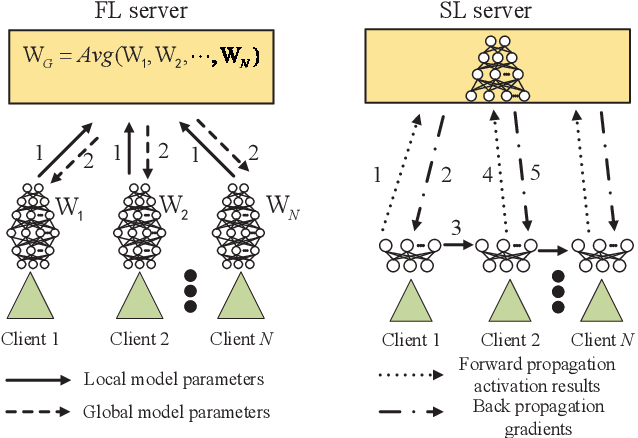
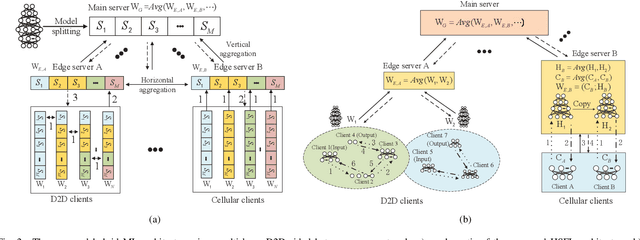
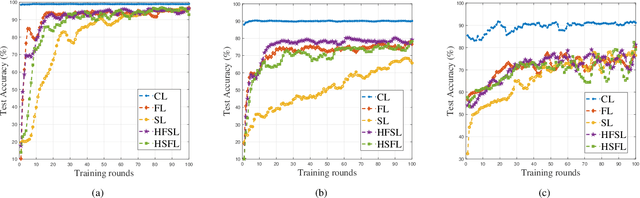
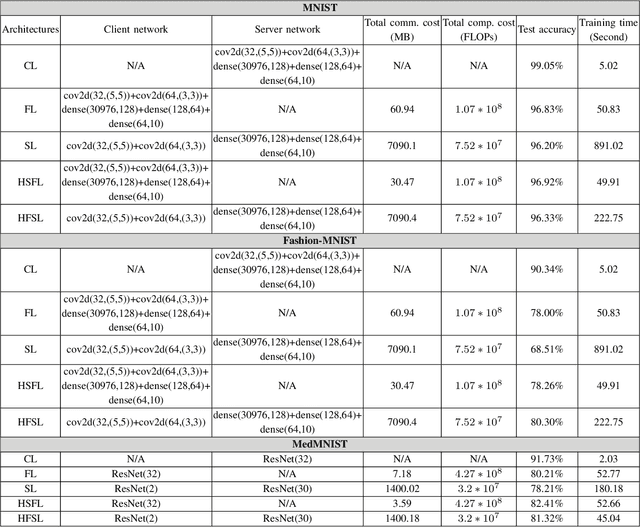
The ever-growing data privacy concerns have transformed machine learning (ML) architectures from centralized to distributed, leading to federated learning (FL) and split learning (SL) as the two most popular privacy-preserving ML paradigms. However, implementing either conventional FL or SL alone with diverse network conditions (e.g., device-to-device (D2D) and cellular communications) and heterogeneous clients (e.g., heterogeneous computation/communication/energy capabilities) may face significant challenges, particularly poor architecture scalability and long training time. To this end, this article proposes two novel hybrid distributed ML architectures, namely, hybrid split FL (HSFL) and hybrid federated SL (HFSL), by combining the advantages of both FL and SL in D2D-enabled heterogeneous wireless networks. Specifically, the performance comparison and advantages of HSFL and HFSL are analyzed generally. Promising open research directions are presented to offer commendable reference for future research. Finally, primary simulations are conducted upon considering three datasets under non-independent and identically distributed settings, to verify the feasibility of our proposed architectures, which can significantly reduce communication/computation cost and training time, as compared with conventional FL and SL.