 Add to Chrome
 Add to Firefox
 Add to Edge
The Curse of Precision: A Data Scaling Law for High-Precision Robotic Manipulation
Jul 25, 2026
While scaling laws for imitation learning have primarily focused on generalization in open-world settings, the relationship between data and precision in closed-world tasks like robotic assembly remains largely unexplored. This paper systematically investigates this relationship and introduces a novel scaling law. We find that to achieve a fixed success rate, the required number of demonstrations $N$ grows super-exponentially as the target precision $P$ approaches a limit $c$. This relationship is accurately captured by the model $\log(N) \propto 1/(P-c)$. Crucially, we reveal that the limit precision $c$ is not a static physical constant of the task but an emergent property of the entire agent system, including its sensors and expert policy. Through experiments on canonical manipulation tasks, we validate this law and demonstrate that improving system components, such as adding a wrist camera or using a more effective expert, measurably lowers $c$, thus expanding the system's achievable precision. Our work provides a new theoretical framework for precision in robotics and a quantitative metric to evaluate system capabilities. Furthermore, these findings provide a practical methodology for guiding the development and debugging of high-precision manipulation systems.

Train Your Data Processor: Distribution-Aware and Error-Compensation Coordinate Decoding for Human Pose Estimation
Jul 17, 2020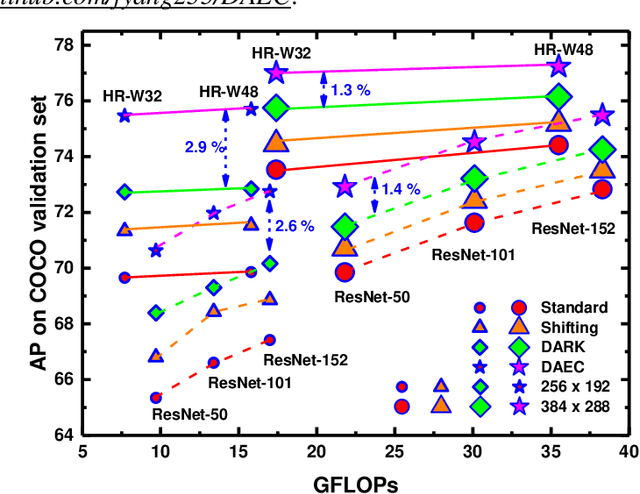
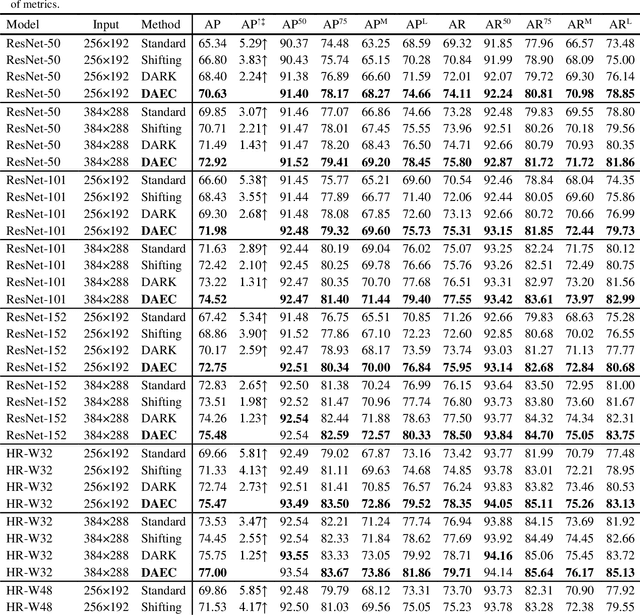
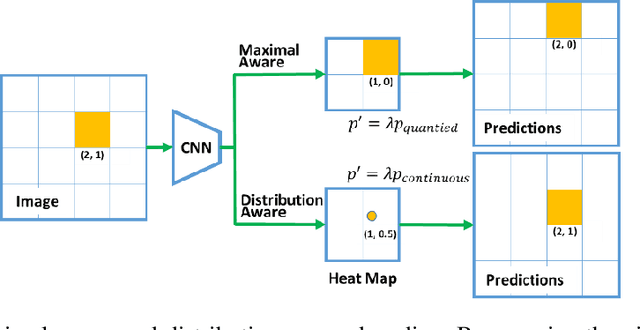
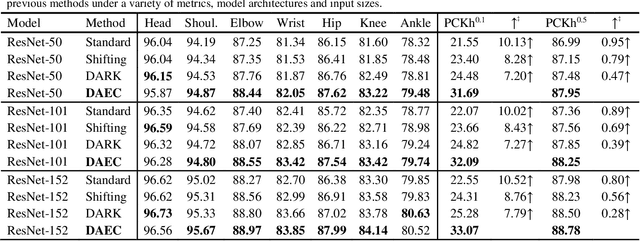
Recently, the leading performance of human pose estimation is dominated by heatmap based methods. While being a fundamental component of heatmap processing, heatmap decoding (i.e. transforming heatmaps to coordinates) receives only limited investigations, to our best knowledge. This work fills the gap by studying the heatmap decoding processing with a particular focus on the errors introduced throughout the prediction process. We found that the errors of heatmap based methods are surprisingly significant, which nevertheless was universally ignored before. In view of the discovered importance, we further reveal the intrinsic limitations of the previous widely used heatmap decoding methods and thereout propose a Distribution-Aware and Error-Compensation Coordinate Decoding (DAEC). Serving as a model-agnostic plug-in, DAEC learns its decoding strategy from training data and remarkably improves the performance of a variety of state-of-the-art human pose estimation models with negligible extra computation. Specifically, equipped with DAEC, the SimpleBaseline-ResNet152-256x192 and HRNet-W48-256x192 are significantly improved by 2.6 AP and 2.9 AP achieving 72.6 AP and 75.7 AP on COCO, respectively. Moreover, the HRNet-W32-256x256 and ResNet-152-256x256 frameworks enjoy even more dramatic promotions of 8.4% and 7.8% on MPII with PCKh0.1 metric. Extensive experiments performed on these two common benchmarks, demonstrates that DAEC exceeds its competitors by considerable margins, backing up the rationality and generality of our novel heatmap decoding idea. The project is available at https://github.com/fyang235/DAEC.