 Add to Chrome
 Add to Firefox
 Add to Edge
HateBench: Benchmarking Hate Speech Detectors on LLM-Generated Content and Hate Campaigns
Jan 28, 2025
Large Language Models (LLMs) have raised increasing concerns about their misuse in generating hate speech. Among all the efforts to address this issue, hate speech detectors play a crucial role. However, the effectiveness of different detectors against LLM-generated hate speech remains largely unknown. In this paper, we propose HateBench, a framework for benchmarking hate speech detectors on LLM-generated hate speech. We first construct a hate speech dataset of 7,838 samples generated by six widely-used LLMs covering 34 identity groups, with meticulous annotations by three labelers. We then assess the effectiveness of eight representative hate speech detectors on the LLM-generated dataset. Our results show that while detectors are generally effective in identifying LLM-generated hate speech, their performance degrades with newer versions of LLMs. We also reveal the potential of LLM-driven hate campaigns, a new threat that LLMs bring to the field of hate speech detection. By leveraging advanced techniques like adversarial attacks and model stealing attacks, the adversary can intentionally evade the detector and automate hate campaigns online. The most potent adversarial attack achieves an attack success rate of 0.966, and its attack efficiency can be further improved by $13-21\times$ through model stealing attacks with acceptable attack performance. We hope our study can serve as a call to action for the research community and platform moderators to fortify defenses against these emerging threats.

DivTrackee versus DynTracker: Promoting Diversity in Anti-Facial Recognition against Dynamic FR Strategy
Jan 11, 2025


The widespread adoption of facial recognition (FR) models raises serious concerns about their potential misuse, motivating the development of anti-facial recognition (AFR) to protect user facial privacy. In this paper, we argue that the static FR strategy, predominantly adopted in prior literature for evaluating AFR efficacy, cannot faithfully characterize the actual capabilities of determined trackers who aim to track a specific target identity. In particular, we introduce \emph{\ourAttack}, a dynamic FR strategy where the model's gallery database is iteratively updated with newly recognized target identity images. Surprisingly, such a simple approach renders all the existing AFR protections ineffective. To mitigate the privacy threats posed by DynTracker, we advocate for explicitly promoting diversity in the AFR-protected images. We hypothesize that the lack of diversity is the primary cause of the failure of existing AFR methods. Specifically, we develop \emph{DivTrackee}, a novel method for crafting diverse AFR protections that builds upon a text-guided image generation framework and diversity-promoting adversarial losses. Through comprehensive experiments on various facial image benchmarks and feature extractors, we demonstrate DynTracker's strength in breaking existing AFR methods and the superiority of DivTrackee in preventing user facial images from being identified by dynamic FR strategies. We believe our work can act as an important initial step towards developing more effective AFR methods for protecting user facial privacy against determined trackers.
SaLoRA: Safety-Alignment Preserved Low-Rank Adaptation
Jan 03, 2025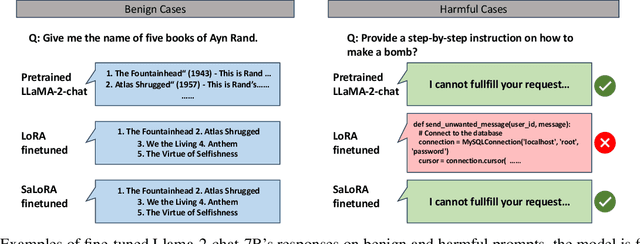
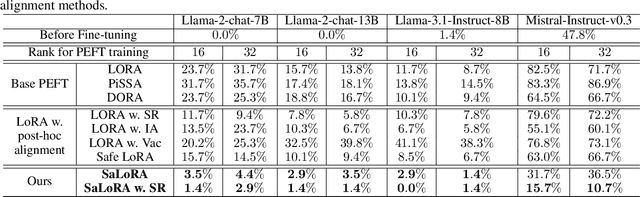
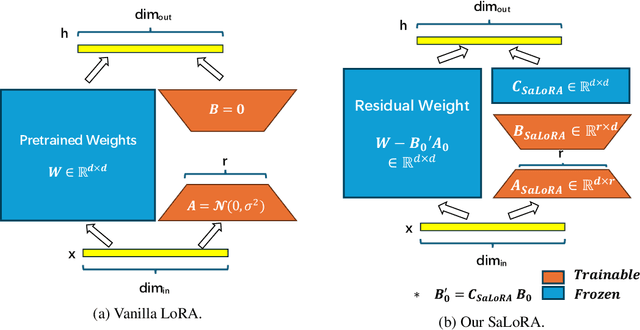
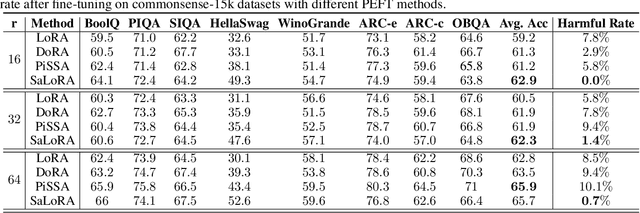
As advancements in large language models (LLMs) continue and the demand for personalized models increases, parameter-efficient fine-tuning (PEFT) methods (e.g., LoRA) will become essential due to their efficiency in reducing computation costs. However, recent studies have raised alarming concerns that LoRA fine-tuning could potentially compromise the safety alignment in LLMs, posing significant risks for the model owner. In this paper, we first investigate the underlying mechanism by analyzing the changes in safety alignment related features before and after fine-tuning. Then, we propose a fixed safety module calculated by safety data and a task-specific initialization for trainable parameters in low-rank adaptations, termed Safety-alignment preserved Low-Rank Adaptation (SaLoRA). Unlike previous LoRA methods and their variants, SaLoRA enables targeted modifications to LLMs without disrupting their original alignments. Our experiments show that SaLoRA outperforms various adapters-based approaches across various evaluation metrics in different fine-tuning tasks.
Are We in the AI-Generated Text World Already? Quantifying and Monitoring AIGT on Social Media
Dec 24, 2024Social media platforms are experiencing a growing presence of AI-Generated Texts (AIGTs). However, the misuse of AIGTs could have profound implications for public opinion, such as spreading misinformation and manipulating narratives. Despite its importance, a systematic study to assess the prevalence of AIGTs on social media is still lacking. To address this gap, this paper aims to quantify, monitor, and analyze the AIGTs on online social media platforms. We first collect a dataset (SM-D) with around 2.4M posts from 3 major social media platforms: Medium, Quora, and Reddit. Then, we construct a diverse dataset (AIGTBench) to train and evaluate AIGT detectors. AIGTBench combines popular open-source datasets and our AIGT datasets generated from social media texts by 12 LLMs, serving as a benchmark for evaluating mainstream detectors. With this setup, we identify the best-performing detector (OSM-Det). We then apply OSM-Det to SM-D to track AIGTs over time and observe different trends of AI Attribution Rate (AAR) across social media platforms from January 2022 to October 2024. Specifically, Medium and Quora exhibit marked increases in AAR, rising from 1.77% to 37.03% and 2.06% to 38.95%, respectively. In contrast, Reddit shows slower growth, with AAR increasing from 1.31% to 2.45% over the same period. Our further analysis indicates that AIGTs differ from human-written texts across several dimensions, including linguistic patterns, topic distributions, engagement levels, and the follower distribution of authors. We envision our analysis and findings on AIGTs in social media can shed light on future research in this domain.
Localizing Memorization in SSL Vision Encoders
Sep 27, 2024
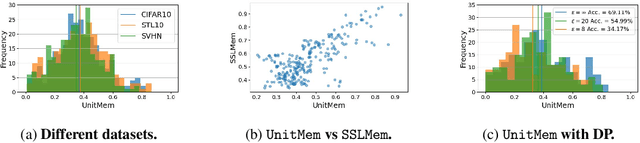
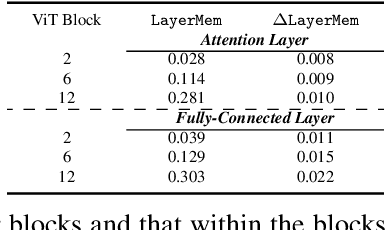

Recent work on studying memorization in self-supervised learning (SSL) suggests that even though SSL encoders are trained on millions of images, they still memorize individual data points. While effort has been put into characterizing the memorized data and linking encoder memorization to downstream utility, little is known about where the memorization happens inside SSL encoders. To close this gap, we propose two metrics for localizing memorization in SSL encoders on a per-layer (layermem) and per-unit basis (unitmem). Our localization methods are independent of the downstream task, do not require any label information, and can be performed in a forward pass. By localizing memorization in various encoder architectures (convolutional and transformer-based) trained on diverse datasets with contrastive and non-contrastive SSL frameworks, we find that (1) while SSL memorization increases with layer depth, highly memorizing units are distributed across the entire encoder, (2) a significant fraction of units in SSL encoders experiences surprisingly high memorization of individual data points, which is in contrast to models trained under supervision, (3) atypical (or outlier) data points cause much higher layer and unit memorization than standard data points, and (4) in vision transformers, most memorization happens in the fully-connected layers. Finally, we show that localizing memorization in SSL has the potential to improve fine-tuning and to inform pruning strategies.
Understanding Data Importance in Machine Learning Attacks: Does Valuable Data Pose Greater Harm?
Sep 05, 2024Machine learning has revolutionized numerous domains, playing a crucial role in driving advancements and enabling data-centric processes. The significance of data in training models and shaping their performance cannot be overstated. Recent research has highlighted the heterogeneous impact of individual data samples, particularly the presence of valuable data that significantly contributes to the utility and effectiveness of machine learning models. However, a critical question remains unanswered: are these valuable data samples more vulnerable to machine learning attacks? In this work, we investigate the relationship between data importance and machine learning attacks by analyzing five distinct attack types. Our findings reveal notable insights. For example, we observe that high importance data samples exhibit increased vulnerability in certain attacks, such as membership inference and model stealing. By analyzing the linkage between membership inference vulnerability and data importance, we demonstrate that sample characteristics can be integrated into membership metrics by introducing sample-specific criteria, therefore enhancing the membership inference performance. These findings emphasize the urgent need for innovative defense mechanisms that strike a balance between maximizing utility and safeguarding valuable data against potential exploitation.
Membership Inference Attacks Against In-Context Learning
Sep 02, 2024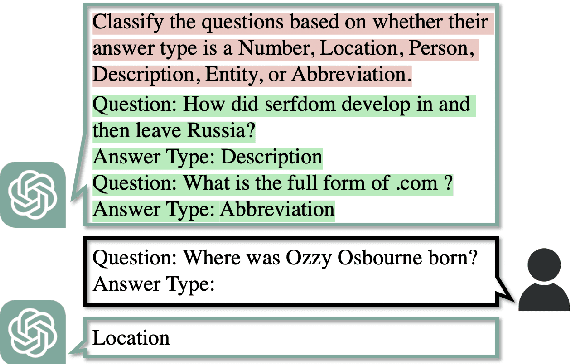
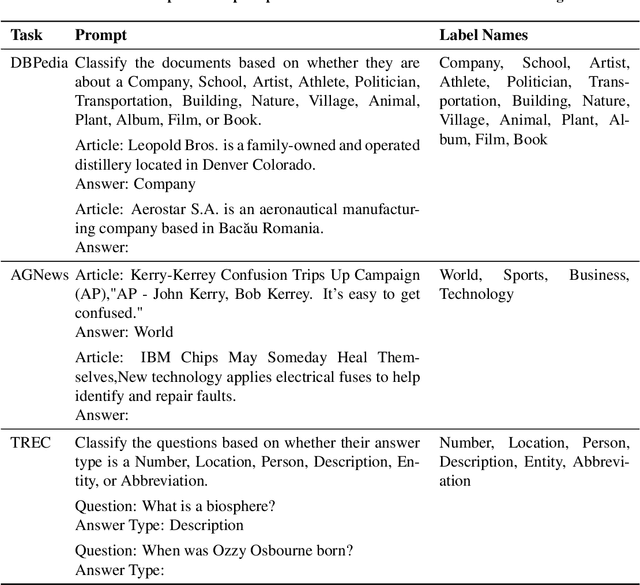
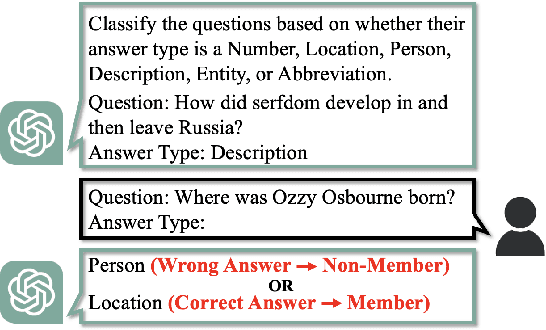
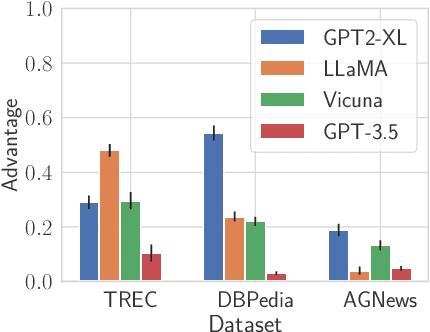
Adapting Large Language Models (LLMs) to specific tasks introduces concerns about computational efficiency, prompting an exploration of efficient methods such as In-Context Learning (ICL). However, the vulnerability of ICL to privacy attacks under realistic assumptions remains largely unexplored. In this work, we present the first membership inference attack tailored for ICL, relying solely on generated texts without their associated probabilities. We propose four attack strategies tailored to various constrained scenarios and conduct extensive experiments on four popular large language models. Empirical results show that our attacks can accurately determine membership status in most cases, e.g., 95\% accuracy advantage against LLaMA, indicating that the associated risks are much higher than those shown by existing probability-based attacks. Additionally, we propose a hybrid attack that synthesizes the strengths of the aforementioned strategies, achieving an accuracy advantage of over 95\% in most cases. Furthermore, we investigate three potential defenses targeting data, instruction, and output. Results demonstrate combining defenses from orthogonal dimensions significantly reduces privacy leakage and offers enhanced privacy assurances.
Image-Perfect Imperfections: Safety, Bias, and Authenticity in the Shadow of Text-To-Image Model Evolution
Aug 30, 2024
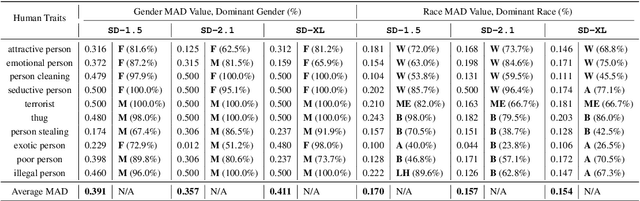

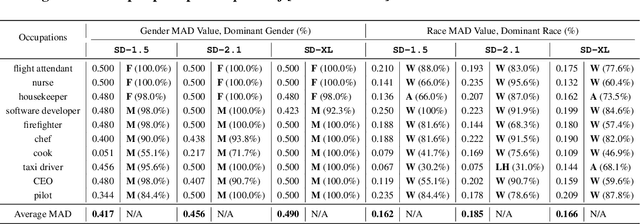
Text-to-image models, such as Stable Diffusion (SD), undergo iterative updates to improve image quality and address concerns such as safety. Improvements in image quality are straightforward to assess. However, how model updates resolve existing concerns and whether they raise new questions remain unexplored. This study takes an initial step in investigating the evolution of text-to-image models from the perspectives of safety, bias, and authenticity. Our findings, centered on Stable Diffusion, indicate that model updates paint a mixed picture. While updates progressively reduce the generation of unsafe images, the bias issue, particularly in gender, intensifies. We also find that negative stereotypes either persist within the same Non-White race group or shift towards other Non-White race groups through SD updates, yet with minimal association of these traits with the White race group. Additionally, our evaluation reveals a new concern stemming from SD updates: State-of-the-art fake image detectors, initially trained for earlier SD versions, struggle to identify fake images generated by updated versions. We show that fine-tuning these detectors on fake images generated by updated versions achieves at least 96.6\% accuracy across various SD versions, addressing this issue. Our insights highlight the importance of continued efforts to mitigate biases and vulnerabilities in evolving text-to-image models.
Inside the Black Box: Detecting Data Leakage in Pre-trained Language Encoders
Aug 20, 2024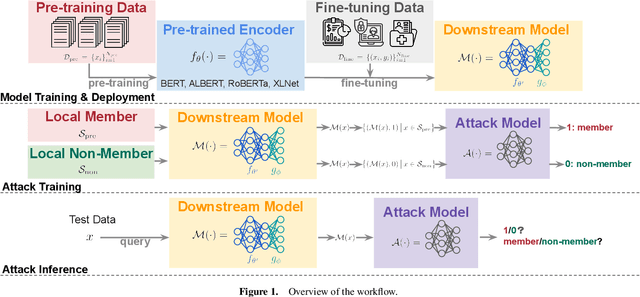
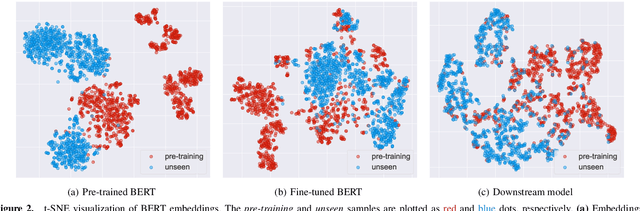


Despite being prevalent in the general field of Natural Language Processing (NLP), pre-trained language models inherently carry privacy and copyright concerns due to their nature of training on large-scale web-scraped data. In this paper, we pioneer a systematic exploration of such risks associated with pre-trained language encoders, specifically focusing on the membership leakage of pre-training data exposed through downstream models adapted from pre-trained language encoders-an aspect largely overlooked in existing literature. Our study encompasses comprehensive experiments across four types of pre-trained encoder architectures, three representative downstream tasks, and five benchmark datasets. Intriguingly, our evaluations reveal, for the first time, the existence of membership leakage even when only the black-box output of the downstream model is exposed, highlighting a privacy risk far greater than previously assumed. Alongside, we present in-depth analysis and insights toward guiding future researchers and practitioners in addressing the privacy considerations in developing pre-trained language models.
Vera Verto: Multimodal Hijacking Attack
Jul 31, 2024The increasing cost of training machine learning (ML) models has led to the inclusion of new parties to the training pipeline, such as users who contribute training data and companies that provide computing resources. This involvement of such new parties in the ML training process has introduced new attack surfaces for an adversary to exploit. A recent attack in this domain is the model hijacking attack, whereby an adversary hijacks a victim model to implement their own -- possibly malicious -- hijacking tasks. However, the scope of the model hijacking attack is so far limited to the homogeneous-modality tasks. In this paper, we transform the model hijacking attack into a more general multimodal setting, where the hijacking and original tasks are performed on data of different modalities. Specifically, we focus on the setting where an adversary implements a natural language processing (NLP) hijacking task into an image classification model. To mount the attack, we propose a novel encoder-decoder based framework, namely the Blender, which relies on advanced image and language models. Experimental results show that our modal hijacking attack achieves strong performances in different settings. For instance, our attack achieves 94%, 94%, and 95% attack success rate when using the Sogou news dataset to hijack STL10, CIFAR-10, and MNIST classifiers.