 Add to Chrome
 Add to Firefox
 Add to Edge
Crystalite: A Lightweight Transformer for Efficient Crystal Modeling
Apr 02, 2026
Generative models for crystalline materials often rely on equivariant graph neural networks, which capture geometric structure well but are costly to train and slow to sample. We present Crystalite, a lightweight diffusion Transformer for crystal modeling built around two simple inductive biases. The first is Subatomic Tokenization, a compact chemically structured atom representation that replaces high-dimensional one-hot encodings and is better suited to continuous diffusion. The second is the Geometry Enhancement Module (GEM), which injects periodic minimum-image pair geometry directly into attention through additive geometric biases. Together, these components preserve the simplicity and efficiency of a standard Transformer while making it better matched to the structure of crystalline materials. Crystalite achieves state-of-the-art results on crystal structure prediction benchmarks, and de novo generation performance, attaining the best S.U.N. discovery score among the evaluated baselines while sampling substantially faster than geometry-heavy alternatives.

CORDS: Continuous Representations of Discrete Structures
Jan 29, 2026Many learning problems require predicting sets of objects when the number of objects is not known beforehand. Examples include object detection, molecular modeling, and scientific inference tasks such as astrophysical source detection. Existing methods often rely on padded representations or must explicitly infer the set size, which often poses challenges. We present a novel strategy for addressing this challenge by casting prediction of variable-sized sets as a continuous inference problem. Our approach, CORDS (Continuous Representations of Discrete Structures), provides an invertible mapping that transforms a set of spatial objects into continuous fields: a density field that encodes object locations and count, and a feature field that carries their attributes over the same support. Because the mapping is invertible, models operate entirely in field space while remaining exactly decodable to discrete sets. We evaluate CORDS across molecular generation and regression, object detection, simulation-based inference, and a mathematical task involving recovery of local maxima, demonstrating robust handling of unknown set sizes with competitive accuracy.
DuoDiff: Accelerating Diffusion Models with a Dual-Backbone Approach
Oct 12, 2024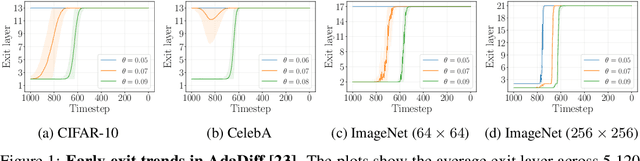

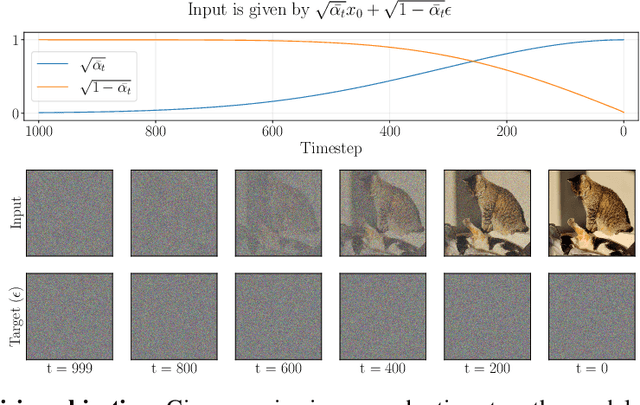
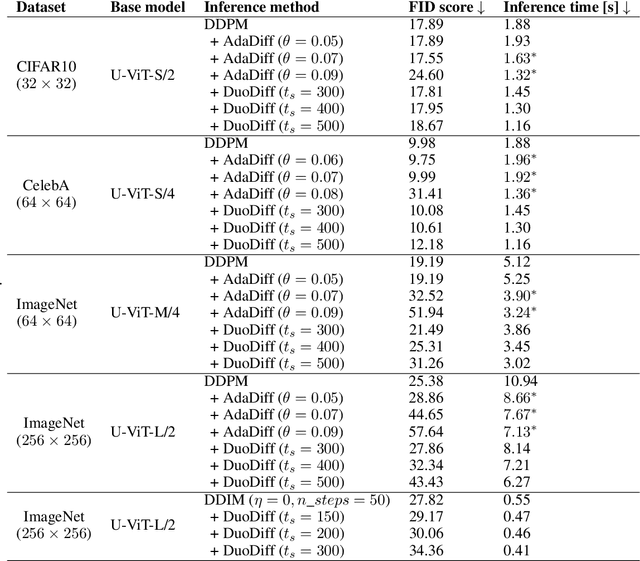
Diffusion models have achieved unprecedented performance in image generation, yet they suffer from slow inference due to their iterative sampling process. To address this, early-exiting has recently been proposed, where the depth of the denoising network is made adaptive based on the (estimated) difficulty of each sampling step. Here, we discover an interesting "phase transition" in the sampling process of current adaptive diffusion models: the denoising network consistently exits early during the initial sampling steps, until it suddenly switches to utilizing the full network. Based on this, we propose accelerating generation by employing a shallower denoising network in the initial sampling steps and a deeper network in the later steps. We demonstrate empirically that our dual-backbone approach, DuoDiff, outperforms existing early-exit diffusion methods in both inference speed and generation quality. Importantly, DuoDiff is easy to implement and complementary to existing approaches for accelerating diffusion.
Fast yet Safe: Early-Exiting with Risk Control
May 31, 2024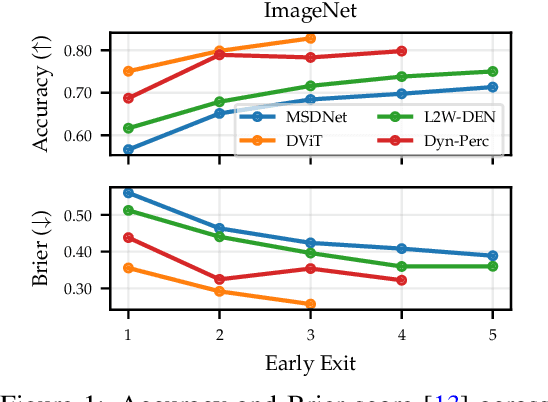
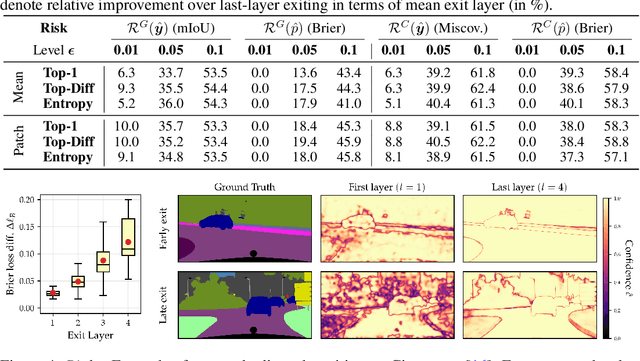
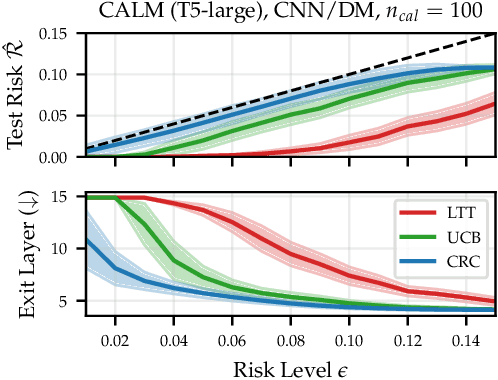
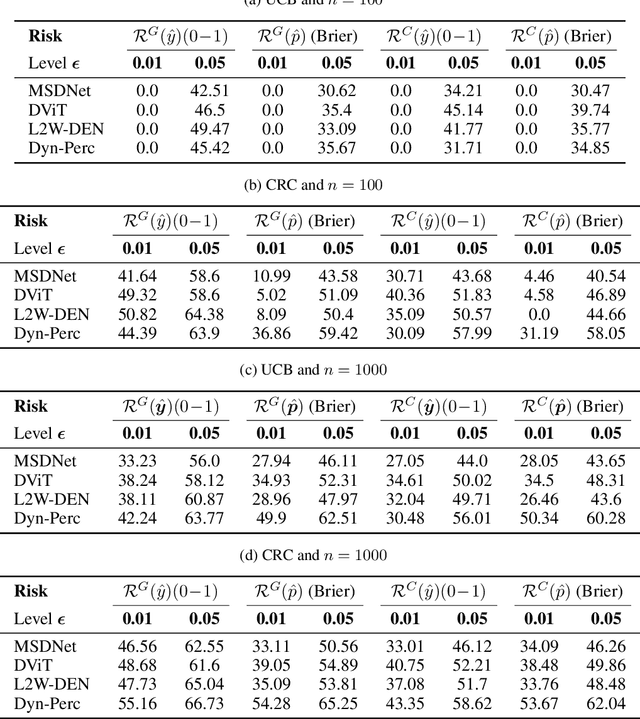
Scaling machine learning models significantly improves their performance. However, such gains come at the cost of inference being slow and resource-intensive. Early-exit neural networks (EENNs) offer a promising solution: they accelerate inference by allowing intermediate layers to exit and produce a prediction early. Yet a fundamental issue with EENNs is how to determine when to exit without severely degrading performance. In other words, when is it 'safe' for an EENN to go 'fast'? To address this issue, we investigate how to adapt frameworks of risk control to EENNs. Risk control offers a distribution-free, post-hoc solution that tunes the EENN's exiting mechanism so that exits only occur when the output is of sufficient quality. We empirically validate our insights on a range of vision and language tasks, demonstrating that risk control can produce substantial computational savings, all the while preserving user-specified performance goals.