 Add to Chrome
 Add to Firefox
 Add to Edge
Meta-Learning Preferences for Multilingual LLM Alignment
Jul 14, 2026
Unequal availability of human preference data across languages poses a significant challenge for aligning large language models in multilingual settings. To address the lack of sufficient data in low-resource language alignment, we propose a meta-learning framework for Reinforcement Learning from Human Feedback and Direct Preference Optimization. By leveraging preference data from other languages, our framework learns a transferable initialization that enables effective adaptation to a target language with minimal data. We provide theoretical guarantees for both the meta-reward modeling and meta-policy optimization settings, and empirically demonstrate the effectiveness of our approach on multilingual benchmarks. In an extremely low-resource setting with only 100 target-language preference samples, our approach achieves up to $28\%$ win-rate improvements over baseline methods, and consistently outperforms baselines across multiple target languages and model scales. Our approaches retain these advantages across different combinations of meta-training languages and varying linguistic distances from the target languages.

SWE-Router: Routing in Multi-turn Agentic Software Engineering Tasks
Jun 30, 2026Large language models (LLMs) embedded in multi-turn agentic harnesses are reshaping software engineering (SWE), but routing every task to a frontier model is wasteful when many issues admit cheap fixes. Existing LLM routers operate on the task description alone, which inherits an information-theoretic Bayes-error floor in agentic settings: a similar issue can hide either a localized typo or a multi-module refactor, and the prompt does not separate the two. We introduce SWE-Router, a value-based temporal approach that lets a cheap model run for a few exploratory turns and reads the resulting partial trajectory before deciding whether to continue cheaply or to escalate to an expensive model. We provide a Bayes-optimality theorem showing that conditioning on the partial trajectory never harms routing and is strictly better whenever exploration is informative. Across the LLM pairs of weak and strong models spanning the contemporary cost--capability frontier, we show that SWE-Router greatly improves the cost efficiency of SWE tasks, while maintaining the majority of the performances of the stronger model. We additionally release a multi-LLM trajectory dataset which allows reproduction of our trajectory-level routing.
Re-evaluating Confidence Remasking in Masked Diffusion Language Models
Jun 10, 2026Masked diffusion language models (dLLMs) have recently emerged as a competitive alternative to autoregressive language models, with the promise of faster inference via parallel token generation. A notable limitation of the masked formulation, however, is that once a token has been unmasked it can no longer be revised, leaving dLLMs vulnerable to early sampling mistakes. To address this, a growing body of work has sought to extend masked dLLMs with self-correcting (remasking) capabilities. One appealing subset of these methods does so in a training-free, post-hoc manner based on token confidences, with encouraging early reported results. In this work, we revisit the empirical evaluation of a representative post-hoc remasking method, WINO [Hong et al., 2026], and find that under standard decoding settings (shorter block lengths) it brings little-to-no benefit over confidence-based unmasking alone [Wu et al., 2025]. Extending the evaluation to non-greedy decoding, we find that while confidence-based remasking can mitigate errors introduced by increased stochasticity to some extent, it also exacerbates the diversity collapse previously reported for confidence-based unmasking. Overall, our results show that the benefits of post-hoc confidence-based remasking are highly setting-dependent, underscoring the need for a more comprehensive evaluation framework.
GDSD: Reinforcement Learning as Guided Denoiser Self-Distillation for Diffusion Language Models
May 28, 2026Reinforcement learning (RL) can be used to improve the policy (denoiser) of diffusion large language models (dLLMs), while being hindered by the intractability of the policy likelihood. A dominant and efficient family of methods replaces the likelihood in standard RL with its evidence lower bound (ELBO), estimated from randomly masked sequences. Despite being well aligned with pre-training, these approaches introduce bias through training--inference mismatch by using the ELBO as a likelihood surrogate, which can degrade performance. In this work, we propose Guided Denoiser Self-Distillation (GDSD) to directly distill the denoiser of dLLMs from an advantage-guided self-teacher, derived from the closed-form optimum of reverse-KL regularized RL. GDSD matches the dLLM's denoiser logits to the teacher's via a normalization-free objective, which reduces RL to likelihood-free self-distillation and thus bypasses the TIM biases. Recent ELBO-based methods emerge as instances of applying different distillation divergences, but with diagnosable pathologies that GDSD avoids. On planning, math, and coding benchmarks with LLaDA-8B and Dream-7B, GDSD consistently outperforms prior state-of-the-art ELBO-based methods with a more stable training reward dynamics, achieving test-accuracy improvements of up to $+19.6\%$. These results suggest that direct denoiser self-distillation, without relying on an ELBO likelihood surrogate, can provide a more stable and effective RL procedure for dLLMs. Code is available at https://github.com/GaryBall/GDSD.
Overton Pluralistic Reinforcement Learning for Large Language Models
Feb 24, 2026Existing alignment paradigms remain limited in capturing the pluralistic nature of human values. Overton Pluralism addresses this gap by generating responses with diverse perspectives from a single query. This paper introduces OP-GRPO (Overton Pluralistic Group Relative Policy Optimization), a reinforcement learning framework for implicit Overton Pluralism that enables a single large language model to produce pluralistic responses without explicit prompting or modular orchestration. Our workflow consists of two main steps. First, similarity estimator training fine-tunes a Sentence Transformer for Overton Pluralism tasks to provide more accurate coverage evaluation of generated responses. Second, OP-GRPO training incorporates this similarity estimator into a dual-reward system designed to ensure both broad coverage of genuine human perspectives and the uniqueness of each perspective, thereby promoting diversity. Empirical results demonstrate a "small models, big perspective coverage" effect. The trained Qwen2.5-3B-Instruct model surpasses a 20B GPT-OSS baseline with a 37.4 percent relative accuracy gain on a Natural Language Inference benchmark, and also outperforms a modular architecture baseline with a 19.1 percent relative improvement. Additional evaluations using GPT-4.1 as a large language model judge further confirm the robustness of the approach.
LLM-WikiRace: Benchmarking Long-term Planning and Reasoning over Real-World Knowledge Graphs
Feb 18, 2026We introduce LLM-Wikirace, a benchmark for evaluating planning, reasoning, and world knowledge in large language models (LLMs). In LLM-Wikirace, models must efficiently navigate Wikipedia hyperlinks step by step to reach a target page from a given source, requiring look-ahead planning and the ability to reason about how concepts are connected in the real world. We evaluate a broad set of open- and closed-source models, including Gemini-3, GPT-5, and Claude Opus 4.5, which achieve the strongest results on the easy level of the task and demonstrate superhuman performance. Despite this, performance drops sharply on hard difficulty: the best-performing model, Gemini-3, succeeds in only 23\% of hard games, highlighting substantial remaining challenges for frontier models. Our analysis shows that world knowledge is a necessary ingredient for success, but only up to a point, beyond this threshold, planning and long-horizon reasoning capabilities become the dominant factors. Trajectory-level analysis further reveals that even the strongest models struggle to replan after failure, frequently entering loops rather than recovering. LLM-Wikirace is a simple benchmark that reveals clear limitations in current reasoning systems, offering an open arena where planning-capable LLMs still have much to prove. Our code and leaderboard available at https:/llmwikirace.github.io.
Multi-Task GRPO: Reliable LLM Reasoning Across Tasks
Feb 05, 2026RL-based post-training with GRPO is widely used to improve large language models on individual reasoning tasks. However, real-world deployment requires reliable performance across diverse tasks. A straightforward multi-task adaptation of GRPO often leads to imbalanced outcomes, with some tasks dominating optimization while others stagnate. Moreover, tasks can vary widely in how frequently prompts yield zero advantages (and thus zero gradients), which further distorts their effective contribution to the optimization signal. To address these issues, we propose a novel Multi-Task GRPO (MT-GRPO) algorithm that (i) dynamically adapts task weights to explicitly optimize worst-task performance and promote balanced progress across tasks, and (ii) introduces a ratio-preserving sampler to ensure task-wise policy gradients reflect the adapted weights. Experiments on both 3-task and 9-task settings show that MT-GRPO consistently outperforms baselines in worst-task accuracy. In particular, MT-GRPO achieves 16-28% and 6% absolute improvement on worst-task performance over standard GRPO and DAPO, respectively, while maintaining competitive average accuracy. Moreover, MT-GRPO requires 50% fewer training steps to reach 50% worst-task accuracy in the 3-task setting, demonstrating substantially improved efficiency in achieving reliable performance across tasks.
Robust Bayesian Optimisation with Unbounded Corruptions
Nov 19, 2025Bayesian Optimization is critically vulnerable to extreme outliers. Existing provably robust methods typically assume a bounded cumulative corruption budget, which makes them defenseless against even a single corruption of sufficient magnitude. To address this, we introduce a new adversary whose budget is only bounded in the frequency of corruptions, not in their magnitude. We then derive RCGP-UCB, an algorithm coupling the famous upper confidence bound (UCB) approach with a Robust Conjugate Gaussian Process (RCGP). We present stable and adaptive versions of RCGP-UCB, and prove that they achieve sublinear regret in the presence of up to $O(T^{1/2})$ and $O(T^{1/3})$ corruptions with possibly infinite magnitude. This robustness comes at near zero cost: without outliers, RCGP-UCB's regret bounds match those of the standard GP-UCB algorithm.
Synthetic Data is Sufficient for Zero-Shot Visual Generalization from Offline Data
Aug 17, 2025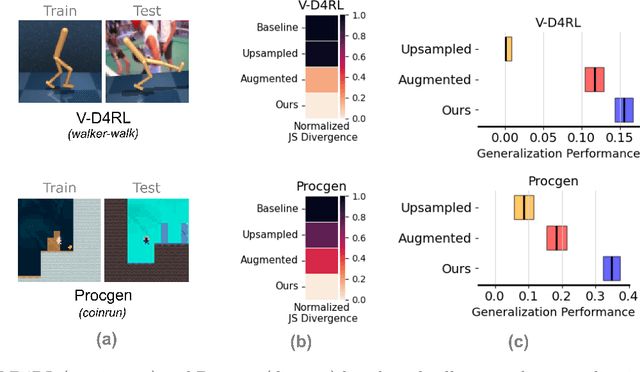
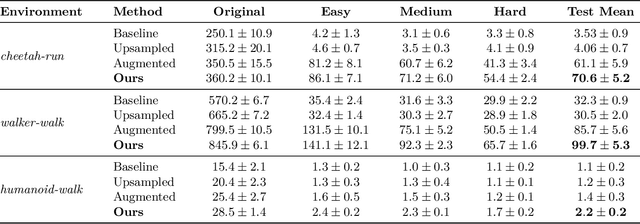
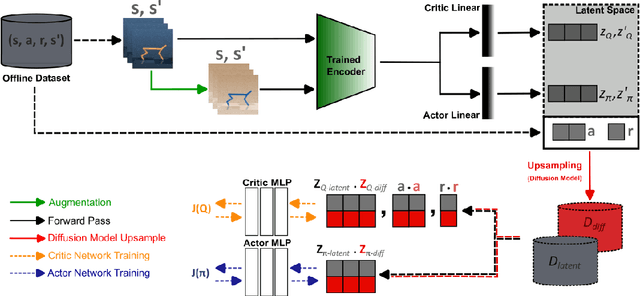
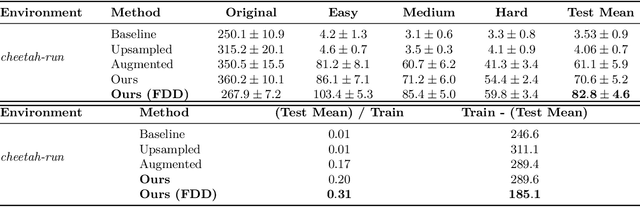
Offline reinforcement learning (RL) offers a promising framework for training agents using pre-collected datasets without the need for further environment interaction. However, policies trained on offline data often struggle to generalise due to limited exposure to diverse states. The complexity of visual data introduces additional challenges such as noise, distractions, and spurious correlations, which can misguide the policy and increase the risk of overfitting if the training data is not sufficiently diverse. Indeed, this makes it challenging to leverage vision-based offline data in training robust agents that can generalize to unseen environments. To solve this problem, we propose a simple approach generating additional synthetic training data. We propose a two-step process, first augmenting the originally collected offline data to improve zero-shot generalization by introducing diversity, then using a diffusion model to generate additional data in latent space. We test our method across both continuous action spaces (Visual D4RL) and discrete action spaces (Procgen), demonstrating that it significantly improves generalization without requiring any algorithmic changes to existing model-free offline RL methods. We show that our method not only increases the diversity of the training data but also significantly reduces the generalization gap at test time while maintaining computational efficiency. We believe this approach could fuel additional progress in generating synthetic data to train more general agents in the future.
Robust Multi-Objective Controlled Decoding of Large Language Models
Mar 11, 2025
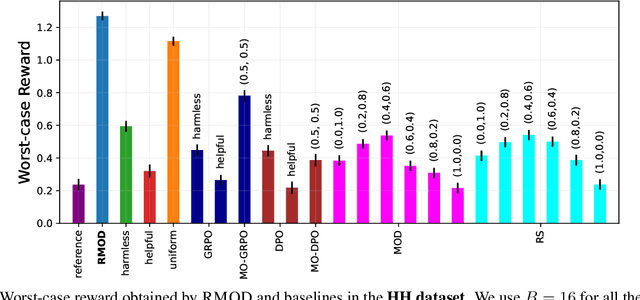
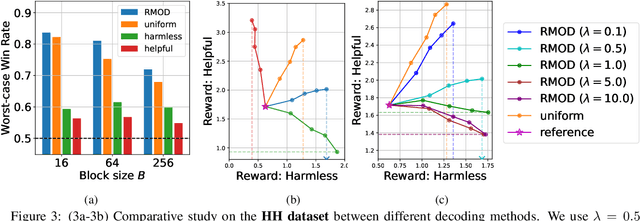
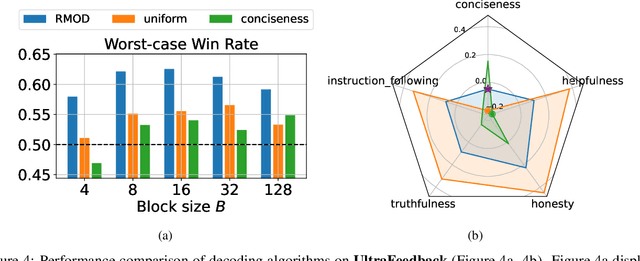
Test-time alignment of Large Language Models (LLMs) to human preferences offers a flexible way to generate responses aligned to diverse objectives without extensive retraining of LLMs. Existing methods achieve alignment to multiple objectives simultaneously (e.g., instruction-following, helpfulness, conciseness) by optimizing their corresponding reward functions. However, they often rely on predefined weights or optimize for averages, sacrificing one objective for another and leading to unbalanced outcomes. To address this, we introduce Robust Multi-Objective Decoding (RMOD), a novel inference-time algorithm that optimizes for improving worst-case rewards. RMOD formalizes the robust decoding problem as a maximin two-player game between reward weights and the sampling policy, solving for the Nash equilibrium. We show that the game reduces to a convex optimization problem to find the worst-case weights, while the best response policy can be computed analytically. We also introduce a practical RMOD variant designed for efficient decoding with contemporary LLMs, incurring minimal computational overhead compared to non-robust Multi-Objective Decoding (MOD) methods. Our experimental results showcase the effectiveness of RMOD in generating responses equitably aligned with diverse objectives, outperforming baselines up to 20%.