 Add to Chrome
 Add to Firefox
 Add to Edge
SlimPer: Make Personalization Model Slim and Smart
Jul 14, 2026
Transformer-style architectures are increasingly adopted for industrial recommendation systems, yet they inherit a design premise misaligned with the task: generative models rely on per-token autoregressive prediction, which justifies maintaining large intermediate tensors that scale with sequence length. In contrast, recommendation systems produce a single set of relevance scores for each <user, item> pair without token-level supervision. Leveraging this observation, we propose SlimPer, which reformulates personalized ranking as iterative refinement of a compact, unified <user, item> knowledge base. At each layer, the model selectively queries raw multi-modal user-side tokens, computes explicit relevance matching scores, and refines the knowledge base, all in O(N) per-layer cost with a fixed-size intermediate representation. As a result, model depth is decoupled from user history length, enabling deeper relevance understanding without proportional growth in compute or memory; request-only optimization further trims memory by sharing a single copy of user-side tokens across all candidate items. SlimPer unifies sparse, dense, and sequence features within a single backbone and provides inherent interpretability through its attention mechanism. Deployed on Instagram Reels and Feed, SlimPer yields measurable improvements in user engagement while streamlining the overall system and enabling effective modeling of 10k+ fine-grained user history events.

Scalable Bottom-Up Hierarchical Clustering
Nov 04, 2020
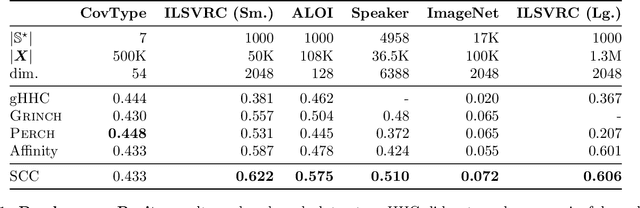

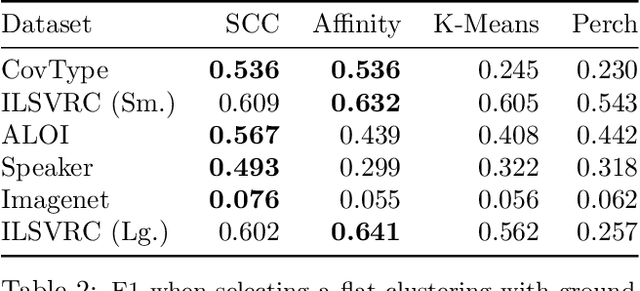
Bottom-up algorithms such as the classic hierarchical agglomerative clustering, are highly effective for hierarchical as well as flat clustering. However, the large number of rounds and their sequential nature limit the scalability of agglomerative clustering. In this paper, we present an alternative round-based bottom-up hierarchical clustering, the Sub-Cluster Component Algorithm (SCC), that scales gracefully to massive datasets. Our method builds many sub-clusters in parallel in a given round and requires many fewer rounds -- usually an order of magnitude smaller than classic agglomerative clustering. Our theoretical analysis shows that, under a modest separability assumption, SCC will contain the optimal flat clustering. SCC also provides a 2-approx solution to the DP-means objective, thereby introducing a novel application of hierarchical clustering methods. Empirically, SCC finds better hierarchies and flat clusterings even when the data does not satisfy the separability assumption. We demonstrate the scalability of our method by applying it to a dataset of 30 billion points and showing that SCC produces higher quality clusterings than the state-of-the-art.