 Add to Chrome
 Add to Firefox
 Add to Edge
Semantic-Geometric Dual Compression: Training-Free Visual Token Reduction for Ultra-High-Resolution Remote Sensing Understanding
Apr 13, 2026
Multimodal Large Language Models (MLLMs) have demonstrated immense potential in Earth observation. However, the massive visual tokens generated when processing Ultra-High-Resolution (UHR) imagery introduce prohibitive computational overhead, severely bottlenecking their inference efficiency. Existing visual token compression methods predominantly adopt static and uniform compression strategies, neglecting the inherent "Semantic-Geometric Duality" in remote sensing interpretation tasks. Specifically, object semantic tasks focus on the abstract semantics of objects and benefit from aggressive background pruning, whereas scene geometric tasks critically rely on the integrity of spatial topology. To address this challenge, we propose DualComp, a task-adaptive dual-stream token compression framework. Dynamically guided by a lightweight pre-trained router, DualComp decouples feature processing into two dedicated pathways. In the object semantic stream, the Spatially-Contiguous Semantic Aggregator (SCSA) utilizes size-adaptive clustering to aggregates redundant background while protecting small object. In the scene geometric stream, the Instruction-Guided Structure Recoverer (IGSR) introduces a greedy path-tracing topology completion mechanism to reconstruct spatial skeletons. Experiments on the UHR remote sensing benchmark XLRS-Bench demonstrate that DualComp accomplishes high-fidelity remote sensing interpretation at an exceptionally low computational cost, achieving simultaneous improvements in both efficiency and accuracy.

Unity is Power: Semi-Asynchronous Collaborative Training of Large-Scale Models with Structured Pruning in Resource-Limited Clients
Oct 11, 2024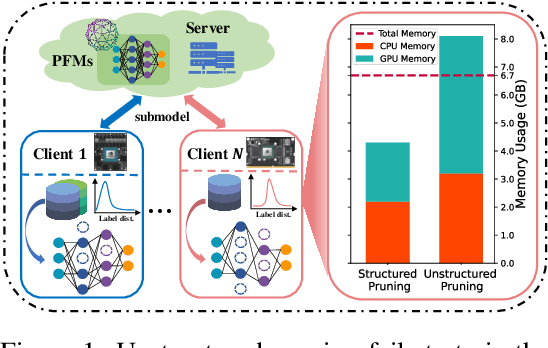
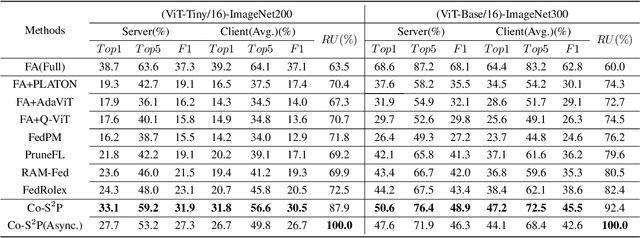

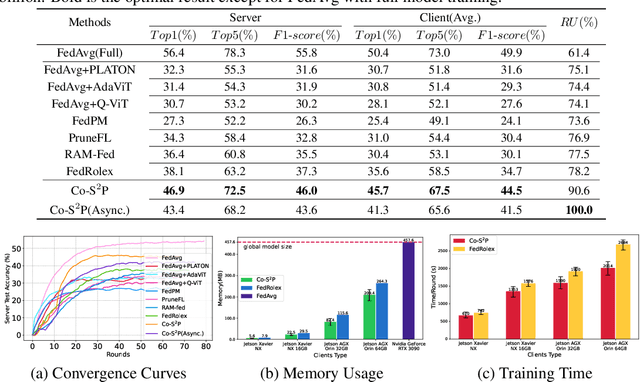
In this work, we study to release the potential of massive heterogeneous weak computing power to collaboratively train large-scale models on dispersed datasets. In order to improve both efficiency and accuracy in resource-adaptive collaborative learning, we take the first step to consider the \textit{unstructured pruning}, \textit{varying submodel architectures}, \textit{knowledge loss}, and \textit{straggler} challenges simultaneously. We propose a novel semi-asynchronous collaborative training framework, namely ${Co\text{-}S}^2{P}$, with data distribution-aware structured pruning and cross-block knowledge transfer mechanism to address the above concerns. Furthermore, we provide theoretical proof that ${Co\text{-}S}^2{P}$ can achieve asymptotic optimal convergence rate of $O(1/\sqrt{N^*EQ})$. Finally, we conduct extensive experiments on a real-world hardware testbed, in which 16 heterogeneous Jetson devices can be united to train large-scale models with parameters up to 0.11 billion. The experimental results demonstrate that $Co\text{-}S^2P$ improves accuracy by up to 8.8\% and resource utilization by up to 1.2$\times$ compared to state-of-the-art methods, while reducing memory consumption by approximately 22\% and training time by about 24\% on all resource-limited devices.