 Add to Chrome
 Add to Firefox
 Add to Edge
P3D-Bench: Benchmarking MLLMs for Parametric 3D Generation and Structural Reasoning
Jun 09, 2026
Multimodal large language models can write code to produce complex programs as well as use programs to do 3D modeling, which opens up a new avenue for 3D generation powered by their priors, world knowledge and reasoning. Yet existing benchmarks rarely evaluate 3D modeling through code. Such modeling demands more than runnable code: from a text or visual specification, a model must generate a parametric 3D program that is geometrically precise, semantically aligned and assembly-consistent. We introduce P3D-Bench, a benchmark for parametric 3D generation. Unlike a 3D mesh, a parametric 3D program exposes explicit dimensions, construction operations and part relations, revealing whether a model recovers a design's structure, not just its appearance. Under a unified protocol, P3D-Bench covers three task families (Text-to-3D, Image-to-3D and Assembly-3D) and scores each output for executability, geometric fidelity, topology, text-grounded constraints, multiview semantic alignment and part-level structure. We evaluate frontier MLLMs and text-only LLMs on 400 text cases, 400 image cases and 203 annotated assemblies, with domain-specific models as reference points. Our extensive evaluation yields three findings. First, assemblies are the hardest setting, where models still fail to compose multiple parts into a coherent structure. Second, models can often recover the global shape and semantic identity of the target object, yet fail to reproduce the precise parametric geometry specified by the input. Third, part-level modeling remains weak on assemblies, where models recover neither the geometry of each part nor the right number of parts. These results position P3D-Bench as a benchmark for evaluating precise parametric geometry and part-level structure in parametric 3D generation.

HLG: Comprehensive 3D Room Construction via Hierarchical Layout Generation
Aug 25, 2025Realistic 3D indoor scene generation is crucial for virtual reality, interior design, embodied intelligence, and scene understanding. While existing methods have made progress in coarse-scale furniture arrangement, they struggle to capture fine-grained object placements, limiting the realism and utility of generated environments. This gap hinders immersive virtual experiences and detailed scene comprehension for embodied AI applications. To address these issues, we propose Hierarchical Layout Generation (HLG), a novel method for fine-grained 3D scene generation. HLG is the first to adopt a coarse-to-fine hierarchical approach, refining scene layouts from large-scale furniture placement to intricate object arrangements. Specifically, our fine-grained layout alignment module constructs a hierarchical layout through vertical and horizontal decoupling, effectively decomposing complex 3D indoor scenes into multiple levels of granularity. Additionally, our trainable layout optimization network addresses placement issues, such as incorrect positioning, orientation errors, and object intersections, ensuring structurally coherent and physically plausible scene generation. We demonstrate the effectiveness of our approach through extensive experiments, showing superior performance in generating realistic indoor scenes compared to existing methods. This work advances the field of scene generation and opens new possibilities for applications requiring detailed 3D environments. We will release our code upon publication to encourage future research.
CityX: Controllable Procedural Content Generation for Unbounded 3D Cities
Jul 29, 2024
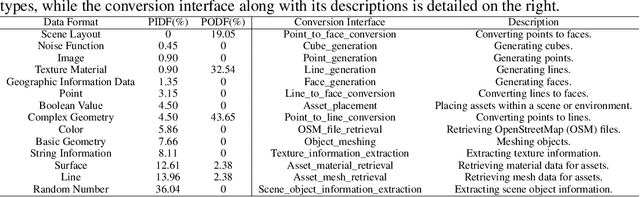
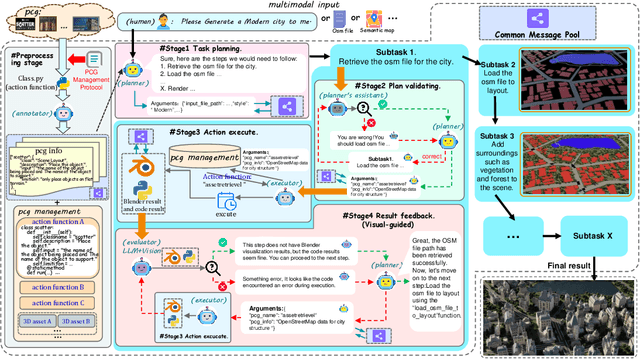
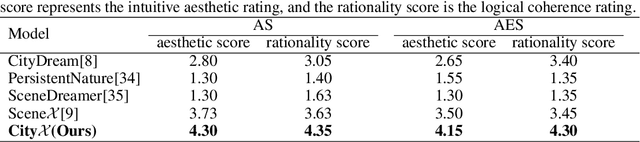
Generating a realistic, large-scale 3D virtual city remains a complex challenge due to the involvement of numerous 3D assets, various city styles, and strict layout constraints. Existing approaches provide promising attempts at procedural content generation to create large-scale scenes using Blender agents. However, they face crucial issues such as difficulties in scaling up generation capability and achieving fine-grained control at the semantic layout level. To address these problems, we propose a novel multi-modal controllable procedural content generation method, named CityX, which enhances realistic, unbounded 3D city generation guided by multiple layout conditions, including OSM, semantic maps, and satellite images. Specifically, the proposed method contains a general protocol for integrating various PCG plugins and a multi-agent framework for transforming instructions into executable Blender actions. Through this effective framework, CityX shows the potential to build an innovative ecosystem for 3D scene generation by bridging the gap between the quality of generated assets and industrial requirements. Extensive experiments have demonstrated the effectiveness of our method in creating high-quality, diverse, and unbounded cities guided by multi-modal conditions. Our project page: https://cityx-lab.github.io.
SceneX:Procedural Controllable Large-scale Scene Generation via Large-language Models
Mar 23, 2024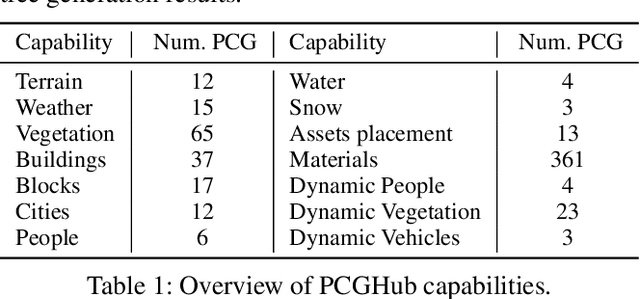
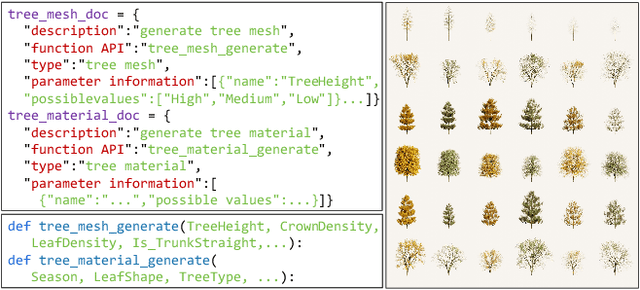
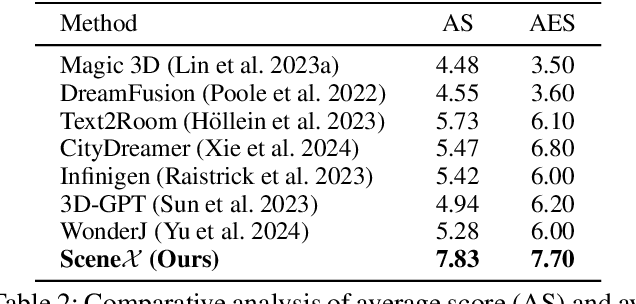
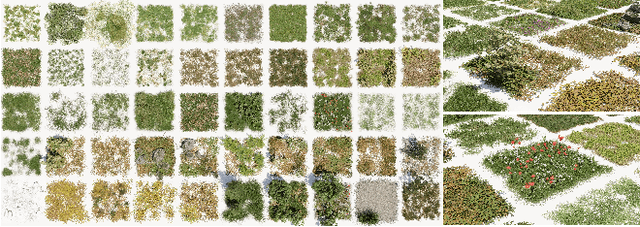
Due to its great application potential, large-scale scene generation has drawn extensive attention in academia and industry. Recent research employs powerful generative models to create desired scenes and achieves promising results. However, most of these methods represent the scene using 3D primitives (e.g. point cloud or radiance field) incompatible with the industrial pipeline, which leads to a substantial gap between academic research and industrial deployment. Procedural Controllable Generation (PCG) is an efficient technique for creating scalable and high-quality assets, but it is unfriendly for ordinary users as it demands profound domain expertise. To address these issues, we resort to using the large language model (LLM) to drive the procedural modeling. In this paper, we introduce a large-scale scene generation framework, SceneX, which can automatically produce high-quality procedural models according to designers' textual descriptions.Specifically, the proposed method comprises two components, PCGBench and PCGPlanner. The former encompasses an extensive collection of accessible procedural assets and thousands of hand-craft API documents. The latter aims to generate executable actions for Blender to produce controllable and precise 3D assets guided by the user's instructions. Our SceneX can generate a city spanning 2.5 km times 2.5 km with delicate layout and geometric structures, drastically reducing the time cost from several weeks for professional PCG engineers to just a few hours for an ordinary user. Extensive experiments demonstrated the capability of our method in controllable large-scale scene generation and editing, including asset placement and season translation.