 Add to Chrome
 Add to Firefox
 Add to Edge
Geospatial-Prior Guidance for 3D Semantic Scene Completion
Aug 04, 2026
Inferring complete 3D geometry and semantics from onboard images remains challenging because occlusions and restricted fields of view leave large scene regions underconstrained. Although satellite imagery provides wide-area context, appearance cues alone offer limited structural guidance and may be unreliable because of spatial or temporal discrepancies. We present GeoScene, a geospatially guided framework that jointly uses satellite imagery and structured OpenStreetMap cues as soft priors for 3D semantic scene completion. GeoScene learns complementary voxel-wise reliability weights for onboard observations and geospatial guidance, and uses them to control feature refinement in observed and unobserved regions. This design preserves local visual evidence while exploiting large-scale road and building structure beyond onboard visibility. Experiments on SemanticKITTI and SSCBench-KITTI-360 demonstrate that GeoScene consistently improves both geometric and semantic completion under the geospatial-prior-assisted setting, with the most pronounced benefits for large-scale static and geospatially structured classes.

RoomPilot: Controllable Synthesis of Interactive Indoor Environments via Multimodal Semantic Parsing
Dec 12, 2025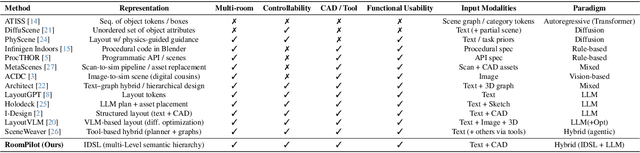
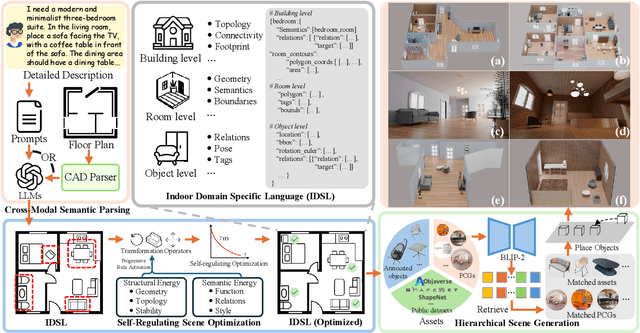
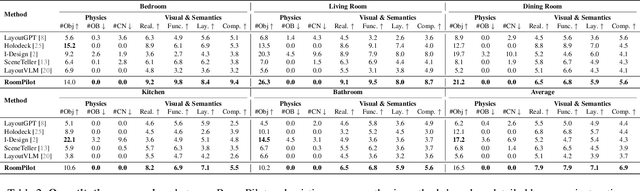
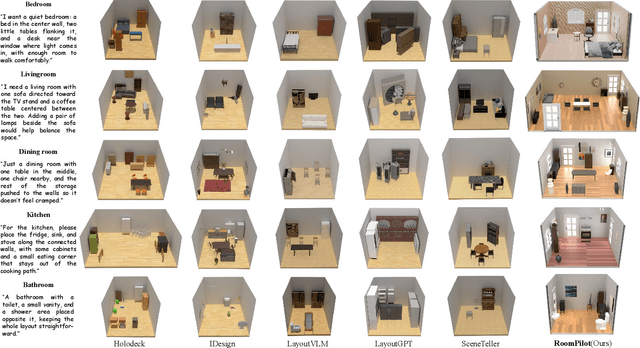
Generating controllable and interactive indoor scenes is fundamental to applications in game development, architectural visualization, and embodied AI training. Yet existing approaches either handle a narrow range of input modalities or rely on stochastic processes that hinder controllability. To overcome these limitations, we introduce RoomPilot, a unified framework that parses diverse multi-modal inputs--textual descriptions or CAD floor plans--into an Indoor Domain-Specific Language (IDSL) for indoor structured scene generation. The key insight is that a well-designed IDSL can act as a shared semantic representation, enabling coherent, high-quality scene synthesis from any single modality while maintaining interaction semantics. In contrast to conventional procedural methods that produce visually plausible but functionally inert layouts, RoomPilot leverages a curated dataset of interaction-annotated assets to synthesize environments exhibiting realistic object behaviors. Extensive experiments further validate its strong multi-modal understanding, fine-grained controllability in scene generation, and superior physical consistency and visual fidelity, marking a significant step toward general-purpose controllable 3D indoor scene generation.
CityX: Controllable Procedural Content Generation for Unbounded 3D Cities
Jul 29, 2024
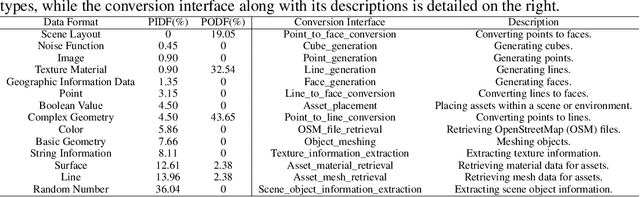
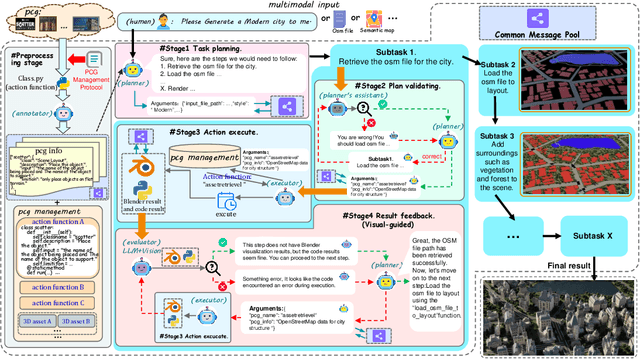
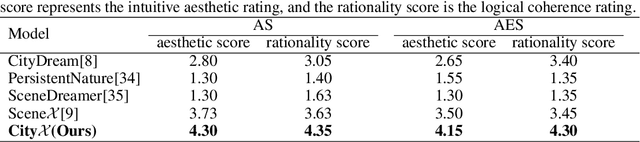
Generating a realistic, large-scale 3D virtual city remains a complex challenge due to the involvement of numerous 3D assets, various city styles, and strict layout constraints. Existing approaches provide promising attempts at procedural content generation to create large-scale scenes using Blender agents. However, they face crucial issues such as difficulties in scaling up generation capability and achieving fine-grained control at the semantic layout level. To address these problems, we propose a novel multi-modal controllable procedural content generation method, named CityX, which enhances realistic, unbounded 3D city generation guided by multiple layout conditions, including OSM, semantic maps, and satellite images. Specifically, the proposed method contains a general protocol for integrating various PCG plugins and a multi-agent framework for transforming instructions into executable Blender actions. Through this effective framework, CityX shows the potential to build an innovative ecosystem for 3D scene generation by bridging the gap between the quality of generated assets and industrial requirements. Extensive experiments have demonstrated the effectiveness of our method in creating high-quality, diverse, and unbounded cities guided by multi-modal conditions. Our project page: https://cityx-lab.github.io.