 Add to Chrome
 Add to Firefox
 Add to Edge
When AI Designs AI: Innovation or Imitation?
Aug 18, 2026
Recent advances in LLM agents have made them increasingly capable of designing methods for complex AI tasks. This raises two central questions about agent-designed methods relative to human-designed methods: how well they perform, and how different their algorithmic designs are. To study these questions, this paper introduces an analysis that derives task-specific algorithmic design spaces from human-designed methods, maps both human- and agent-designed methods into these spaces, and quantifies their algorithmic differences at the module level. Widely used LLM agents are evaluated on a suite of representative, open-ended AI tasks spanning multiple modalities, and the methods they design are analyzed in terms of both task performance and algorithmic differences from human-designed methods. Experimental results show that current agents can occasionally match or surpass human state-of-the-art (SOTA) performance (10/72 configurations), but such success does not generalize reliably across tasks or agents. Moreover, 96.8% of agent-designed methods fall within human-derived algorithmic design spaces, largely recombining algorithmic choices found in human-designed methods, while nearly half exactly match an existing human algorithmic design. Taken together, these findings suggest that although current agents can occasionally match or surpass human SOTA performance, their algorithmic designs remain within human-derived algorithmic design spaces, reflecting the reuse and recombination of algorithmic choices.

P3D-Bench: Benchmarking MLLMs for Parametric 3D Generation and Structural Reasoning
Jun 09, 2026Multimodal large language models can write code to produce complex programs as well as use programs to do 3D modeling, which opens up a new avenue for 3D generation powered by their priors, world knowledge and reasoning. Yet existing benchmarks rarely evaluate 3D modeling through code. Such modeling demands more than runnable code: from a text or visual specification, a model must generate a parametric 3D program that is geometrically precise, semantically aligned and assembly-consistent. We introduce P3D-Bench, a benchmark for parametric 3D generation. Unlike a 3D mesh, a parametric 3D program exposes explicit dimensions, construction operations and part relations, revealing whether a model recovers a design's structure, not just its appearance. Under a unified protocol, P3D-Bench covers three task families (Text-to-3D, Image-to-3D and Assembly-3D) and scores each output for executability, geometric fidelity, topology, text-grounded constraints, multiview semantic alignment and part-level structure. We evaluate frontier MLLMs and text-only LLMs on 400 text cases, 400 image cases and 203 annotated assemblies, with domain-specific models as reference points. Our extensive evaluation yields three findings. First, assemblies are the hardest setting, where models still fail to compose multiple parts into a coherent structure. Second, models can often recover the global shape and semantic identity of the target object, yet fail to reproduce the precise parametric geometry specified by the input. Third, part-level modeling remains weak on assemblies, where models recover neither the geometry of each part nor the right number of parts. These results position P3D-Bench as a benchmark for evaluating precise parametric geometry and part-level structure in parametric 3D generation.
GraDE: A Graph Diffusion Estimator for Frequent Subgraph Discovery in Neural Architectures
Feb 03, 2026Finding frequently occurring subgraph patterns or network motifs in neural architectures is crucial for optimizing efficiency, accelerating design, and uncovering structural insights. However, as the subgraph size increases, enumeration-based methods are perfectly accurate but computationally prohibitive, while sampling-based methods are computationally tractable but suffer from a severe decline in discovery capability. To address these challenges, this paper proposes GraDE, a diffusion-guided search framework that ensures both computational feasibility and discovery capability. The key innovation is the Graph Diffusion Estimator (GraDE), which is the first to introduce graph diffusion models to identify frequent subgraphs by scoring their typicality within the learned distribution. Comprehensive experiments demonstrate that the estimator achieves superior ranking accuracy, with up to 114\% improvement compared to sampling-based baselines. Benefiting from this, the proposed framework successfully discovers large-scale frequent patterns, achieving up to 30$\times$ higher median frequency than sampling-based methods.
Direct3D-S2: Gigascale 3D Generation Made Easy with Spatial Sparse Attention
May 26, 2025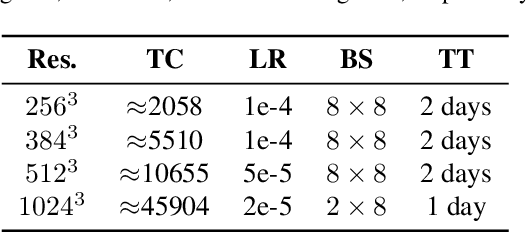
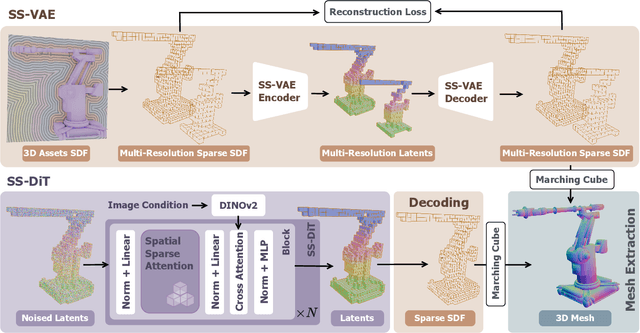
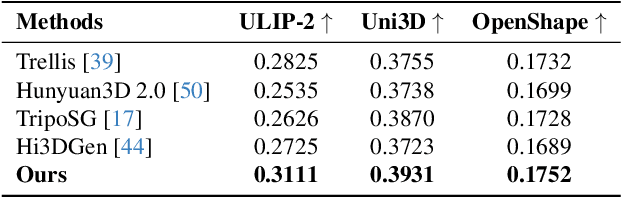
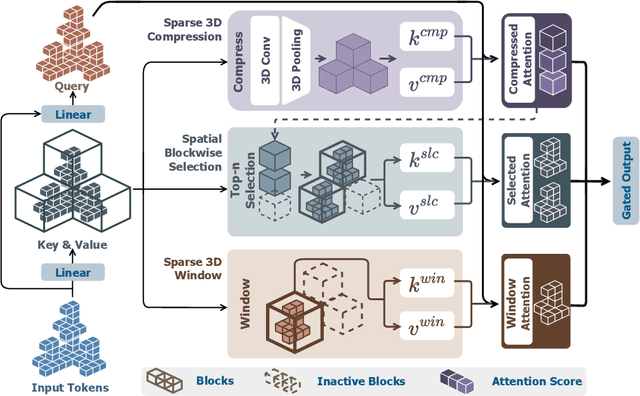
Generating high-resolution 3D shapes using volumetric representations such as Signed Distance Functions (SDFs) presents substantial computational and memory challenges. We introduce Direct3D-S2, a scalable 3D generation framework based on sparse volumes that achieves superior output quality with dramatically reduced training costs. Our key innovation is the Spatial Sparse Attention (SSA) mechanism, which greatly enhances the efficiency of Diffusion Transformer (DiT) computations on sparse volumetric data. SSA allows the model to effectively process large token sets within sparse volumes, substantially reducing computational overhead and achieving a 3.9x speedup in the forward pass and a 9.6x speedup in the backward pass. Our framework also includes a variational autoencoder (VAE) that maintains a consistent sparse volumetric format across input, latent, and output stages. Compared to previous methods with heterogeneous representations in 3D VAE, this unified design significantly improves training efficiency and stability. Our model is trained on public available datasets, and experiments demonstrate that Direct3D-S2 not only surpasses state-of-the-art methods in generation quality and efficiency, but also enables training at 1024 resolution using only 8 GPUs, a task typically requiring at least 32 GPUs for volumetric representations at 256 resolution, thus making gigascale 3D generation both practical and accessible. Project page: https://www.neural4d.com/research/direct3d-s2.