 Add to Chrome
 Add to Firefox
 Add to Edge
A Study on Building Efficient Zero-Shot Relation Extraction Models
Mar 04, 2026
Zero-shot relation extraction aims to identify relations between entity mentions using textual descriptions of novel types (i.e., previously unseen) instead of labeled training examples. Previous works often rely on unrealistic assumptions: (1) pairs of mentions are often encoded directly in the input, which prevents offline pre-computation for large scale document database querying; (2) no rejection mechanism is introduced, biasing the evaluation when using these models in a retrieval scenario where some (and often most) inputs are irrelevant and must be ignored. In this work, we study the robustness of existing zero-shot relation extraction models when adapting them to a realistic extraction scenario. To this end, we introduce a typology of existing models, and propose several strategies to build single pass models and models with a rejection mechanism. We adapt several state-of-the-art tools, and compare them in this challenging setting, showing that no existing work is really robust to realistic assumptions, but overall AlignRE (Li et al., 2024) performs best along all criteria.

Suffix-Constrained Greedy Search Algorithms for Causal Language Models
Mar 01, 2026Large language models (LLMs) are powerful tools that have found applications beyond human-machine interfaces and chatbots. In particular, their ability to generate reasoning traces motivated their use in many prediction tasks like math question answering. Unfortunately, extracting the final answer in an LLM free-form output is difficult, as it is an information extraction problem on its own. In this work, we introduce suffix-constrained generation, that aims to produce well-formed LLM responses in which final answers follow strict templates and are guaranteed to be trivially parseable. To this end, we introduce several algorithms that are based on greedy search procedures. We experiment on several datasets, and show that our approach allows to guarantee trivial deterministic extraction of the final answer from an LLM output without having a negative impact on results, and even improving them.
Kad: A Framework for Proxy-based Test-time Alignment with Knapsack Approximation Deferral
Oct 30, 2025Several previous works concluded that the largest part of generation capabilities of large language models (LLM) are learned (early) during pre-training. However, LLMs still require further alignment to adhere to downstream task requirements and stylistic preferences, among other desired properties. As LLMs continue to scale in terms of size, the computational cost of alignment procedures increase prohibitively. In this work, we propose a novel approach to circumvent these costs via proxy-based test-time alignment, i.e. using guidance from a small aligned model. Our approach can be described as token-specific cascading method, where the token-specific deferral rule is reduced to 0-1 knapsack problem. In this setting, we derive primal and dual approximations of the optimal deferral decision. We experimentally show the benefits of our method both in task performance and speculative decoding speed.
EuroBERT: Scaling Multilingual Encoders for European Languages
Mar 07, 2025General-purpose multilingual vector representations, used in retrieval, regression and classification, are traditionally obtained from bidirectional encoder models. Despite their wide applicability, encoders have been recently overshadowed by advances in generative decoder-only models. However, many innovations driving this progress are not inherently tied to decoders. In this paper, we revisit the development of multilingual encoders through the lens of these advances, and introduce EuroBERT, a family of multilingual encoders covering European and widely spoken global languages. Our models outperform existing alternatives across a diverse range of tasks, spanning multilingual capabilities, mathematics, and coding, and natively supporting sequences of up to 8,192 tokens. We also examine the design decisions behind EuroBERT, offering insights into our dataset composition and training pipeline. We publicly release the EuroBERT models, including intermediate training checkpoints, together with our training framework.
Training LayoutLM from Scratch for Efficient Named-Entity Recognition in the Insurance Domain
Dec 12, 2024
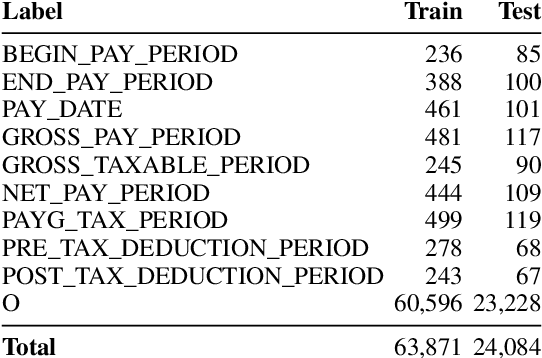
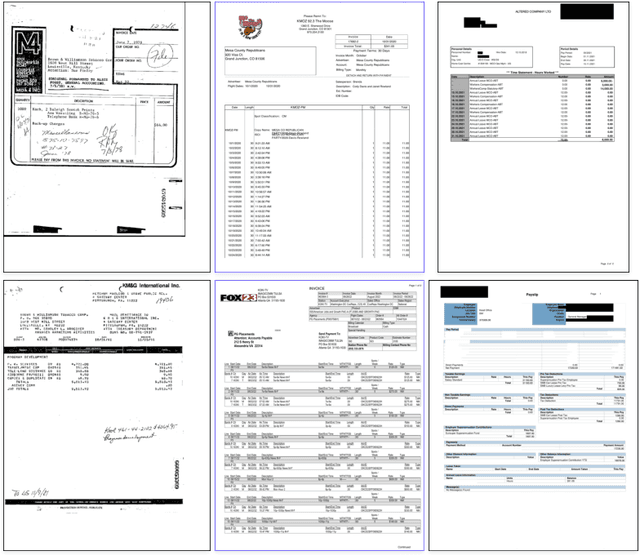
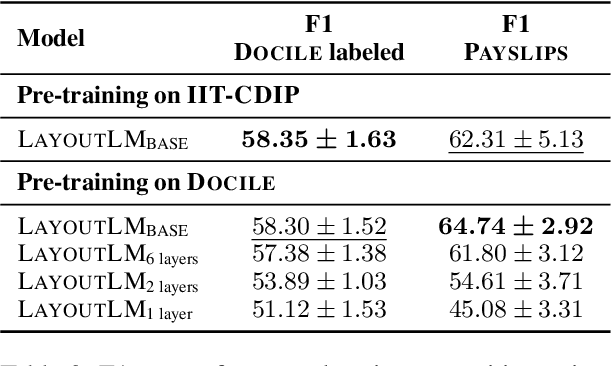
Generic pre-trained neural networks may struggle to produce good results in specialized domains like finance and insurance. This is due to a domain mismatch between training data and downstream tasks, as in-domain data are often scarce due to privacy constraints. In this work, we compare different pre-training strategies for LayoutLM. We show that using domain-relevant documents improves results on a named-entity recognition (NER) problem using a novel dataset of anonymized insurance-related financial documents called Payslips. Moreover, we show that we can achieve competitive results using a smaller and faster model.
Few-Shot Domain Adaptation for Named-Entity Recognition via Joint Constrained k-Means and Subspace Selection
Nov 30, 2024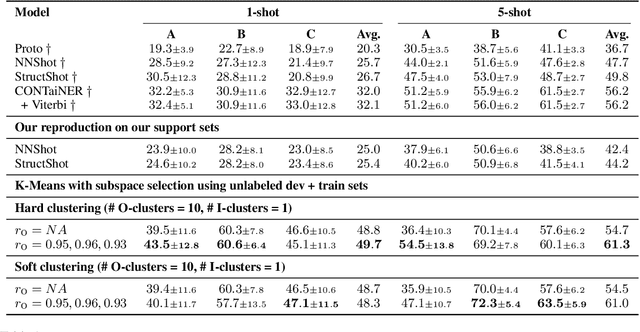
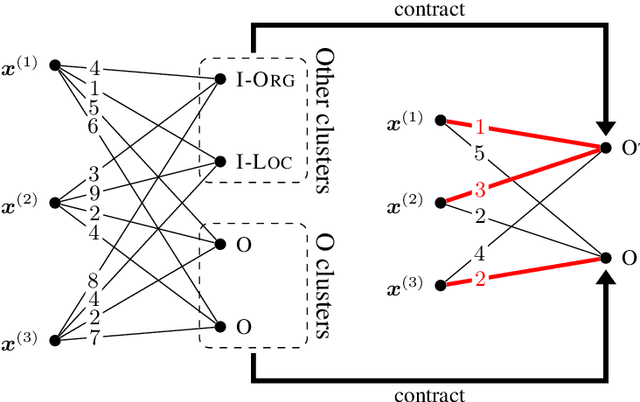
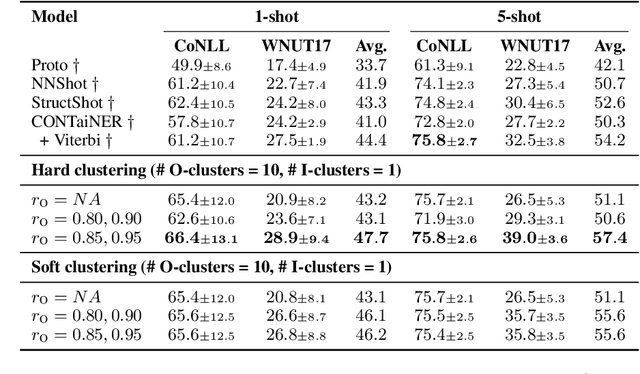
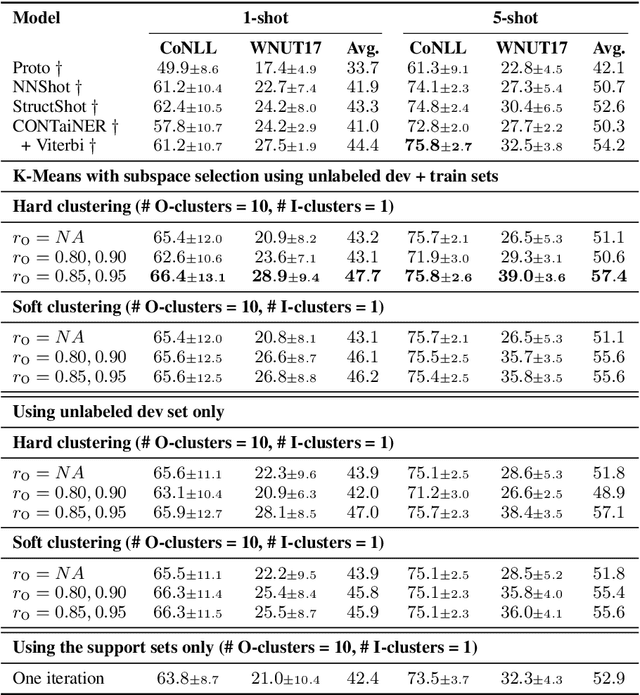
Named-entity recognition (NER) is a task that typically requires large annotated datasets, which limits its applicability across domains with varying entity definitions. This paper addresses few-shot NER, aiming to transfer knowledge to new domains with minimal supervision. Unlike previous approaches that rely solely on limited annotated data, we propose a weakly supervised algorithm that combines small labeled datasets with large amounts of unlabeled data. Our method extends the k-means algorithm with label supervision, cluster size constraints and domain-specific discriminative subspace selection. This unified framework achieves state-of-the-art results in few-shot NER on several English datasets.
A fast and sound tagging method for discontinuous named-entity recognition
Sep 24, 2024We introduce a novel tagging scheme for discontinuous named entity recognition based on an explicit description of the inner structure of discontinuous mentions. We rely on a weighted finite state automaton for both marginal and maximum a posteriori inference. As such, our method is sound in the sense that (1) well-formedness of predicted tag sequences is ensured via the automaton structure and (2) there is an unambiguous mapping between well-formed sequences of tags and (discontinuous) mentions. We evaluate our approach on three English datasets in the biomedical domain, and report comparable results to state-of-the-art while having a way simpler and faster model.
Sparse Logistic Regression with High-order Features for Automatic Grammar Rule Extraction from Treebanks
Mar 26, 2024
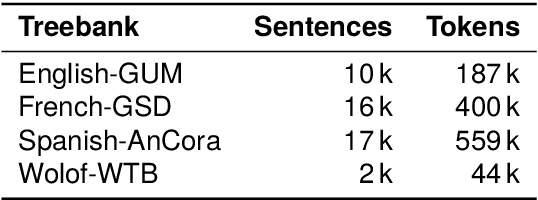

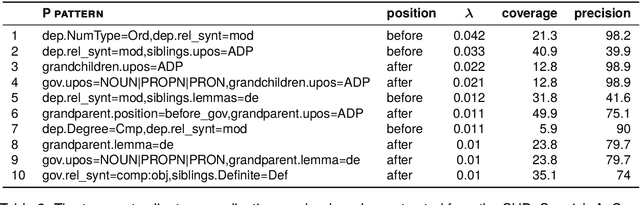
Descriptive grammars are highly valuable, but writing them is time-consuming and difficult. Furthermore, while linguists typically use corpora to create them, grammar descriptions often lack quantitative data. As for formal grammars, they can be challenging to interpret. In this paper, we propose a new method to extract and explore significant fine-grained grammar patterns and potential syntactic grammar rules from treebanks, in order to create an easy-to-understand corpus-based grammar. More specifically, we extract descriptions and rules across different languages for two linguistic phenomena, agreement and word order, using a large search space and paying special attention to the ranking order of the extracted rules. For that, we use a linear classifier to extract the most salient features that predict the linguistic phenomena under study. We associate statistical information to each rule, and we compare the ranking of the model's results to those of other quantitative and statistical measures. Our method captures both well-known and less well-known significant grammar rules in Spanish, French, and Wolof.
SaulLM-7B: A pioneering Large Language Model for Law
Mar 07, 2024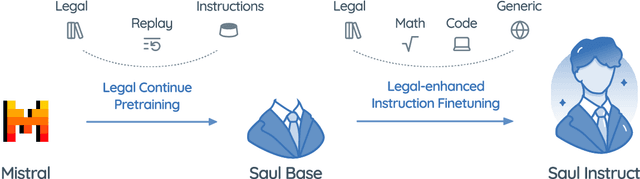
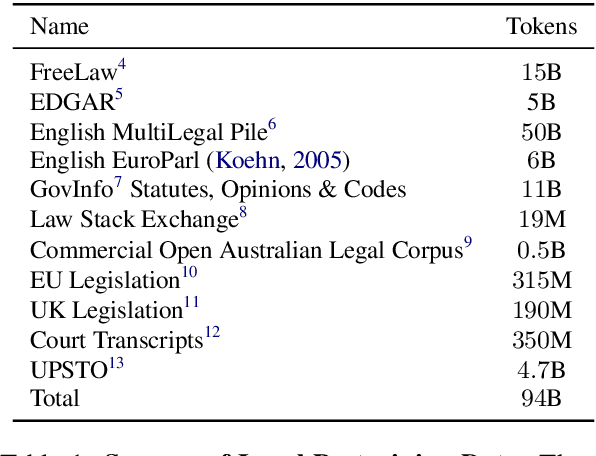
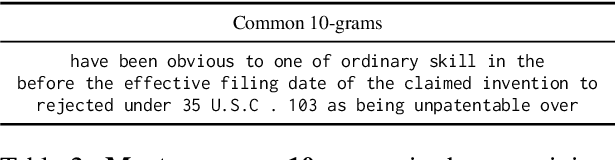
In this paper, we introduce SaulLM-7B, a large language model (LLM) tailored for the legal domain. With 7 billion parameters, SaulLM-7B is the first LLM designed explicitly for legal text comprehension and generation. Leveraging the Mistral 7B architecture as its foundation, SaulLM-7B is trained on an English legal corpus of over 30 billion tokens. SaulLM-7B exhibits state-of-the-art proficiency in understanding and processing legal documents. Additionally, we present a novel instructional fine-tuning method that leverages legal datasets to further enhance SaulLM-7B's performance in legal tasks. SaulLM-7B is released under the MIT License.
CroissantLLM: A Truly Bilingual French-English Language Model
Feb 02, 2024


We introduce CroissantLLM, a 1.3B language model pretrained on a set of 3T English and French tokens, to bring to the research and industrial community a high-performance, fully open-sourced bilingual model that runs swiftly on consumer-grade local hardware. To that end, we pioneer the approach of training an intrinsically bilingual model with a 1:1 English-to-French pretraining data ratio, a custom tokenizer, and bilingual finetuning datasets. We release the training dataset, notably containing a French split with manually curated, high-quality, and varied data sources. To assess performance outside of English, we craft a novel benchmark, FrenchBench, consisting of an array of classification and generation tasks, covering various orthogonal aspects of model performance in the French Language. Additionally, rooted in transparency and to foster further Large Language Model research, we release codebases, and dozens of checkpoints across various model sizes, training data distributions, and training steps, as well as fine-tuned Chat models, and strong translation models. We evaluate our model through the FMTI framework, and validate 81 % of the transparency criteria, far beyond the scores of even most open initiatives. This work enriches the NLP landscape, breaking away from previous English-centric work in order to strengthen our understanding of multilinguality in language models.