 Add to Chrome
 Add to Firefox
 Add to Edge
Who Annotates in NLP? A Large-scale Assessment of Human Annotation Reporting between 2018 and 2025
Jun 01, 2026
Human annotation is the empirical foundation of much NLP research, from dataset construction to model evaluation, but papers often leave unclear who produced the annotations and how the annotation process was controlled. We provide the first large-scale, task-level audit of human annotation reporting across major NLP venues, asking which annotation details are documented, which are missing, and how reporting varies across time, topic, venue, and intended use of human judgment. We introduce a unified taxonomy of annotation-reporting practices and validate an LLM-assisted extraction pipeline against Annotated-gold, a human-adjudicated gold standard of 41 papers and 72 annotation tasks, where the best model reaches human-comparable agreement with adjudicated labels, with Krippendorff's alpha of 0.606 versus 0.585 for human-human agreement. Using this pipeline, we construct Annotated-llm, a dataset covering ACL-venue papers from 2018-2025, with 2,667 extracted annotation tasks from 1,603 papers, and find that papers frequently report operational details such as recruitment strategies, annotator expertise, and annotation volume, but often omit details needed to assess annotation validity, including training, language proficiency, compensation, socio-demographics, adjudication, and agreement values, especially in model-evaluation studies. Our results show that annotation reporting in NLP has improved over time but remains uneven, and they establish a scalable framework and bare-minimum reporting recommendations for making human annotation more reliable, reproducible, and interpretable.

Beyond LLM-as-a-Judge: Deterministic Metrics for Multilingual Generative Text Evaluation
Apr 06, 2026While Large Language Models (LLMs) are increasingly adopted as automated judges for evaluating generated text, their outputs are often costly, and highly sensitive to prompt design, language, and aggregation strategies, severely, which limits reproducibility. To address these challenges, we propose \textbf{\textit{OmniScore}}, a family of complementary, deterministic learned metrics developed using small size ($<$1B) parameter models. OmniScore approximates LLM-judge behavior while preserving the low latency and consistency of traditional model-based scoring. We trained the models large-scale synthetic supervision ($\sim$564k instances, in \textbf{107 languages}) and evaluated using 8,617 manually annotated instances. The OmniScore family supports reliable, multi-dimensional scores across a variety of settings, including reference-based, source-grounded, and hybrid evaluations. We evaluate these models across question answering (QA), translation, and summarization in \textbf{6 languages}. Our results demonstrate that lightweight, deterministic learned metrics provide a highly practical and scalable alternative to frontier LLMs. Our models and datasets can be found at https://huggingface.co/collections/QCRI/omniscore
What Really Controls Temporal Reasoning in Large Language Models: Tokenisation or Representation of Time?
Mar 19, 2026We present MultiTempBench, a multilingual temporal reasoning benchmark spanning three tasks, date arithmetic, time zone conversion, and temporal relation extraction across five languages (English, German, Chinese, Arabic, and Hausa) and multiple calendar conventions (Gregorian, Hijri, and Chinese Lunar). MultiTempBench contains $15,000$ examples built by translating $750$ curated English questions and expanding each into controlled date-format variants. We evaluate 20 LLMs and introduce the multilingual Date Fragmentation Ratio (mDFR), calibrated with human severity ratings, together with geometric-probing analyses of internal temporal representations. We find tokenisation quality of temporal artefacts is a resource-dependent bottleneck: in low-resource languages and rarer calendar formats, fragmentation disrupts Year/Month/Day separation and accuracy collapses, while high-resource settings are often robust to digit-level splitting. Beyond tokenisation, crossed mixed-effects regression shows that temporal linearity is the strongest predictor of temporal reasoning in high-resource languages, whereas fragmentation is the stronger predictor in low-resource languages. Code is available at: https://github.com/gagan3012/mtb
Fanar-Sadiq: A Multi-Agent Architecture for Grounded Islamic QA
Mar 10, 2026Large language models (LLMs) can answer religious knowledge queries fluently, yet they often hallucinate and misattribute sources, which is especially consequential in Islamic settings where users expect grounding in canonical texts (Qur'an and Hadith) and jurisprudential (fiqh) nuance. Retrieval-augmented generation (RAG) reduces some of these limitations by grounding generation in external evidence. However, a single ``retrieve-then-generate'' pipeline is limited to deal with the diversity of Islamic queries. Users may request verbatim scripture, fatwa-style guidance with citations or rule-constrained computations such as zakat and inheritance that require strict arithmetic and legal invariants. In this work, we present a bilingual (Arabic/English) multi-agent Islamic assistant, called Fanar-Sadiq, which is a core component of the Fanar AI platform. Fanar-Sadiq routes Islamic-related queries to specialized modules within an agentic, tool-using architecture. The system supports intent-aware routing, retrieval-grounded fiqh answers with deterministic citation normalization and verification traces, exact verse lookup with quotation validation, and deterministic calculators for Sunni zakat and inheritance with madhhab-sensitive branching. We evaluate the complete end-to-end system on public Islamic QA benchmarks and demonstrate effectiveness and efficiency. Our system is currently publicly and freely accessible through API and a Web application, and has been accessed $\approx$1.9M times in less than a year.
From RAG to Agentic RAG for Faithful Islamic Question Answering
Jan 12, 2026LLMs are increasingly used for Islamic question answering, where ungrounded responses may carry serious religious consequences. Yet standard MCQ/MRC-style evaluations do not capture key real-world failure modes, notably free-form hallucinations and whether models appropriately abstain when evidence is lacking. To shed a light on this aspect we introduce ISLAMICFAITHQA, a 3,810-item bilingual (Arabic/English) generative benchmark with atomic single-gold answers, which enables direct measurement of hallucination and abstention. We additionally developed an end-to-end grounded Islamic modelling suite consisting of (i) 25K Arabic text-grounded SFT reasoning pairs, (ii) 5K bilingual preference samples for reward-guided alignment, and (iii) a verse-level Qur'an retrieval corpus of $\sim$6k atomic verses (ayat). Building on these resources, we develop an agentic Quran-grounding framework (agentic RAG) that uses structured tool calls for iterative evidence seeking and answer revision. Experiments across Arabic-centric and multilingual LLMs show that retrieval improves correctness and that agentic RAG yields the largest gains beyond standard RAG, achieving state-of-the-art performance and stronger Arabic-English robustness even with a small model (i.e., Qwen3 4B). We will make the experimental resources and datasets publicly available for the community.
Prototypicality Bias Reveals Blindspots in Multimodal Evaluation Metrics
Jan 08, 2026Automatic metrics are now central to evaluating text-to-image models, often substituting for human judgment in benchmarking and large-scale filtering. However, it remains unclear whether these metrics truly prioritize semantic correctness or instead favor visually and socially prototypical images learned from biased data distributions. We identify and study \emph{prototypicality bias} as a systematic failure mode in multimodal evaluation. We introduce a controlled contrastive benchmark \textsc{\textbf{ProtoBias}} (\textit{\textbf{Proto}typical \textbf{Bias}}), spanning Animals, Objects, and Demography images, where semantically correct but non-prototypical images are paired with subtly incorrect yet prototypical adversarial counterparts. This setup enables a directional evaluation of whether metrics follow textual semantics or default to prototypes. Our results show that widely used metrics, including CLIPScore, PickScore, and VQA-based scores, frequently misrank these pairs, while even LLM-as-Judge systems exhibit uneven robustness in socially grounded cases. Human evaluations consistently favour semantic correctness with larger decision margins. Motivated by these findings, we propose \textbf{\textsc{ProtoScore}}, a robust 7B-parameter metric that substantially reduces failure rates and suppresses misranking, while running at orders of magnitude faster than the inference time of GPT-5, approaching the robustness of much larger closed-source judges.
Leveraging Vision-Language Pre-training for Human Activity Recognition in Still Images
Jun 16, 2025

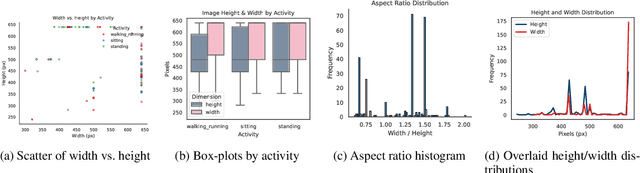
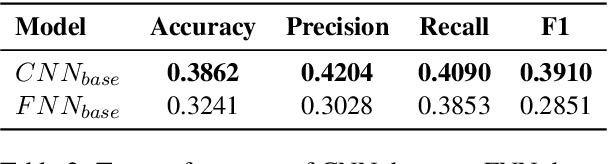
Recognising human activity in a single photo enables indexing, safety and assistive applications, yet lacks motion cues. Using 285 MSCOCO images labelled as walking, running, sitting, and standing, scratch CNNs scored 41% accuracy. Fine-tuning multimodal CLIP raised this to 76%, demonstrating that contrastive vision-language pre-training decisively improves still-image action recognition in real-world deployments.
Date Fragments: A Hidden Bottleneck of Tokenization for Temporal Reasoning
May 22, 2025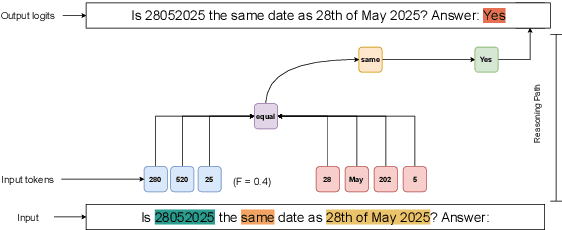
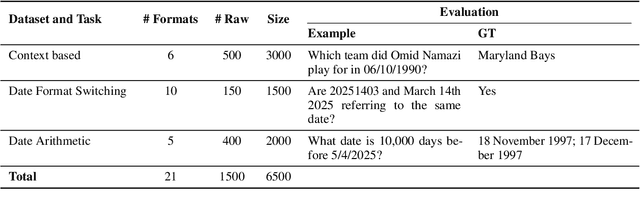
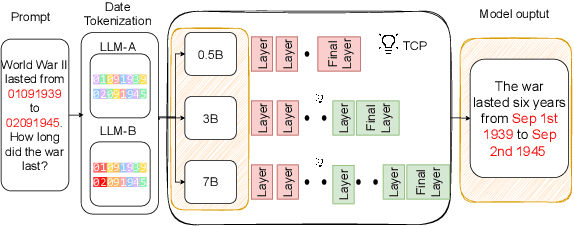
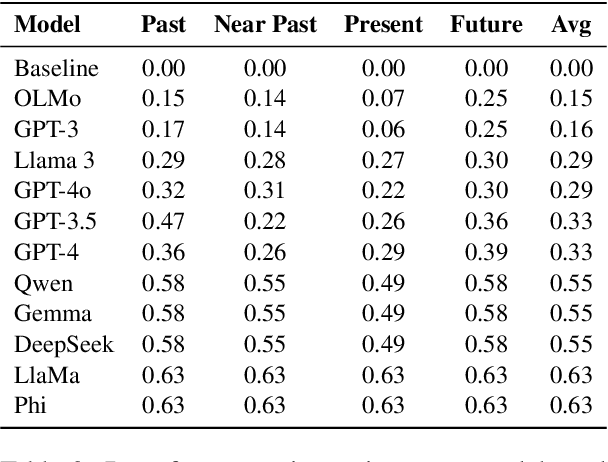
Modern BPE tokenizers often split calendar dates into meaningless fragments, e.g., 20250312 $\rightarrow$ 202, 503, 12, inflating token counts and obscuring the inherent structure needed for robust temporal reasoning. In this work, we (1) introduce a simple yet interpretable metric, termed date fragmentation ratio, that measures how faithfully a tokenizer preserves multi-digit date components; (2) release DateAugBench, a suite of 6500 examples spanning three temporal reasoning tasks: context-based date resolution, format-invariance puzzles, and date arithmetic across historical, contemporary, and future regimes; and (3) through layer-wise probing and causal attention-hop analyses, uncover an emergent date-abstraction mechanism whereby large language models stitch together the fragments of month, day, and year components for temporal reasoning. Our experiments show that excessive fragmentation correlates with accuracy drops of up to 10 points on uncommon dates like historical and futuristic dates. Further, we find that the larger the model, the faster the emergent date abstraction that heals date fragments is accomplished. Lastly, we observe a reasoning path that LLMs follow to assemble date fragments, typically differing from human interpretation (year $\rightarrow$ month $\rightarrow$ day).
DateLogicQA: Benchmarking Temporal Biases in Large Language Models
Dec 17, 2024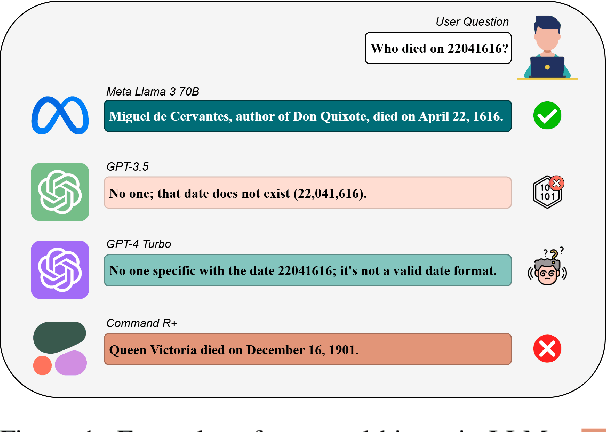
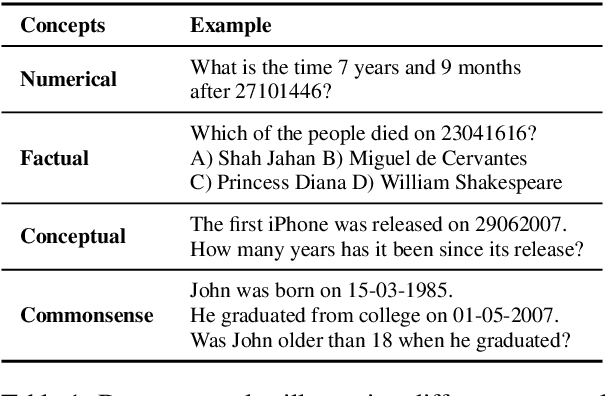
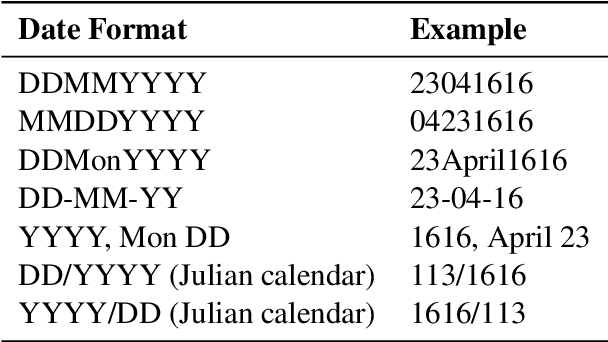
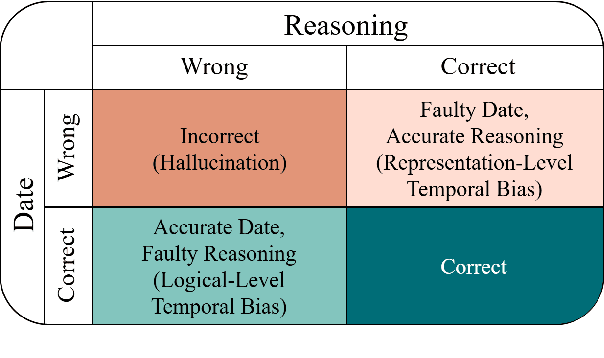
This paper introduces DateLogicQA, a benchmark with 190 questions covering diverse date formats, temporal contexts, and reasoning types. We propose the Semantic Integrity Metric to assess tokenization quality and analyse two biases: Representation-Level Bias, affecting embeddings, and Logical-Level Bias, influencing reasoning outputs. Our findings provide a comprehensive evaluation of LLMs' capabilities and limitations in temporal reasoning, highlighting key challenges in handling temporal data accurately. The GitHub repository for our work is available at https://github.com/gagan3012/EAIS-Temporal-Bias
Swan and ArabicMTEB: Dialect-Aware, Arabic-Centric, Cross-Lingual, and Cross-Cultural Embedding Models and Benchmarks
Nov 02, 2024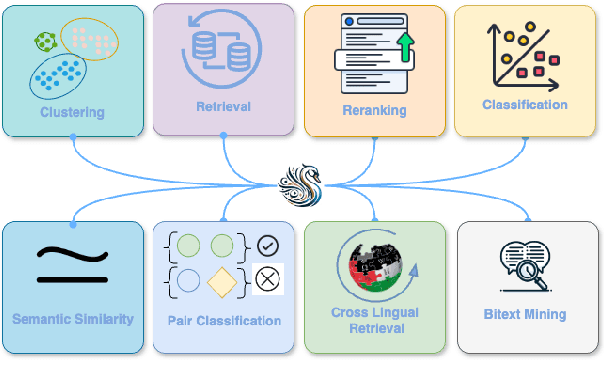
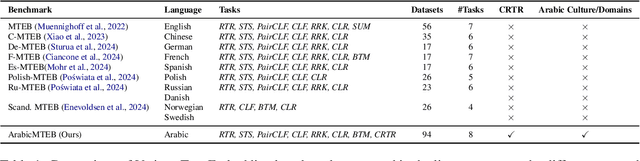
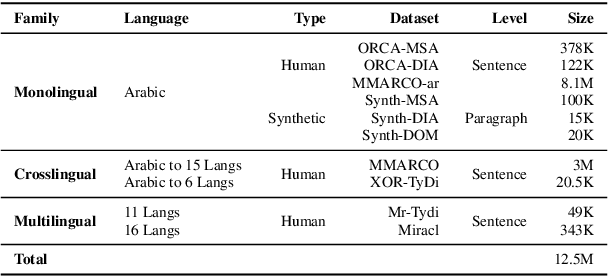
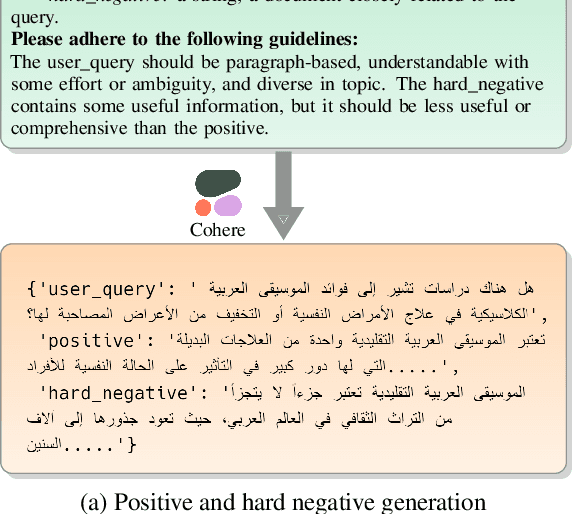
We introduce Swan, a family of embedding models centred around the Arabic language, addressing both small-scale and large-scale use cases. Swan includes two variants: Swan-Small, based on ARBERTv2, and Swan-Large, built on ArMistral, a pretrained Arabic large language model. To evaluate these models, we propose ArabicMTEB, a comprehensive benchmark suite that assesses cross-lingual, multi-dialectal, multi-domain, and multi-cultural Arabic text embedding performance, covering eight diverse tasks and spanning 94 datasets. Swan-Large achieves state-of-the-art results, outperforming Multilingual-E5-large in most Arabic tasks, while the Swan-Small consistently surpasses Multilingual-E5 base. Our extensive evaluations demonstrate that Swan models are both dialectally and culturally aware, excelling across various Arabic domains while offering significant monetary efficiency. This work significantly advances the field of Arabic language modelling and provides valuable resources for future research and applications in Arabic natural language processing. Our models and benchmark will be made publicly accessible for research.