 Add to Chrome
 Add to Firefox
 Add to Edge
Artifact-centered Claim-aware Observability for Autonomous Scientific Agents
Aug 18, 2026
Autonomous scientific agents now increasingly propose ideas, write code, run experiments, analyze results, and even draft papers. Observe and audit those agents are necessary but logging every model call is not enough, scientists also need to inspect the artifacts and claims that the systems produced and their relations. This is driven by the fact that failures in scientific agent systems are often distributed across several objects. A manuscript claim may cite the wrong evidence, a search process may select a degenerate candidate, a laboratory novelty claim may depend on an unstated rule, or a multi-agent plan may change without a visible trigger. Existing tracing, experiment tracking, and archival provenance tools are valuable, but their native objects do not make these scientific audit relations first-class. We argue that autonomous scientific systems should emit portable, claim-aware artifact lineage as a minimum audit layer. We propose a compact observability profile organized around individuals, operators, fitness records, lineage, archives, runs, streams, and steering commands. In this profile, scientific claims are ordinary individuals with explicit evidence bindings and verification records. The profile is intended as a semantic layer that complements current telemetry and provenance standards. Execution details can remain in OpenTelemetry. Final packages can export to PROV-O or RO-Crate standards.

XRF-to-Optical Field-of-View Localization with Vision Language Models
Aug 18, 2026Registering images acquired with different microscopy modalities is essential for relating complementary measurements of the same specimen. In correlative X-ray fluorescence (XRF) and optical microscopy, the XRF map often covers only a small region of an optical image acquired from the same or an adjacent tissue section. Field-of-view (FOV) localization is necessary but can be difficult when appearance and structure differ across modalities. Here we evaluate training-free vision language model (VLM) localization on two datasets representing same-section high-correspondence and adjacent-section low-correspondence imaging. We test unconstrained and metadata-constrained search and compare VLMs with geometric controls, classical template matching, and two alternative training-free approaches (DINOv2 and multiGradICON). Direct VLM prompting produced content-dependent spatial signals but was not reliable alone. Classical matching was most accurate when cross-modal structure was preserved but failed in the low-correspondence collection. A proposal-and-verify workflow used repeated VLM predictions as candidates and image-based similarity to select the final location. This workflow recovered useful localization in the low-correspondence regime.
Acquisition Geometry-Assisted Whole-Group Localization of X-ray Fluorescence Maps in Optical Microscopy Images
Aug 18, 2026X-ray fluorescence (XRF) microscopy maps elemental distributions, while optical microscopy can provide complementary morphological context. Localizing XRF fields of view (FOVs) in optical images is difficult because the two modalities differ in contrast mechanism and resolution. Most current workflows place each XRF tile independently, even when acquisition metadata already record the tiles' relative scan positions. This study formalizes XRF tile-group localization, in which one optical-frame placement is estimated for the whole group, constrained by acquisition geometry and quantified using group intersection-over-union (GroupIoU). In a controlled case study, independent localization failed with GroupIoU 0.000, whereas group localization achieved 0.931. Replacing the normalized cross-correlation (NCC) metric with mutual information (MI) gave nearly identical results, showing that the outcome is not specific to one local similarity metric. In another multiscale case study, using a coarse XRF survey scan to connect the fine-scale tile group to the optical image increased mean GroupIoU from 0.694 to 0.856. These case studies support using acquisition geometry as an explicit constraint when localizing related XRF tiles.
A corrective agentic hybrid RAG and an operations-grounded evaluation for a scientific facility
Jul 27, 2026Scientific user facilities accumulate decades of operational knowledge that no single search index covers: electronic logbooks, technical documents, internal wikis, operations chat messages, maintenance records, and live control-system data. We present APS-RAG, Advanced Photon Source Retrieval Augmented Generation, a deployed platform that makes the institutional knowledge at the Advanced Photon Source (APS) accessible to staff through natural-language queries, along with an operations-grounded evaluation. The retrieval engine fuses dense, sparse, and knowledge-graph (KG) channels with query-type-adaptive reciprocal-rank fusion, adds a corrective agentic loop, and runs a native-tool ReAct executor over a Model Context Protocol (MCP) tooling layer. We construct APS-Bench, a 50-question, question-answering (QA) dataset with auditable gold answers. Every retrieval-augmented variant numerically improves strict vital-nugget recall over a naive BM25 baseline (63.8%), with the full corrective Agentic GraphRAG scoring (70.3%). The cross-encoder reranker contributes significantly to answer quality: removing it and allowing the LLM to score relevance drastically reduces strict vital recall by 32.8%. The graph channel and corrective loop contribute positively as expected, but the performance gains are marginal. Additionally, we also compare the performance of open-source and closed-source LLMs in final answer synthesis. We release the APS-Bench construction methodology, the six-layer evaluation harness, and the underlying codebase, along with the '/aps-rag' retrieval agent skill framework, to support reproduction and adoption at other facilities. Together, the deployed platform and its operations-grounded evaluation present a promising workflow for trustworthy, statistically grounded AI assistance in facility operations, transferable to other large scientific instruments.
EAA: Automating materials characterization with vision language model agents
Feb 17, 2026We present Experiment Automation Agents (EAA), a vision-language-model-driven agentic system designed to automate complex experimental microscopy workflows. EAA integrates multimodal reasoning, tool-augmented action, and optional long-term memory to support both autonomous procedures and interactive user-guided measurements. Built on a flexible task-manager architecture, the system enables workflows ranging from fully agent-driven automation to logic-defined routines that embed localized LLM queries. EAA further provides a modern tool ecosystem with two-way compatibility for Model Context Protocol (MCP), allowing instrument-control tools to be consumed or served across applications. We demonstrate EAA at an imaging beamline at the Advanced Photon Source, including automated zone plate focusing, natural language-described feature search, and interactive data acquisition. These results illustrate how vision-capable agents can enhance beamline efficiency, reduce operational burden, and lower the expertise barrier for users.
Demonstration of an AI-driven workflow for dynamic x-ray spectroscopy
Apr 23, 2025X-ray absorption near edge structure (XANES) spectroscopy is a powerful technique for characterizing the chemical state and symmetry of individual elements within materials, but requires collecting data at many energy points which can be time-consuming. While adaptive sampling methods exist for efficiently collecting spectroscopic data, they often lack domain-specific knowledge about XANES spectra structure. Here we demonstrate a knowledge-injected Bayesian optimization approach for adaptive XANES data collection that incorporates understanding of spectral features like absorption edges and pre-edge peaks. We show this method accurately reconstructs the absorption edge of XANES spectra using only 15-20% of the measurement points typically needed for conventional sampling, while maintaining the ability to determine the x-ray energy of the sharp peak after absorption edge with errors less than 0.03 eV, the absorption edge with errors less than 0.1 eV; and overall root-mean-square errors less than 0.005 compared to compared to traditionally sampled spectra. Our experiments on battery materials and catalysts demonstrate the method's effectiveness for both static and dynamic XANES measurements, improving data collection efficiency and enabling better time resolution for tracking chemical changes. This approach advances the degree of automation in XANES experiments reducing the common errors of under- or over-sampling points in near the absorption edge and enabling dynamic experiments that require high temporal resolution or limited measurement time.
Ptychographic Image Reconstruction from Limited Data via Score-Based Diffusion Models with Physics-Guidance
Feb 26, 2025
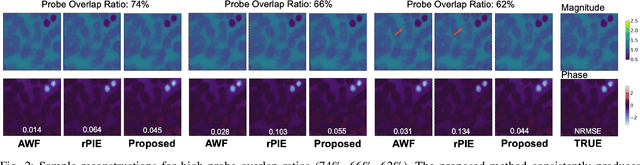

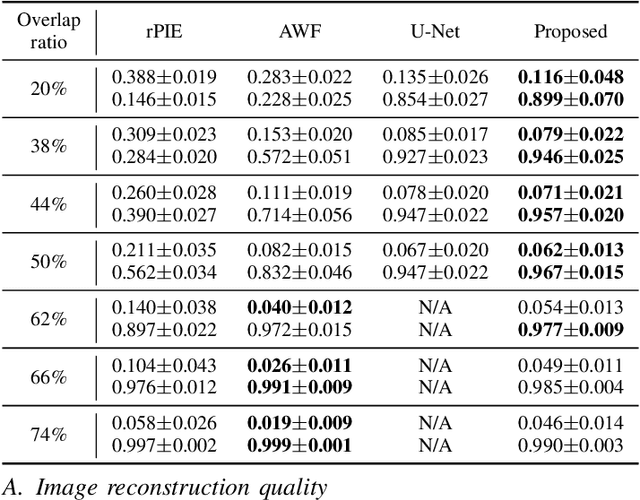
Ptychography is a computational imaging technique that achieves high spatial resolution over large fields of view. It involves scanning a coherent beam across overlapping regions and recording diffraction patterns. Conventional reconstruction algorithms require substantial overlap, increasing data volume and experimental time. We propose a reconstruction method employing a physics-guided score-based diffusion model. Our approach trains a diffusion model on representative object images to learn an object distribution prior. During reconstruction, we modify the reverse diffusion process to enforce data consistency, guiding reverse diffusion toward a physically plausible solution. This method requires a single pretraining phase, allowing it to generalize across varying scan overlap ratios and positions. Our results demonstrate that the proposed method achieves high-fidelity reconstructions with only a 20% overlap, while the widely employed rPIE method requires a 62% overlap to achieve similar accuracy. This represents a significant reduction in data requirements, offering an alternative to conventional techniques.
Predicting ptychography probe positions using single-shot phase retrieval neural network
May 31, 2024Ptychography is a powerful imaging technique that is used in a variety of fields, including materials science, biology, and nanotechnology. However, the accuracy of the reconstructed ptychography image is highly dependent on the accuracy of the recorded probe positions which often contain errors. These errors are typically corrected jointly with phase retrieval through numerical optimization approaches. When the error accumulates along the scan path or when the error magnitude is large, these approaches may not converge with satisfactory result. We propose a fundamentally new approach for ptychography probe position prediction for data with large position errors, where a neural network is used to make single-shot phase retrieval on individual diffraction patterns, yielding the object image at each scan point. The pairwise offsets among these images are then found using a robust image registration method, and the results are combined to yield the complete scan path by constructing and solving a linear equation. We show that our method can achieve good position prediction accuracy for data with large and accumulating errors on the order of $10^2$ pixels, a magnitude that often makes optimization-based algorithms fail to converge. For ptychography instruments without sophisticated position control equipment such as interferometers, our method is of significant practical potential.
Deep learning at the edge enables real-time streaming ptychographic imaging
Sep 20, 2022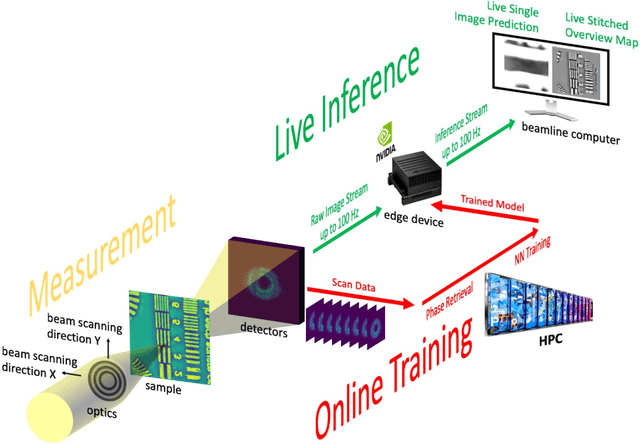
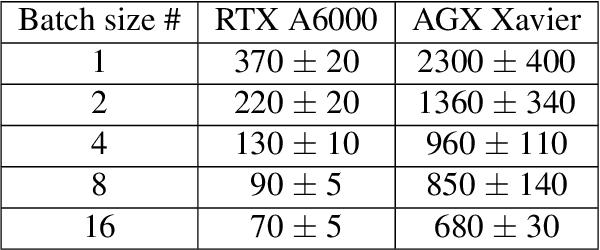
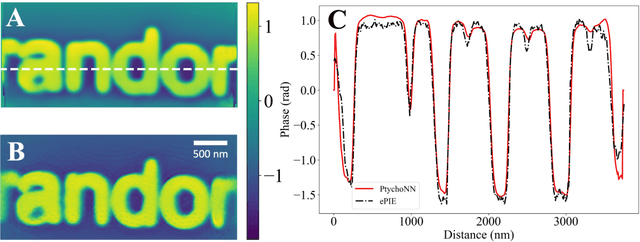
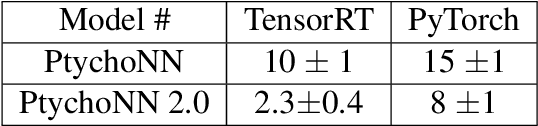
Coherent microscopy techniques provide an unparalleled multi-scale view of materials across scientific and technological fields, from structural materials to quantum devices, from integrated circuits to biological cells. Driven by the construction of brighter sources and high-rate detectors, coherent X-ray microscopy methods like ptychography are poised to revolutionize nanoscale materials characterization. However, associated significant increases in data and compute needs mean that conventional approaches no longer suffice for recovering sample images in real-time from high-speed coherent imaging experiments. Here, we demonstrate a workflow that leverages artificial intelligence at the edge and high-performance computing to enable real-time inversion on X-ray ptychography data streamed directly from a detector at up to 2 kHz. The proposed AI-enabled workflow eliminates the sampling constraints imposed by traditional ptychography, allowing low dose imaging using orders of magnitude less data than required by traditional methods.
Real-time X-ray Phase-contrast Imaging Using SPINNet -- A Speckle-based Phase-contrast Imaging Neural Network
Jan 18, 2022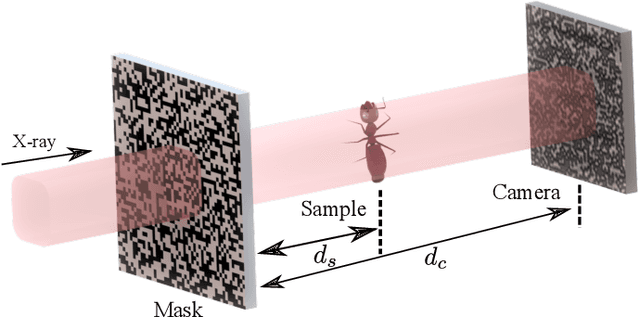
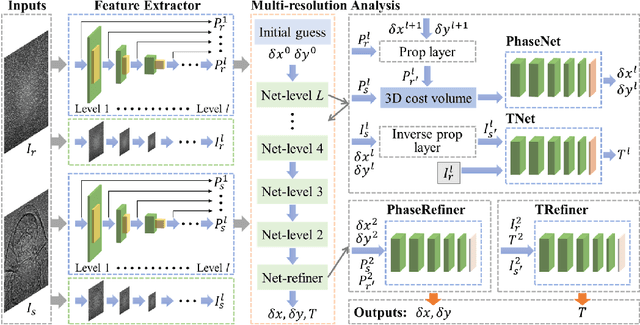
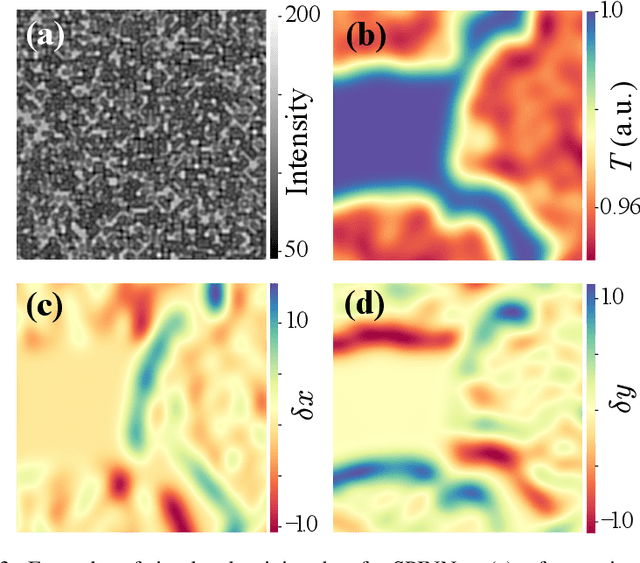
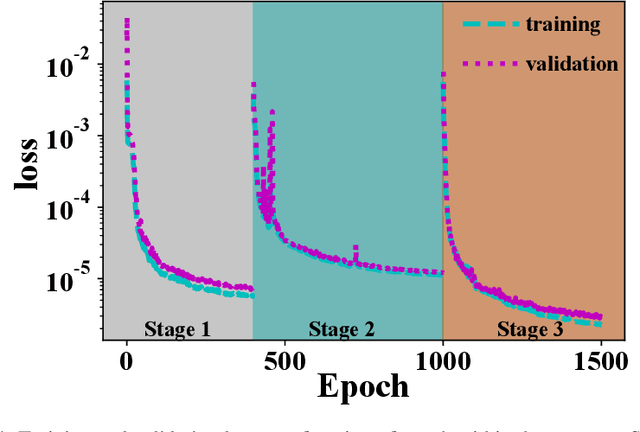
X-ray phase-contrast imaging has become indispensable for visualizing samples with low absorption contrast. In this regard, speckle-based techniques have shown significant advantages in spatial resolution, phase sensitivity, and implementation flexibility compared with traditional methods. However, their computational cost has hindered their wider adoption. By exploiting the power of deep learning, we developed a new speckle-based phase-contrast imaging neural network (SPINNet) that boosts the phase retrieval speed by at least two orders of magnitude compared to existing methods. To achieve this performance, we combined SPINNet with a novel coded-mask-based technique, an enhanced version of the speckle-based method. Using this scheme, we demonstrate a simultaneous reconstruction of absorption and phase images on the order of 100 ms, where a traditional correlation-based analysis would take several minutes even with a cluster. In addition to significant improvement in speed, our experimental results show that the imaging resolution and phase retrieval quality of SPINNet outperform existing single-shot speckle-based methods. Furthermore, we successfully demonstrate its application in 3D X-ray phase-contrast tomography. Our result shows that SPINNet could enable many applications requiring high-resolution and fast data acquisition and processing, such as in-situ and in-operando 2D and 3D phase-contrast imaging and real-time at-wavelength metrology and wavefront sensing.