 Add to Chrome
 Add to Firefox
 Add to Edge
Certification of Machine Learning Models via Directional Sharpness
Jun 23, 2026
In machine learning, model certification has been identified as an important method for gaining assurance about a model's trustworthiness and quality. A model's quality is largely determined by its ability to generalize, i.e., to perform well on data beyond what it was trained on. It is not possible to certify generalization directly, however, as it depends on unknown data and is not directly measurable. Proxies such as test accuracy can be misleading when the training process is perturbed (intentionally or accidentally), and metrics such as sharpness -- which has an empirically supported link to generalization -- are computationally expensive and can also serve as unreliable signals when training deviates from a prescribed procedure. In this work, we propose directional sharpness, a metric designed to efficiently and reliably indicate generalization despite potential training deviations. We provide empirical and analytical evidence that directional sharpness (1) correlates more strongly with generalization than existing metrics and (2) identifies models with poor generalization more reliably than existing metrics. Furthermore, directional sharpness is efficiently computable in model auditing settings, where the verifier has access to training data, and via zero-knowledge proofs that certify quality without revealing training data.

Engineering Robustness into Personal Agents with the AI Workflow Store
May 11, 2026The dominant paradigm for AI agents is an "on-the-fly" loop in which agents synthesize plans and execute actions within seconds or minutes in response to user prompts. We argue that this paradigm short-circuits disciplined software engineering (SE) processes -- iterative design, rigorous testing, adversarial evaluation, staged deployment, and more -- that have delivered the (relatively) reliable and secure systems we use today. By focusing on rapid, real-time synthesis, are AI agents effectively delivering users improvised prototypes rather than systems fit for high-stakes scenarios in which users may unwittingly apply them? This paper argues for the need to integrate rigorous SE processes into the agentic loop to produce production-grade, hardened, and deterministically-constrained agent *workflows* that substantially outperform the potentially brittle and vulnerable results of on-the-fly synthesis. Doing so may require extra compute and time, and if so, we must amortize the cost of rigor through reuse across a broad user community. We envision an *AI Workflow Store* that consists of hardened and reusable workflows that agents can invoke with far greater reliability and security than improvised tool chains. We outline the research challenges of this vision, which stem from a broader flexibility-robustness tension that we argue requires moving beyond the ``on-the-fly'' paradigm to navigate effectively.
Provably Robust Watermarks for Open-Source Language Models
Oct 24, 2024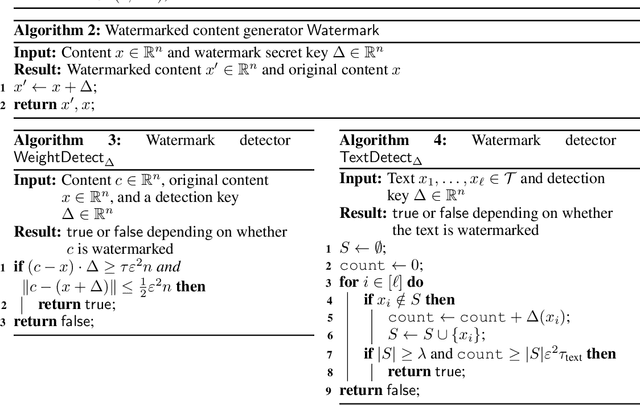


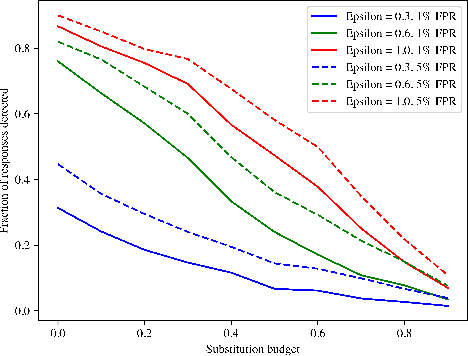
The recent explosion of high-quality language models has necessitated new methods for identifying AI-generated text. Watermarking is a leading solution and could prove to be an essential tool in the age of generative AI. Existing approaches embed watermarks at inference and crucially rely on the large language model (LLM) specification and parameters being secret, which makes them inapplicable to the open-source setting. In this work, we introduce the first watermarking scheme for open-source LLMs. Our scheme works by modifying the parameters of the model, but the watermark can be detected from just the outputs of the model. Perhaps surprisingly, we prove that our watermarks are unremovable under certain assumptions about the adversary's knowledge. To demonstrate the behavior of our construction under concrete parameter instantiations, we present experimental results with OPT-6.7B and OPT-1.3B. We demonstrate robustness to both token substitution and perturbation of the model parameters. We find that the stronger of these attacks, the model-perturbation attack, requires deteriorating the quality score to 0 out of 100 in order to bring the detection rate down to 50%.
Advances and Open Problems in Federated Learning
Dec 10, 2019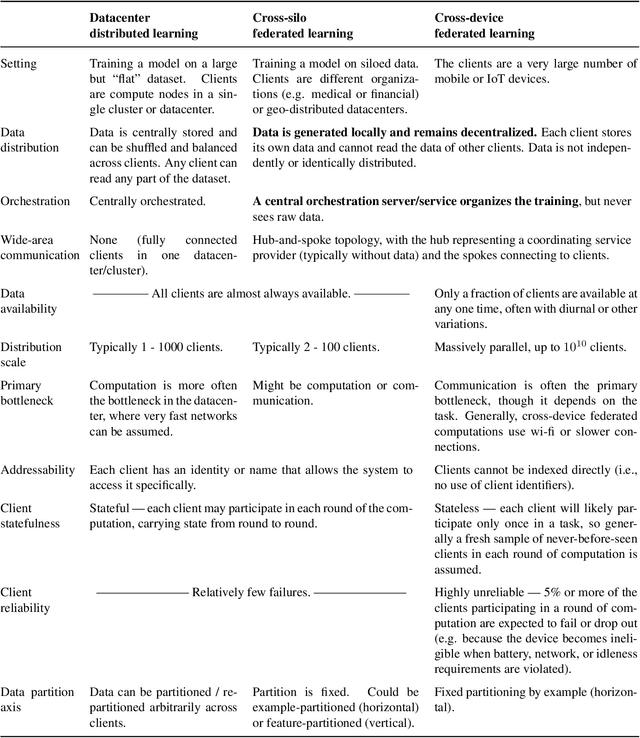
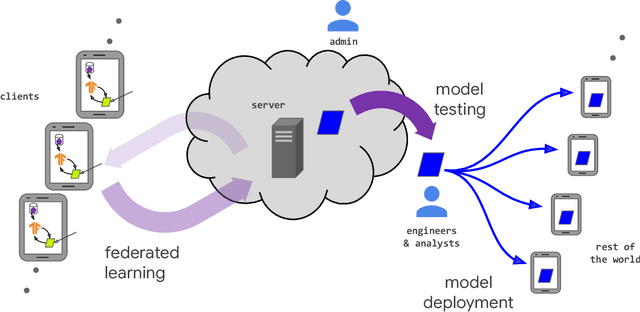
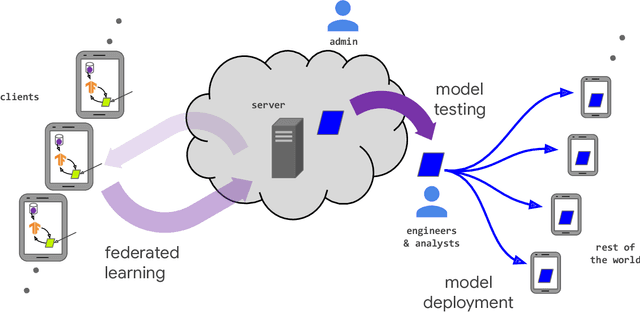
Federated learning (FL) is a machine learning setting where many clients (e.g. mobile devices or whole organizations) collaboratively train a model under the orchestration of a central server (e.g. service provider), while keeping the training data decentralized. FL embodies the principles of focused data collection and minimization, and can mitigate many of the systemic privacy risks and costs resulting from traditional, centralized machine learning and data science approaches. Motivated by the explosive growth in FL research, this paper discusses recent advances and presents an extensive collection of open problems and challenges.