 Add to Chrome
 Add to Firefox
 Add to Edge
RM-Distiller: Exploiting Generative LLM for Reward Model Distillation
Jan 20, 2026
Reward models (RMs) play a pivotal role in aligning large language models (LLMs) with human preferences. Due to the difficulty of obtaining high-quality human preference annotations, distilling preferences from generative LLMs has emerged as a standard practice. However, existing approaches predominantly treat teacher models as simple binary annotators, failing to fully exploit the rich knowledge and capabilities for RM distillation. To address this, we propose RM-Distiller, a framework designed to systematically exploit the multifaceted capabilities of teacher LLMs: (1) Refinement capability, which synthesizes highly correlated response pairs to create fine-grained and contrastive signals. (2) Scoring capability, which guides the RM in capturing precise preference strength via a margin-aware optimization objective. (3) Generation capability, which incorporates the teacher's generative distribution to regularize the RM to preserve its fundamental linguistic knowledge. Extensive experiments demonstrate that RM-Distiller significantly outperforms traditional distillation methods both on RM benchmarks and reinforcement learning-based alignment, proving that exploiting multifaceted teacher capabilities is critical for effective reward modeling. To the best of our knowledge, this is the first systematic research on RM distillation from generative LLMs.

Lost in Benchmarks? Rethinking Large Language Model Benchmarking with Item Response Theory
May 21, 2025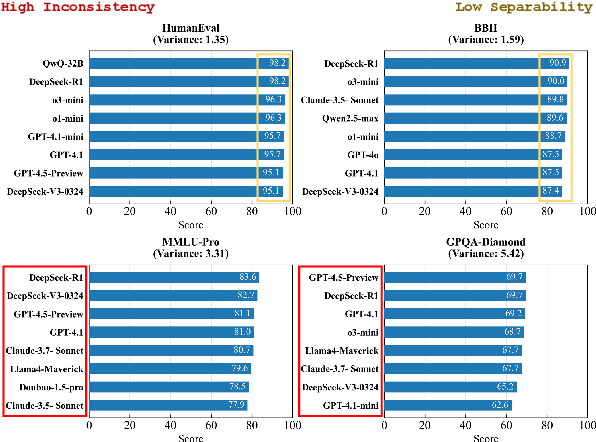
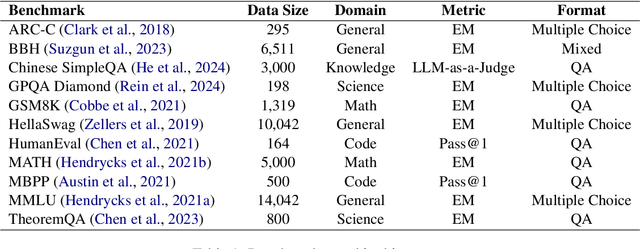
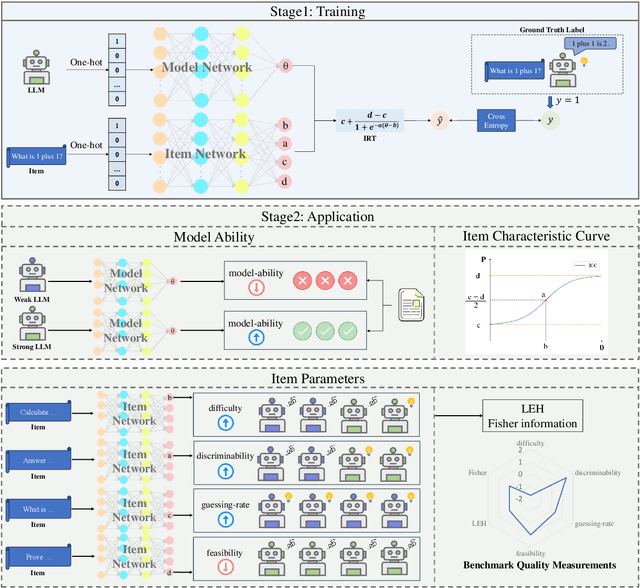
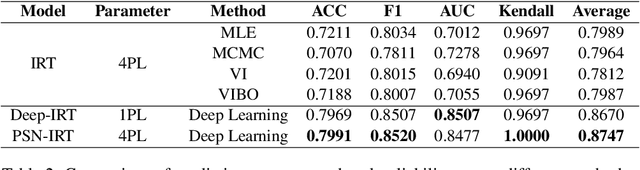
The evaluation of large language models (LLMs) via benchmarks is widespread, yet inconsistencies between different leaderboards and poor separability among top models raise concerns about their ability to accurately reflect authentic model capabilities. This paper provides a critical analysis of benchmark effectiveness, examining main-stream prominent LLM benchmarks using results from diverse models. We first propose a new framework for accurate and reliable estimations of item characteristics and model abilities. Specifically, we propose Pseudo-Siamese Network for Item Response Theory (PSN-IRT), an enhanced Item Response Theory framework that incorporates a rich set of item parameters within an IRT-grounded architecture. Based on PSN-IRT, we conduct extensive analysis which reveals significant and varied shortcomings in the measurement quality of current benchmarks. Furthermore, we demonstrate that leveraging PSN-IRT is able to construct smaller benchmarks while maintaining stronger alignment with human preference.