 Add to Chrome
 Add to Firefox
 Add to Edge
Meta-Soft: Leveraging Composable Meta-Tokens for Context-Preserving KV Cache Compression
May 21, 2026
The KV cache used in large language models has linearly growing time complexity, so LLMs face memory blow-up and reduced decoding efficiency when they process long contexts.Current KV Cache eviction has become an important research direction; however, existing methods based on fixed Soft Tokens (e.g., Judge Q) rely on a static parameter set as the query to evaluate the importance of KV pairs, so they cannot adapt dynamically to different input prompts, and they cannot precisely capture complex and changing task relevance.Also, evicted KV pairs are discarded permanently, so this causes irreversible information loss and context breaks. To address this problem, we propose Meta-Soft, a dynamic compression framework based on probe-driven context integration. Specifically, we build a meta-library with a learnable orthogonal basis matrix $\mathcal{L}$, and we use a selector network with Gumbel-Softmax to produce differentiable sparse combination weights, so we dynamically synthesize the most targeted $k$ Soft Tokens from the input prompt features.We append these Soft Tokens to the end of the input sequence to probe key information. We also introduce an attention-flow based integration mechanism, which redistributes the semantic information of removed tokens into retained tokens, and this keeps the dropped context information effectively.Experiments on multiple datasets show that our method outperforms existing state-of-the-art eviction methods and provides a new solution for KV Cache compression.

Expert Streaming: Accelerating Low-Batch MoE Inference via Multi-chiplet Architecture and Dynamic Expert Trajectory Scheduling
Mar 29, 2026Mixture-of-Experts is a promising approach for edge AI with low-batch inference. Yet, on-device deployments often face limited on-chip memory and severe workload imbalance; the prevalent use of offloading further incurs off-chip memory access bottlenecks. Moreover, MoE sparsity and dynamic gating shift distributed strategies toward much finer granularity and introduce runtime scheduling considerations. Recently, high die-to-die bandwidth chiplet interconnects have created new opportunities for multi-chiplet systems to address workload imbalance and offloading bottlenecks with fine-grained scheduling. In this paper, we propose Fully Sharded Expert Data Parallelism, a parallelization paradigm specifically architected for low-batch MoE inference on multi-chiplet accelerators. FSE-DP attains adaptive computation-communication overlap and balanced load by orchestrating fine-grained, complementary expert streams along dynamic trajectories across high-bandwidth D2D links. The attendant dataflow complexity is tamed by a minimal, hardware-amenable set of virtualization rules and a lightweight scheduling algorithm. Our approach achieves 1.22 to 2.00 times speedup over state-of-the-art baselines and saves up to 78.8 percent on-chip memory.
General-purpose Dataflow Model with Neuromorphic Primitives
Aug 02, 2024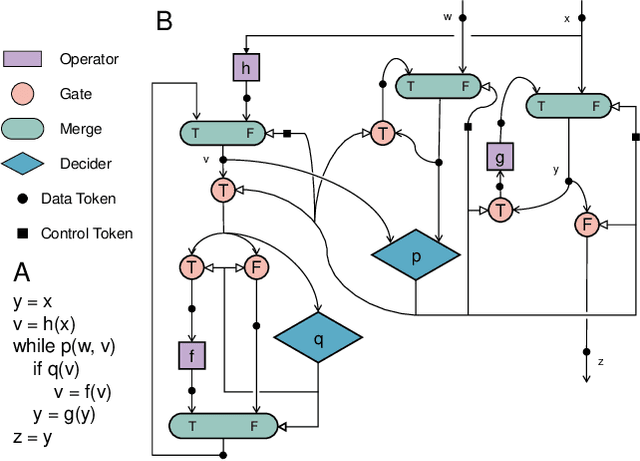
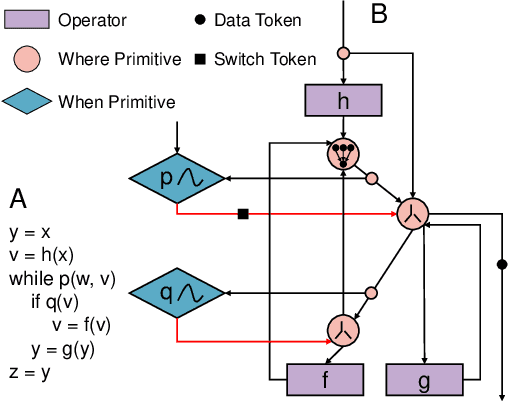
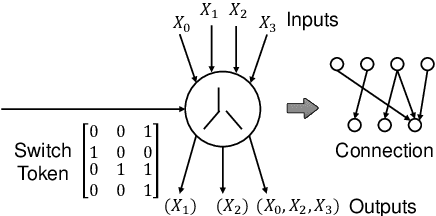
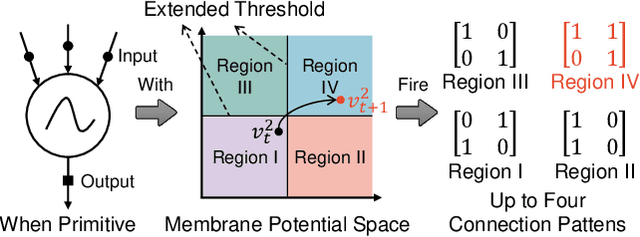
Neuromorphic computing exhibits great potential to provide high-performance benefits in various applications beyond neural networks. However, a general-purpose program execution model that aligns with the features of neuromorphic computing is required to bridge the gap between program versatility and neuromorphic hardware efficiency. The dataflow model offers a potential solution, but it faces high graph complexity and incompatibility with neuromorphic hardware when dealing with control flow programs, which decreases the programmability and performance. Here, we present a dataflow model tailored for neuromorphic hardware, called neuromorphic dataflow, which provides a compact, concise, and neuromorphic-compatible program representation for control logic. The neuromorphic dataflow introduces "when" and "where" primitives, which restructure the view of control. The neuromorphic dataflow embeds these primitives in the dataflow schema with the plasticity inherited from the spiking algorithms. Our method enables the deployment of general-purpose programs on neuromorphic hardware with both programmability and plasticity, while fully utilizing the hardware's potential.