 Add to Chrome
 Add to Firefox
 Add to Edge
EVA-Client: A Unified Data Collection, Inference, and Deployment Framework for Embodied Policies on Real Robots
Jul 02, 2026
We present EVA-Client, an open-source framework for deployment, data collection, and evaluation of trained manipulation policies on real robots. Sitting between a policy server and the physical hardware, EVA-Client unifies the real-robot stages of the policy iteration loop within a single codebase. It makes three contributions. First, a component-decoupled architecture in which robot backends, inference strategies, and transport middlewares form an orthogonal grid: adding a robot or a strategy touches only its own layer. Second, inspectable execution through Debug, Collect, and Eval workflows, with modes ranging from open-loop simulation to continuous real-time control. Third, every evaluation run doubles as a data collection, recording full rollouts in training-ready format alongside exhaustive logs and a side-by-side comparison viewer, so each evaluation feeds the next round of training rather than ending as an unrecorded impression. EVA-Client further consolidates major real-time inference strategies, synchronous and asynchronous execution, ACT-style temporal ensembling, Real-Time Chunking, and a naive-async ablation baseline, behind a single configuration surface.

Beyond 2D Matching: A Unified Single-Stage Framework for Geometry-Aware Cross-View Object Geo-Localization
Jun 29, 2026Cross-view object geo-localization (CVOGL) aims to locate a target object from a query view (e.g., ground or drone) within a geo-tagged reference image (e.g., satellite). Existing approaches heavily rely on 2D appearance matching and are constrained by limited datasets lacking geometric metadata, diverse prompts, and standard field-of-view imagery. To address these intertwined challenges, we first introduce \dataset, a large-scale, high-fidelity building dataset comprising over 220,000 ground-satellite and drone-satellite pairs. It provides multi-modal prompts (points, boxes, masks) and camera poses to enable flexible target referring and explicit spatial modeling. Furthermore, we propose a novel single-stage Geometry-Aware Geo-localization framework (GAGeo), built upon the permutation-equivariant 3D foundation model $π^3$. By seamlessly integrating visual features, referring prompts, and learnable task tokens, our model adapts the inherited 3D prior to jointly predict bounding boxes, segmentation masks, and camera poses in a single forward pass. Additionally, we introduce a contrastive loss that utilizes the satellite view as a universal anchor, implicitly aligning ground and drone representations to enable zero-shot ground-to-drone localization without requiring triplet training data. Extensive experiments demonstrate that our approach significantly outperforms state-of-the-art methods, exhibiting exceptional generalization ability in unseen scenes and novel cross-view setups.
AnimeColor: Reference-based Animation Colorization with Diffusion Transformers
Jul 27, 2025Animation colorization plays a vital role in animation production, yet existing methods struggle to achieve color accuracy and temporal consistency. To address these challenges, we propose \textbf{AnimeColor}, a novel reference-based animation colorization framework leveraging Diffusion Transformers (DiT). Our approach integrates sketch sequences into a DiT-based video diffusion model, enabling sketch-controlled animation generation. We introduce two key components: a High-level Color Extractor (HCE) to capture semantic color information and a Low-level Color Guider (LCG) to extract fine-grained color details from reference images. These components work synergistically to guide the video diffusion process. Additionally, we employ a multi-stage training strategy to maximize the utilization of reference image color information. Extensive experiments demonstrate that AnimeColor outperforms existing methods in color accuracy, sketch alignment, temporal consistency, and visual quality. Our framework not only advances the state of the art in animation colorization but also provides a practical solution for industrial applications. The code will be made publicly available at \href{https://github.com/IamCreateAI/AnimeColor}{https://github.com/IamCreateAI/AnimeColor}.
Discretionary Lane-Change Decision and Control via Parameterized Soft Actor-Critic for Hybrid Action Space
Feb 24, 2024This study focuses on a crucial task in the field of autonomous driving, autonomous lane change. Autonomous lane change plays a pivotal role in improving traffic flow, alleviating driver burden, and reducing the risk of traffic accidents. However, due to the complexity and uncertainty of lane-change scenarios, the functionality of autonomous lane change still faces challenges. In this research, we conduct autonomous lane-change simulations using both Deep Reinforcement Learning (DRL) and Model Predictive Control (MPC). Specifically, we propose the Parameterized Soft Actor-Critic (PASAC) algorithm to train a DRL-based lane-change strategy to output both discrete lane-change decision and continuous longitudinal vehicle acceleration. We also use MPC for lane selection based on predictive car-following costs for different lanes. For the first time, we compare the performance of DRL and MPC in the context of lane-change decision. Simulation results indicate that, under the same reward/cost functions and traffic flow, both MPC and PASAC achieve a collision rate of 0\%. PASAC demonstrates comparable performance to MPC in terms of episodic rewards/costs and average vehicle speeds.
Steady-State Error Compensation for Reinforcement Learning with Quadratic Rewards
Feb 14, 2024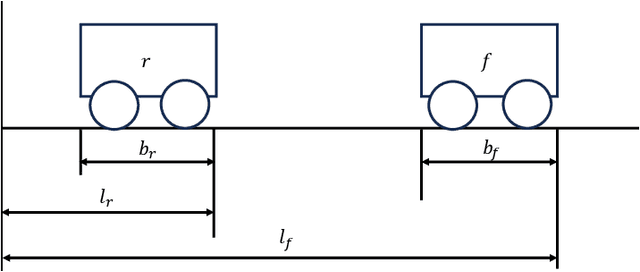
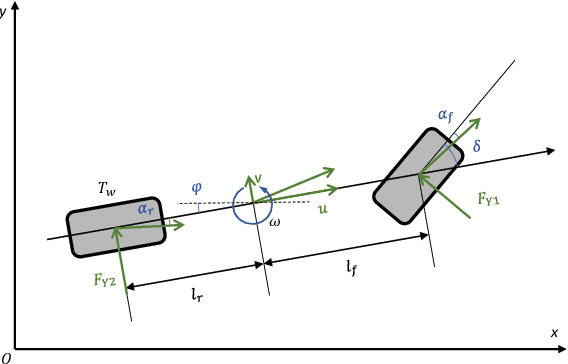
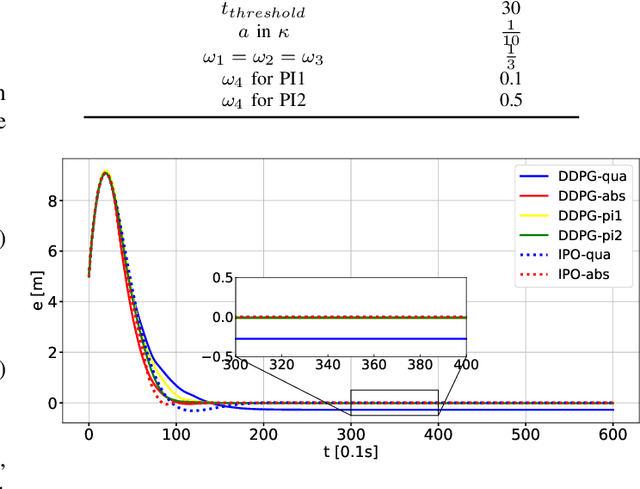
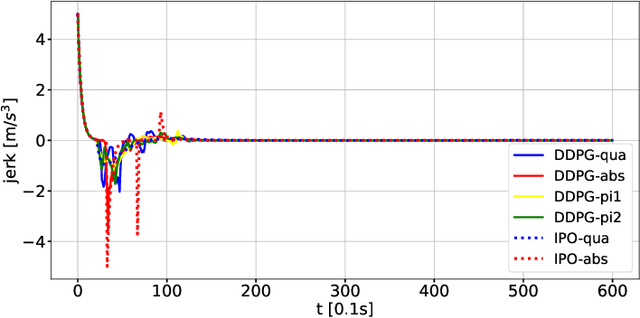
The selection of a reward function in Reinforcement Learning (RL) has garnered significant attention because of its impact on system performance. Issues of steady-state error often manifest when quadratic reward functions are employed. Although existing solutions using absolute-value-type reward functions partially address this problem, they tend to induce substantial fluctuations in specific system states, leading to abrupt changes. In response to this challenge, this study proposes an approach that introduces an integral term. By integrating this term into quadratic-type reward functions, the RL algorithm is adeptly tuned, augmenting the system's consideration of long-term rewards and, consequently, alleviating concerns related to steady-state errors. Through experiments and performance evaluations on the Adaptive Cruise Control (ACC) model and lane change models, we validate that the proposed method not only effectively diminishes steady-state errors but also results in smoother variations in system states.