 Add to Chrome
 Add to Firefox
 Add to Edge
SoccerNet 2026 Challenges Results
Jul 08, 2026
The SoccerNet 2026 Challenges constitute the sixth annual edition of the SoccerNet open benchmarking effort, dedicated to advancing computer vision research in sports video understanding. This year's challenges span five vision-based tasks: (1) Ball Action Anticipation, predicting the timing and class of ball-related actions within a short future window from a preceding observation window; (2) Player-Centric Ball Action Spotting, temporally localizing and classifying ball-related actions while assigning each action to the acting player through team affiliation and jersey number; (3) Novel View Synthesis, rendering images from unobserved camera poses in multi-view football scenes; (4) Spiideo SoccerNet Synloc, localizing athletes in real-world pitch coordinates from a single calibrated static-camera image; and (5) Visual Question Answering, answering multiple-choice questions about football broadcasts across text, image, and video inputs. For each task, participants were provided with annotated data, a unified evaluation protocol, and a public baseline. This edition saw broad participation, with 427 teams submitting 1,129 entries across the five tasks and 28 teams contributing reviewed technical reports. This paper describes each task and its evaluation protocol, presents the challenge leaderboards, and summarizes the leading submissions, with the aim of documenting the current state of each task as measured on held-out challenge data.

OneFocus: Enabling Real-World X-ray Security Screening with a Unified Vision-Language Model
Jun 14, 2026X-ray contraband detection is critical for security in large-scale logistics and transportation, yet conventional detectors struggle to adapt to emerging contraband types and lack fundamental visual understanding. Vision-language models (VLMs) offer strong generalization but are hindered by the scarcity of high-quality X-ray image-caption data. To bridge this critical gap, we present MMXray, a meticulously curated benchmark of 52,124 image-caption pairs spanning 28 fine-grained classes of X-ray contraband. To enrich MMXray with realistic occlusion patterns, we further introduce CleanDET, a dedicated synthesis dataset containing clean foreground contraband images from 28 categories and background images with diverse density levels, together with AnyContraSyn, a controllable synthesis method designed to operate on CleanDET. We also develop OnePipe, an extensible pipeline for systematic data curation. Built on MMXray, we propose OneFocus, a unified VLM that supports four core tasks: visual question answering, contraband localization, classification, and image understanding. OneFocus achieves state-of-the-art performance in X-ray contraband understanding and demonstrates robust cross-domain generalization, establishing a strong vision-language baseline for security screening.
MSUE: Multi-Modal Soccer Understanding Expert
Jun 10, 2026This paper presents our solution to the 2026 SoccerNet VQA Challenge. We first develop a cost-effective data synthesis pipeline driven by a Vision-Language Model (VLM), which systematically restructures raw domain data into diverse VQA samples, including concise answers and long-form responses. Second, we propose MSUE, a multi-expert question answering architecture that employs a Large Language Model (LLM) to dynamically dispatch questions to text, image, and video experts. These experts are instantiated as a strong text baseline Gemini3-Flash, a fine-tuned Qwen3-VL, and an external knowledge base, respectively, working collaboratively to enhance VQA performance. MSUE achieves an accuracy of \textbf{0.95} on the challenge benchmark, securing third place in the leaderboard.
Tora3: Trajectory-Guided Audio-Video Generation with Physical Coherence
Apr 10, 2026Audio-video (AV) generation has recently made strong progress in perceptual quality and multimodal coherence, yet generating content with plausible motion-sound relations remains challenging. Existing methods often produce object motions that are visually unstable and sounds that are only loosely aligned with salient motion or contact events, largely because they lack an explicit motion-aware structure shared by video and audio generation. We present Tora3, a trajectory-guided AV generation framework that improves physical coherence by using object trajectories as a shared kinematic prior. Rather than treating trajectories as a video-only control signal, Tora3 uses them to jointly guide visual motion and acoustic events. Specifically, we design a trajectory-aligned motion representation for video, a kinematic-audio alignment module driven by trajectory-derived second-order kinematic states, and a hybrid flow matching scheme that preserves trajectory fidelity in trajectory-conditioned regions while maintaining local coherence elsewhere. We further curate PAV, a large-scale AV dataset emphasizing motion-relevant patterns with automatically extracted motion annotations. Extensive experiments show that Tora3 improves motion realism, motion-sound synchronization, and overall AV generation quality over strong open-source baselines.
XSeg: A Large-scale X-ray Contraband Segmentation Benchmark For Real-World Security Screening
Apr 04, 2026X-ray contraband detection is critical for public safety. However, current methods primarily rely on bounding box annotations, which limit model generalization and performance due to the lack of pixel-level supervision and real-world data. To address these limitations, we introduce XSeg. To the best of our knowledge, XSeg is the largest X-ray contraband segmentation dataset to date, including 98,644 images and 295,932 instance masks, and contains the latest 30 common contraband categories. The images are sourced from public datasets and our synthesized data, filtered through a custom data cleaning pipeline to remove low-quality samples. To enable accurate and efficient annotation and reduce manual labeling effort, we propose Adaptive Point SAM (APSAM), a specialized mask annotation model built upon the Segment Anything Model (SAM). We address SAM's poor cross-domain generalization and limited capability in detecting stacked objects by introducing an Energy-Aware Encoder that enhances the initialization of the mask decoder, significantly improving sensitivity to overlapping items. Additionally, we design an Adaptive Point Generator that allows users to obtain precise mask labels with only a single coarse point prompt. Extensive experiments on XSeg demonstrate the superior performance of APSAM.
World of Workflows: a Benchmark for Bringing World Models to Enterprise Systems
Jan 29, 2026Frontier large language models (LLMs) excel as autonomous agents in many domains, yet they remain untested in complex enterprise systems where hidden workflows create cascading effects across interconnected databases. Existing enterprise benchmarks evaluate surface-level agentic task completion similar to general consumer benchmarks, ignoring true challenges in enterprises, such as limited observability, large database state, and hidden workflows with cascading side effects. We introduce World of Workflows (WoW), a realistic ServiceNow-based environment incorporating 4,000+ business rules and 55 active workflows embedded in the system, alongside WoW-bench, a benchmark of 234 tasks evaluating constrained agentic task completion and enterprise dynamics modeling capabilities. We reveal two major takeaways: (1) Frontier LLMs suffer from dynamics blindness, consistently failing to predict the invisible, cascading side effects of their actions, which leads to silent constraint violations, and (2) reliability in opaque systems requires grounded world modeling, where agents must mentally simulate hidden state transitions to bridge the observability gap when high-fidelity feedback is unavailable. For reliable and useful enterprise agents, WoW motivates a new paradigm to explicitly learn system dynamics. We release our GitHub for setting up and evaluating WoW.
Dynamic Neural Control Flow Execution: An Agent-Based Deep Equilibrium Approach for Binary Vulnerability Detection
Apr 03, 2024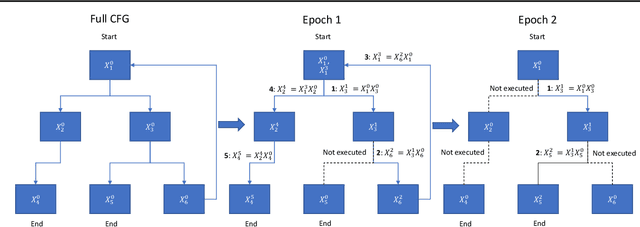
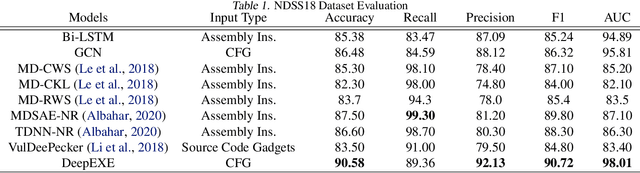
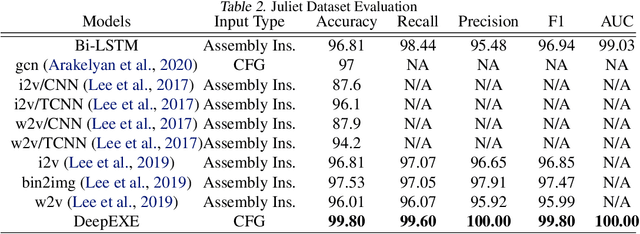
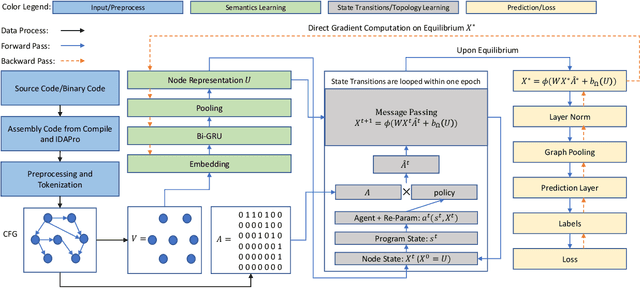
Software vulnerabilities are a challenge in cybersecurity. Manual security patches are often difficult and slow to be deployed, while new vulnerabilities are created. Binary code vulnerability detection is less studied and more complex compared to source code, and this has important practical implications. Deep learning has become an efficient and powerful tool in the security domain, where it provides end-to-end and accurate prediction. Modern deep learning approaches learn the program semantics through sequence and graph neural networks, using various intermediate representation of programs, such as abstract syntax trees (AST) or control flow graphs (CFG). Due to the complex nature of program execution, the output of an execution depends on the many program states and inputs. Also, a CFG generated from static analysis can be an overestimation of the true program flow. Moreover, the size of programs often does not allow a graph neural network with fixed layers to aggregate global information. To address these issues, we propose DeepEXE, an agent-based implicit neural network that mimics the execution path of a program. We use reinforcement learning to enhance the branching decision at every program state transition and create a dynamic environment to learn the dependency between a vulnerability and certain program states. An implicitly defined neural network enables nearly infinite state transitions until convergence, which captures the structural information at a higher level. The experiments are conducted on two semi-synthetic and two real-world datasets. We show that DeepEXE is an accurate and efficient method and outperforms the state-of-the-art vulnerability detection methods.