 Add to Chrome
 Add to Firefox
 Add to Edge
Jiao: Bridging Isolation and Customization in Mixed Criticality Robotics
May 05, 2026
Consumer robotics demands consolidation of safety-critical control, perception pipelines, and user applications on shared multicore platforms. While static partitioning hypervisors provide hardware-enforced isolation, directly transplanting automotive architectures encounters an expertise asymmetry problem in which end-users modifying robot behavior lack the systems knowledge that platform developers possess. We present an architecture addressing this challenge through three integrated components. A Safe IO Cell provides hardware-level override capability. A Parameter Synchronization Service encapsulates cross-domain complexity. A Safety Communication Layer implements IEC~61508-aligned verification. Our empirical evaluation on an ARM Cortex-A55 platform demonstrates that partition isolation reduces cycle-period jitter by 84.5\% and cuts tail timing error by nearly an order of magnitude (p99 $|$jitter$|$ from 69.0\,$μ$s to 7.8\,$μ$s), eliminating all $>$50\,$μ$s~excursions.

BuddyMoE: Exploiting Expert Redundancy to Accelerate Memory-Constrained Mixture-of-Experts Inference
Nov 13, 2025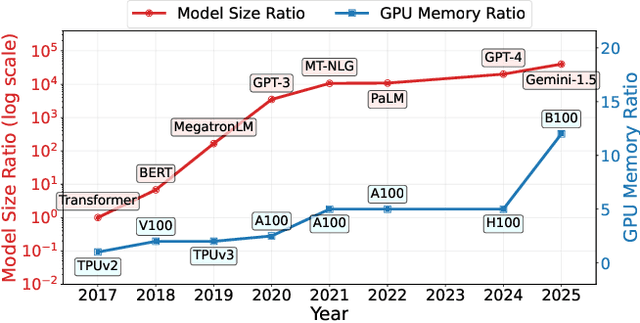
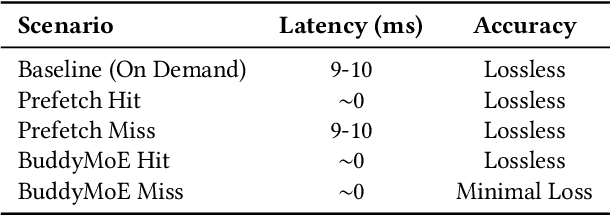
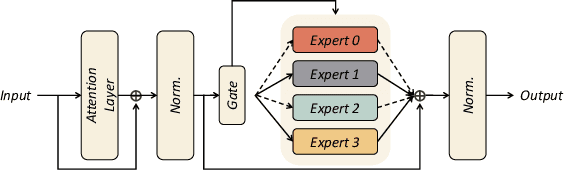
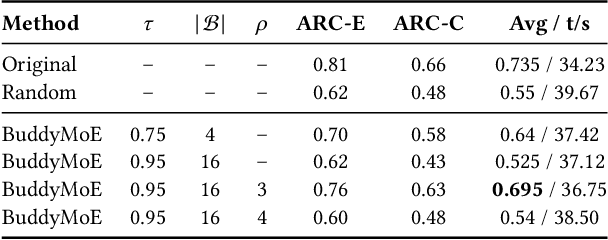
Mixture-of-Experts (MoE) architectures scale language models by activating only a subset of specialized expert networks for each input token, thereby reducing the number of floating-point operations. However, the growing size of modern MoE models causes their full parameter sets to exceed GPU memory capacity; for example, Mixtral-8x7B has 45 billion parameters and requires 87 GB of memory even though only 14 billion parameters are used per token. Existing systems alleviate this limitation by offloading inactive experts to CPU memory, but transferring experts across the PCIe interconnect incurs significant latency (about 10 ms). Prefetching heuristics aim to hide this latency by predicting which experts are needed, but prefetch failures introduce significant stalls and amplify inference latency. In the event of a prefetch failure, prior work offers two primary solutions: either fetch the expert on demand, which incurs a long stall due to the PCIe bottleneck, or drop the expert from the computation, which significantly degrades model accuracy. The critical challenge, therefore, is to maintain both high inference speed and model accuracy when prefetching fails.