 Add to Chrome
 Add to Firefox
 Add to Edge
OneRetrieval: Unifying Multi-Branch E-commerce Retrieval with an Editable Generative Model
Jun 11, 2026
Industrial e-commerce search serves hundreds of millions of items through a multi-branch retrieval stage fused by hand-tuned merging without joint optimization. Generative retrieval (GR) raises the prospect of collapsing this stage into a single model, yet unification is gated by more than retrieval quality: the inverted-index branch converts below the platform average yet persists because it is almost the only branch where operations can inject a new term within hours without any model update; a one-model substitute must preserve this real-time editability. Existing GR methods structurally lack it: closed-codebook methods fix each slot to a quantized embedding at training, while open-vocabulary methods leave new-term routing to model generalization. We present OneRetrieval, a one-model GR framework built on Keyword-Aligned Encoding (KAE), which ties each identifier position to an interpretable attribute word, pairing competitive recall quality with the editability of the inverted index -- to our knowledge the first editable generative retrieval method. An information-theoretic merging organizes 18 attribute categories into six codebook groups with non-uniform capacity; reserved slots in each codebook can be bound to new words after deployment without retraining; and a four-stage fine-tuning pipeline secures quality and editability jointly. On five million real-traffic requests, OneRetrieval matches the deep recall of the strongest generative baseline, with an intervention hit rate over an order of magnitude above closed-codebook encodings. Online, replacing the inverted-index branch significantly lifts order volume; extending to nearly the entire stage holds conversion while improving CTR. The system is deployed at Kuaishou, serving hundreds of millions of PVs daily.

Search-E1: Self-Distillation Drives Self-Evolution in Search-Augmented Reasoning
May 21, 2026Post-training has become the dominant recipe for turning a language model into a competent search-augmented reasoning agent. A line of recent work pushes its performance further by adding elaborate machinery on top of this standard pipeline. These augmentations import external supervision from stronger external systems, attach auxiliary modules such as process reward models or retrospective critics, restructure the rollout itself with tree search or multi-stage curricula, or shape the reward with hand-crafted bonuses and penalties. Each addition delivers a measurable gain, but each also inflates the training pipeline and ties the recipe to resources or designs that may not always be available. We take a step back and ask whether any of this machinery is actually necessary, and propose Search-E1, a self-evolution method that lets a search-augmented agent improve through only vanilla GRPO interleaved with offline self-distillation (OFSD). After each GRPO round, the policy rolls out on its own training questions. A token-level forward KL objective then aligns the policy's inference-time distribution to its own distribution under a privileged context that exposes a more efficient sibling trajectory. Despite this simplicity, the procedure naturally provides dense per-step supervision. On seven QA benchmarks, Search-E1 reaches $0.440$ average EM with Qwen2.5-3B, surpassing all open-source baselines at both scales. Code and complete version will be made public soon.
TIGER-FG: Text-Guided Implicit Fine-Grained Grounding for E-commerce Retrieval
May 18, 2026E-commerce image search often takes a cropped image as the query, while each candidate is represented by full item images and structured text. This image-to-multimodal retrieval setting presents two asymmetries: a modality disparity -- a visual query must match image--text items, and a granularity disparity -- a cropped query must be compared with full images containing background context and possible distractors. Detection-based pipelines handle the granularity disparity through explicit localization but incur extra cost and error propagation, whereas CLIP-style encoders avoid detection, but are vulnerable to backgrounds or irrelevant items. To address these limitations, we propose TIGER-FG, a text-guided implicit fine-grained grounding framework for image-to-multimodal e-commerce retrieval. TIGER-FG uses item text as semantic guidance to produce target-focused item representations without object detection for retrieval. We further introduce dual distillation objectives that preserve target-region spatial consistency and query--item similarity structure, yielding more stable and discriminative multimodal representations. In addition, we construct ECom-RF-IMMR, a realistic benchmark suite with a 10M-pair training set and two evaluation benchmarks covering standard and cluttered item layouts. TIGER-FG improves Recall@1 over the strongest baseline by 6.1 and 34.4 percentage points on the two evaluation benchmarks, respectively, with only 85.7M query-side parameters and 256-dim embeddings. Results on public e-commerce benchmarks further demonstrate its generalization to noisy and one-to-many retrieval scenarios. Code and data will be released.
SD-Search: On-Policy Hindsight Self-Distillation for Search-Augmented Reasoning
May 18, 2026Search-augmented reasoning agents interleave internal reasoning with calls to an external retriever, and their performance relies on the quality of each issued query. However, under outcome-reward reinforcement learning, every search decision in a rollout shares the same trajectory-level reward, leaving individual queries without step-specific credit. Recent process-supervision approaches address this gap by drawing step-level signals from outside the policy, relying either on a much larger teacher model, or on sub-question annotations produced by a stronger external system. In contrast, we propose SD-Search, which derives step-level supervision from the policy itself through on-policy hindsight self-distillation, requiring neither an external teacher nor additional annotations. In SD-Search, a single model plays two roles that differ only in conditioning: a student that sees only the context available at inference time, and a teacher that additionally conditions on a compact hindsight block summarizing the search queries and final outcomes of a group of rollouts sampled from the same question. Since the teacher knows how each rollout unfolded and which ones succeeded, its query distribution implicitly marks which decisions were worth making, and the student is trained to recover this behavior by minimizing the token-level Jensen--Shannon divergence to the teacher at search-query positions. This layers a dense, step-level signal on top of GRPO's coarse trajectory reward. Crucially, this signal is produced by the policy itself within the standard RL training loop, without external model inference, auxiliary annotation pipeline, or additional training stage.
IG-Search: Step-Level Information Gain Rewards for Search-Augmented Reasoning
Apr 16, 2026Reinforcement learning has emerged as an effective paradigm for training large language models to perform search-augmented reasoning. However, existing approaches rely on trajectory-level rewards that cannot distinguish precise search queries from vague or redundant ones within a rollout group, and collapse to a near-zero gradient signal whenever every sampled trajectory fails. In this paper, we propose IG-Search, a reinforcement learning framework that introduces a step-level reward based on Information Gain (IG). For each search step, IG measures how much the retrieved documents improve the model's confidence in the gold answer relative to a counterfactual baseline of random documents, thereby reflecting the effectiveness of the underlying search query. This signal is fed back to the corresponding search-query tokens via per-token advantage modulation in GRPO, enabling fine-grained, step-level credit assignment within a rollout. Unlike prior step-level methods that require either externally annotated intermediate supervision or shared environment states across trajectories, IG-Search derives its signals from the policy's own generation probabilities, requiring no intermediate annotations beyond standard question-answer pairs. Experiments on seven single-hop and multi-hop QA benchmarks demonstrate that IG-Search achieves an average EM of 0.430 with Qwen2.5-3B, outperforming the strongest trajectory-level baseline (MR-Search) by 1.6 points and the step-level method GiGPO by 0.9 points on average across benchmarks, with particularly pronounced gains on multi-hop reasoning tasks. Despite introducing a dense step-level signal, IG-Search adds only ~6.4% to per-step training wall-clock time over the trajectory-level baseline and leaves inference latency unchanged, while still providing a meaningful gradient signal even when every sampled trajectory answers incorrectly.
OneSearch-V2: The Latent Reasoning Enhanced Self-distillation Generative Search Framework
Mar 25, 2026Generative Retrieval (GR) has emerged as a promising paradigm for modern search systems. Compared to multi-stage cascaded architecture, it offers advantages such as end-to-end joint optimization and high computational efficiency. OneSearch, as a representative industrial-scale deployed generative search framework, has brought significant commercial and operational benefits. However, its inadequate understanding of complex queries, inefficient exploitation of latent user intents, and overfitting to narrow historical preferences have limited its further performance improvement. To address these challenges, we propose \textbf{OneSearch-V2}, a latent reasoning enhanced self-distillation generative search framework. It contains three key innovations: (1) a thought-augmented complex query understanding module, which enables deep query understanding and overcomes the shallow semantic matching limitations of direct inference; (2) a reasoning-internalized self-distillation training pipeline, which uncovers users' potential yet precise e-commerce intentions beyond log-fitting through implicit in-context learning; (3) a behavior preference alignment optimization system, which mitigates reward hacking arising from the single conversion metric, and addresses personal preference via direct user feedback. Extensive offline evaluations demonstrate OneSearch-V2's strong query recognition and user profiling capabilities. Online A/B tests further validate its business effectiveness, yielding +3.98\% item CTR, +3.05\% buyer conversion rate, and +2.11\% order volume. Manual evaluation further confirms gains in search experience quality, with +1.65\% in page good rate and +1.37\% in query-item relevance. More importantly, OneSearch-V2 effectively mitigates common search system issues such as information bubbles and long-tail sparsity, without incurring additional inference costs or serving latency.
InfoGain-RAG: Boosting Retrieval-Augmented Generation via Document Information Gain-based Reranking and Filtering
Sep 16, 2025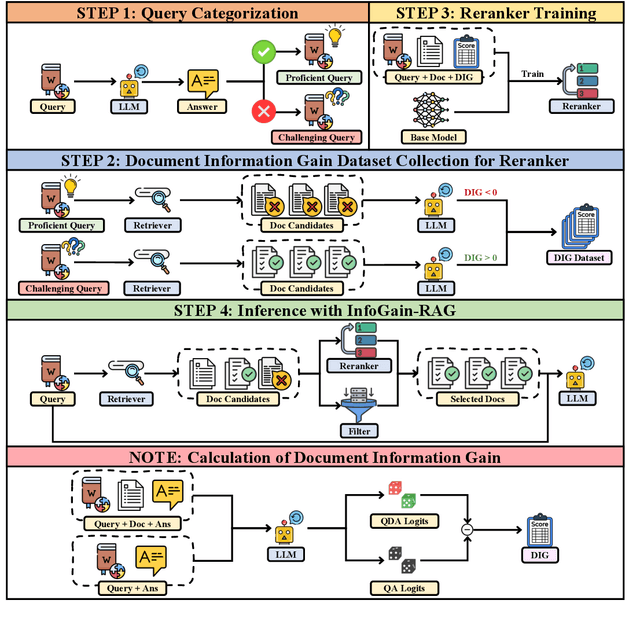
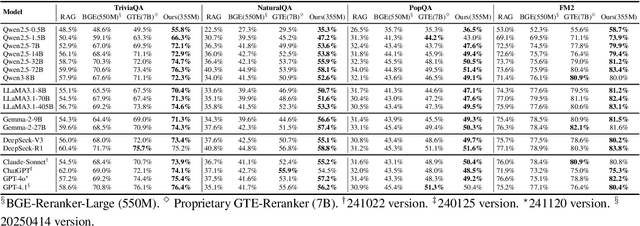
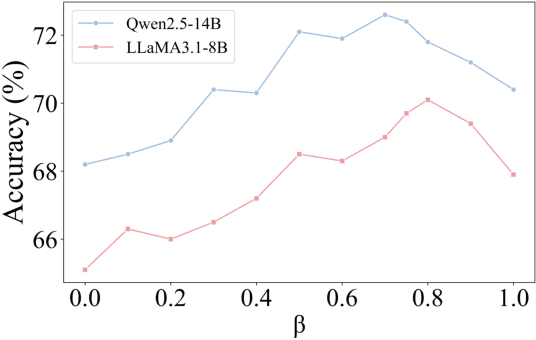
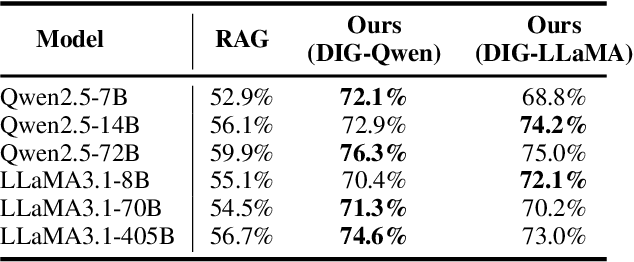
Retrieval-Augmented Generation (RAG) has emerged as a promising approach to address key limitations of Large Language Models (LLMs), such as hallucination, outdated knowledge, and lacking reference. However, current RAG frameworks often struggle with identifying whether retrieved documents meaningfully contribute to answer generation. This shortcoming makes it difficult to filter out irrelevant or even misleading content, which notably impacts the final performance. In this paper, we propose Document Information Gain (DIG), a novel metric designed to quantify the contribution of retrieved documents to correct answer generation. DIG measures a document's value by computing the difference of LLM's generation confidence with and without the document augmented. Further, we introduce InfoGain-RAG, a framework that leverages DIG scores to train a specialized reranker, which prioritizes each retrieved document from exact distinguishing and accurate sorting perspectives. This approach can effectively filter out irrelevant documents and select the most valuable ones for better answer generation. Extensive experiments across various models and benchmarks demonstrate that InfoGain-RAG can significantly outperform existing approaches, on both single and multiple retrievers paradigm. Specifically on NaturalQA, it achieves the improvements of 17.9%, 4.5%, 12.5% in exact match accuracy against naive RAG, self-reflective RAG and modern ranking-based RAG respectively, and even an average of 15.3% increment on advanced proprietary model GPT-4o across all datasets. These results demonstrate the feasibility of InfoGain-RAG as it can offer a reliable solution for RAG in multiple applications.