 Add to Chrome
 Add to Firefox
 Add to Edge
LDU-Bench: Multimodal LLM Evaluation for Lithography Defect Understanding under Layout-Varying Circuit Backgrounds
Aug 04, 2026
Multimodal large language models have demonstrated strong defect recognition capability in industrial anomaly detection. However, in lithography review, merely determining whether an image contains a defect is insufficient for engineering inspection; models must also understand defect morphology, spatial location, and the potential causes supported by visible evidence. To this end, this paper proposes LDU-Bench, a multi-task multimodal benchmark for lithography defect understanding. Constructed from real lithography and integrated-circuit review images, LDU-Bench decomposes the review workflow into four independent tasks: defect triage, morphology recognition, coarse localization, and image-conditioned cause analysis. It systematically evaluates models using task-level metrics, diagnostic readouts, and the Lithography Closure Score (LCS). Experimental results show that although existing MLLMs can perform defect triage relatively reliably, this ability does not stably transfer to downstream review stages. Morphology alignment, effective localization, and evidence-to-cause mapping remain the major bottlenecks. Further diagnostics indicate that this capability break is not a fluctuation of a single metric, but reflects insufficient structured understanding across semantic levels. Overall, LDU-Bench provides a quantifiable and diagnostic unified platform for evaluating the usability, failure points, and capability boundaries of industrial MLLMs in lithography review chains.

OneRetrieval: Unifying Multi-Branch E-commerce Retrieval with an Editable Generative Model
Jun 11, 2026Industrial e-commerce search serves hundreds of millions of items through a multi-branch retrieval stage fused by hand-tuned merging without joint optimization. Generative retrieval (GR) raises the prospect of collapsing this stage into a single model, yet unification is gated by more than retrieval quality: the inverted-index branch converts below the platform average yet persists because it is almost the only branch where operations can inject a new term within hours without any model update; a one-model substitute must preserve this real-time editability. Existing GR methods structurally lack it: closed-codebook methods fix each slot to a quantized embedding at training, while open-vocabulary methods leave new-term routing to model generalization. We present OneRetrieval, a one-model GR framework built on Keyword-Aligned Encoding (KAE), which ties each identifier position to an interpretable attribute word, pairing competitive recall quality with the editability of the inverted index -- to our knowledge the first editable generative retrieval method. An information-theoretic merging organizes 18 attribute categories into six codebook groups with non-uniform capacity; reserved slots in each codebook can be bound to new words after deployment without retraining; and a four-stage fine-tuning pipeline secures quality and editability jointly. On five million real-traffic requests, OneRetrieval matches the deep recall of the strongest generative baseline, with an intervention hit rate over an order of magnitude above closed-codebook encodings. Online, replacing the inverted-index branch significantly lifts order volume; extending to nearly the entire stage holds conversion while improving CTR. The system is deployed at Kuaishou, serving hundreds of millions of PVs daily.
OneSearch-V2: The Latent Reasoning Enhanced Self-distillation Generative Search Framework
Mar 25, 2026Generative Retrieval (GR) has emerged as a promising paradigm for modern search systems. Compared to multi-stage cascaded architecture, it offers advantages such as end-to-end joint optimization and high computational efficiency. OneSearch, as a representative industrial-scale deployed generative search framework, has brought significant commercial and operational benefits. However, its inadequate understanding of complex queries, inefficient exploitation of latent user intents, and overfitting to narrow historical preferences have limited its further performance improvement. To address these challenges, we propose \textbf{OneSearch-V2}, a latent reasoning enhanced self-distillation generative search framework. It contains three key innovations: (1) a thought-augmented complex query understanding module, which enables deep query understanding and overcomes the shallow semantic matching limitations of direct inference; (2) a reasoning-internalized self-distillation training pipeline, which uncovers users' potential yet precise e-commerce intentions beyond log-fitting through implicit in-context learning; (3) a behavior preference alignment optimization system, which mitigates reward hacking arising from the single conversion metric, and addresses personal preference via direct user feedback. Extensive offline evaluations demonstrate OneSearch-V2's strong query recognition and user profiling capabilities. Online A/B tests further validate its business effectiveness, yielding +3.98\% item CTR, +3.05\% buyer conversion rate, and +2.11\% order volume. Manual evaluation further confirms gains in search experience quality, with +1.65\% in page good rate and +1.37\% in query-item relevance. More importantly, OneSearch-V2 effectively mitigates common search system issues such as information bubbles and long-tail sparsity, without incurring additional inference costs or serving latency.
Dynamic Low-Rank Instance Adaptation for Universal Neural Image Compression
Aug 15, 2023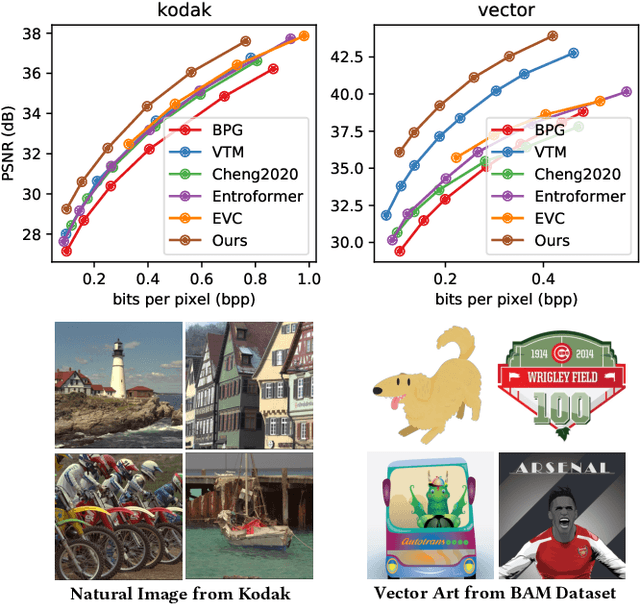
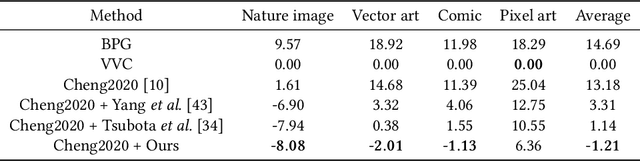
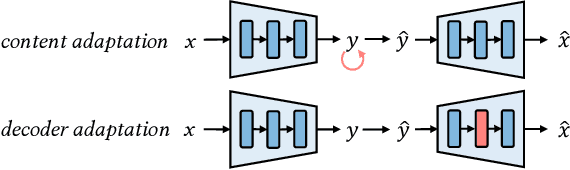
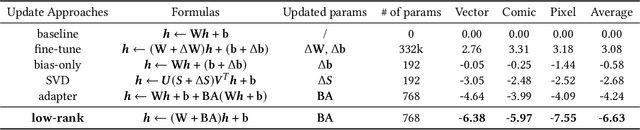
The latest advancements in neural image compression show great potential in surpassing the rate-distortion performance of conventional standard codecs. Nevertheless, there exists an indelible domain gap between the datasets utilized for training (i.e., natural images) and those utilized for inference (e.g., artistic images). Our proposal involves a low-rank adaptation approach aimed at addressing the rate-distortion drop observed in out-of-domain datasets. Specifically, we perform low-rank matrix decomposition to update certain adaptation parameters of the client's decoder. These updated parameters, along with image latents, are encoded into a bitstream and transmitted to the decoder in practical scenarios. Due to the low-rank constraint imposed on the adaptation parameters, the resulting bit rate overhead is small. Furthermore, the bit rate allocation of low-rank adaptation is \emph{non-trivial}, considering the diverse inputs require varying adaptation bitstreams. We thus introduce a dynamic gating network on top of the low-rank adaptation method, in order to decide which decoder layer should employ adaptation. The dynamic adaptation network is optimized end-to-end using rate-distortion loss. Our proposed method exhibits universality across diverse image datasets. Extensive results demonstrate that this paradigm significantly mitigates the domain gap, surpassing non-adaptive methods with an average BD-rate improvement of approximately $19\%$ across out-of-domain images. Furthermore, it outperforms the most advanced instance adaptive methods by roughly $5\%$ BD-rate. Ablation studies confirm our method's ability to universally enhance various image compression architectures.