 Add to Chrome
 Add to Firefox
 Add to Edge
RoboBlockly Studio: Conversational Block Programming with Embodied Robot Feedback for Computational Thinking
May 12, 2026
Computational thinking (CT) is increasingly promoted as a core literacy, yet learners and teachers face challenges in connecting abstract program logic to meaningful outcomes. We design and evaluate RoboBlockly Studio, an integrated interactive system that combines block-based programming, a conversational AI teaching agent, and embodied robot execution. RoboBlockly Studio creates a tight iterative loop of authoring, running, observing, and revising. Informed by interviews with five programming teachers, the system was designed to support four goals: (1) preserving learner agency in computational thinking, (2) making program behavior transparent and interpretable, (3) grounding programming in embodied, classroom-aligned tasks, and (4) scaffolding reflection through pedagogically grounded AI dialogue. We deployed RoboBlockly Studio with 32 high school students, observing how robot and AI feedback influenced students' interactions with code, reflections on problem-solving strategies, and understanding of CT concepts. We discuss design insights and implications for creating interactive, embodied learning environments that integrate AI and robotics to support CT learning in computing education.

GAIA: Zero-shot Talking Avatar Generation
Nov 26, 2023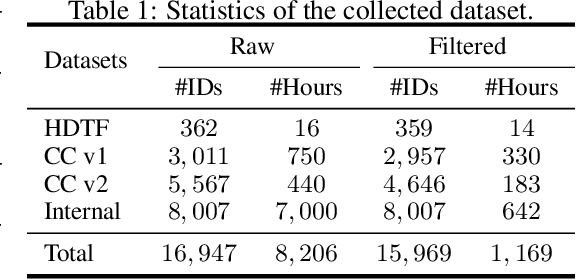

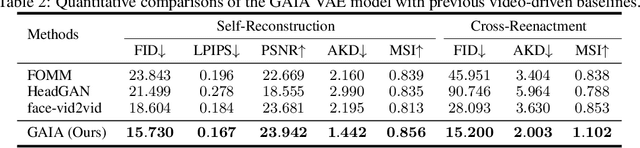

Zero-shot talking avatar generation aims at synthesizing natural talking videos from speech and a single portrait image. Previous methods have relied on domain-specific heuristics such as warping-based motion representation and 3D Morphable Models, which limit the naturalness and diversity of the generated avatars. In this work, we introduce GAIA (Generative AI for Avatar), which eliminates the domain priors in talking avatar generation. In light of the observation that the speech only drives the motion of the avatar while the appearance of the avatar and the background typically remain the same throughout the entire video, we divide our approach into two stages: 1) disentangling each frame into motion and appearance representations; 2) generating motion sequences conditioned on the speech and reference portrait image. We collect a large-scale high-quality talking avatar dataset and train the model on it with different scales (up to 2B parameters). Experimental results verify the superiority, scalability, and flexibility of GAIA as 1) the resulting model beats previous baseline models in terms of naturalness, diversity, lip-sync quality, and visual quality; 2) the framework is scalable since larger models yield better results; 3) it is general and enables different applications like controllable talking avatar generation and text-instructed avatar generation.