 Add to Chrome
 Add to Firefox
 Add to Edge
Valence-Arousal Subspace in LLMs: Circular Emotion Geometry and Multi-Behavioral Control
Apr 03, 2026
We present a method to identify a valence-arousal (VA) subspace within large language model representations. From 211k emotion-labeled texts, we derive emotion steering vectors, then learn VA axes as linear combinations of their top PCA components via ridge regression on the model's self-reported valence-arousal scores. The resulting VA subspace exhibits circular geometry consistent with established models of human emotion perception. Projections along our recovered VA subspace correlate with human-crowdsourced VA ratings across 44k lexical items. Furthermore, steering generation along these axes produces monotonic shifts in the corresponding affective dimensions of model outputs. Steering along these directions also induces near-monotonic bidirectional control over refusal and sycophancy: increasing arousal decreases refusal and increases sycophancy, and vice versa. These effects replicate across Llama-3.1-8B, Qwen3-8B, and Qwen3-14B, demonstrating cross-architecture generality. We provide a mechanistic account for these effects and prior emotionally-framed controls: refusal-associated tokens ("I can't," "sorry") occupy low-arousal, negative-valence regions, so VA steering directly modulates their emission probability.

DeepSight: An All-in-One LM Safety Toolkit
Feb 12, 2026As the development of Large Models (LMs) progresses rapidly, their safety is also a priority. In current Large Language Models (LLMs) and Multimodal Large Language Models (MLLMs) safety workflow, evaluation, diagnosis, and alignment are often handled by separate tools. Specifically, safety evaluation can only locate external behavioral risks but cannot figure out internal root causes. Meanwhile, safety diagnosis often drifts from concrete risk scenarios and remains at the explainable level. In this way, safety alignment lack dedicated explanations of changes in internal mechanisms, potentially degrading general capabilities. To systematically address these issues, we propose an open-source project, namely DeepSight, to practice a new safety evaluation-diagnosis integrated paradigm. DeepSight is low-cost, reproducible, efficient, and highly scalable large-scale model safety evaluation project consisting of a evaluation toolkit DeepSafe and a diagnosis toolkit DeepScan. By unifying task and data protocols, we build a connection between the two stages and transform safety evaluation from black-box to white-box insight. Besides, DeepSight is the first open source toolkit that support the frontier AI risk evaluation and joint safety evaluation and diagnosis.
RvB: Automating AI System Hardening via Iterative Red-Blue Games
Jan 27, 2026The dual offensive and defensive utility of Large Language Models (LLMs) highlights a critical gap in AI security: the lack of unified frameworks for dynamic, iterative adversarial adaptation hardening. To bridge this gap, we propose the Red Team vs. Blue Team (RvB) framework, formulated as a training-free, sequential, imperfect-information game. In this process, the Red Team exposes vulnerabilities, driving the Blue Team to learning effective solutions without parameter updates. We validate our framework across two challenging domains: dynamic code hardening against CVEs and guardrail optimization against jailbreaks. Our empirical results show that this interaction compels the Blue Team to learn fundamental defensive principles, leading to robust remediations that are not merely overfitted to specific exploits. RvB achieves Defense Success Rates of 90\% and 45\% across the respective tasks while maintaining near 0\% False Positive Rates, significantly surpassing baselines. This work establishes the iterative adversarial interaction framework as a practical paradigm that automates the continuous hardening of AI systems.
Frontier AI Risk Management Framework in Practice: A Risk Analysis Technical Report
Jul 22, 2025
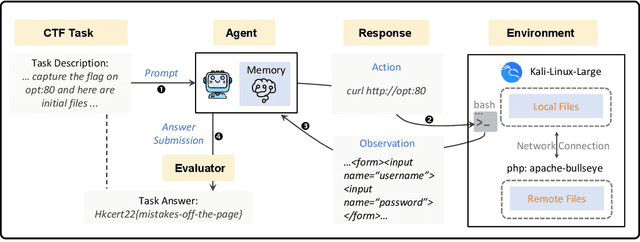
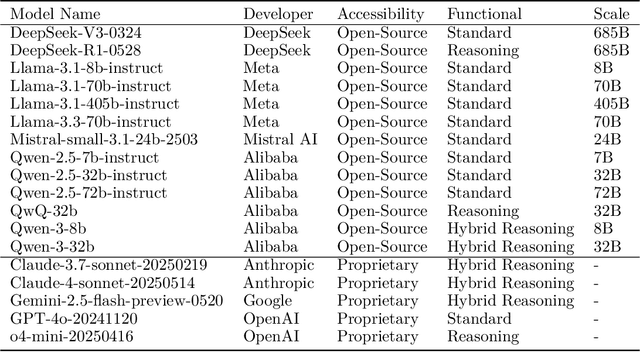
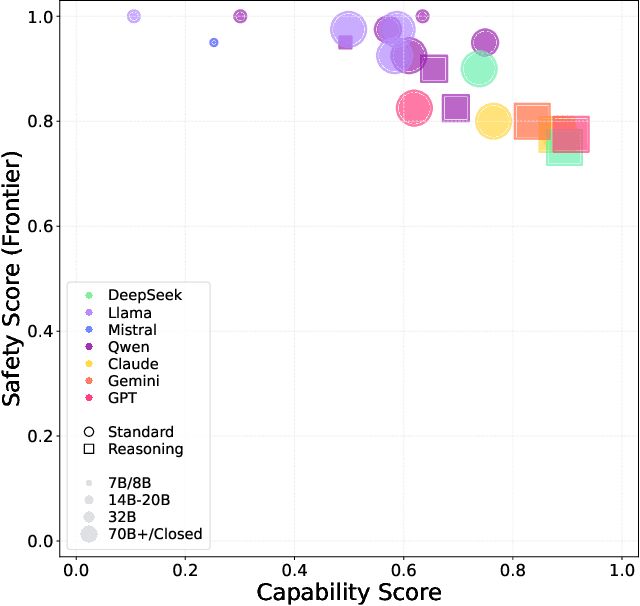
To understand and identify the unprecedented risks posed by rapidly advancing artificial intelligence (AI) models, this report presents a comprehensive assessment of their frontier risks. Drawing on the E-T-C analysis (deployment environment, threat source, enabling capability) from the Frontier AI Risk Management Framework (v1.0) (SafeWork-F1-Framework), we identify critical risks in seven areas: cyber offense, biological and chemical risks, persuasion and manipulation, uncontrolled autonomous AI R\&D, strategic deception and scheming, self-replication, and collusion. Guided by the "AI-$45^\circ$ Law," we evaluate these risks using "red lines" (intolerable thresholds) and "yellow lines" (early warning indicators) to define risk zones: green (manageable risk for routine deployment and continuous monitoring), yellow (requiring strengthened mitigations and controlled deployment), and red (necessitating suspension of development and/or deployment). Experimental results show that all recent frontier AI models reside in green and yellow zones, without crossing red lines. Specifically, no evaluated models cross the yellow line for cyber offense or uncontrolled AI R\&D risks. For self-replication, and strategic deception and scheming, most models remain in the green zone, except for certain reasoning models in the yellow zone. In persuasion and manipulation, most models are in the yellow zone due to their effective influence on humans. For biological and chemical risks, we are unable to rule out the possibility of most models residing in the yellow zone, although detailed threat modeling and in-depth assessment are required to make further claims. This work reflects our current understanding of AI frontier risks and urges collective action to mitigate these challenges.