 Add to Chrome
 Add to Firefox
 Add to Edge
Channel2World: A Wireless Foundation Model for RF Environment Representation
Aug 18, 2026
Wireless channels are commonly treated as link-specific observations, although their multipath structure is governed by the surrounding radio-frequency (RF) environment. In this paper, we propose Channel2World, a wireless foundation model that learns a reusable environment-level representation from multiple-input multiple-output (MIMO) channel-position observations. The model aggregates channels collected within the same base-station-centered environment into a wireless world embedding using a Transformer-based encoder. The encoder is pretrained through context-query prediction, where context channels condition user equipment (UE) position and relative path-gain prediction for disjoint query channels. After pretraining, the encoder is frozen and used as a task-agnostic environment-conditioning module for downstream wireless models, enabling adaptation to unseen environments without site-specific fine-tuning. To learn an environment-level latent space that generalizes across deployments, we pretrain Channel2World using ray-tracing data from 26,000 environments, with approximately 5,000 channel measurements per environment. Evaluations on UE localization, beam-domain channel state information (CSI) reconstruction, and RF-observable geometry reconstruction show that the learned embeddings provide effective conditioning in unseen environments. For localization and CSI reconstruction tasks, embedding-based conditioning outperforms or remains competitive with site-specific fine-tuning, although fine-tuning requires task-specific labeled data and additional gradient-based adaptation. The embeddings also support the reconstruction of dominant reflector structures, indicating their utility as reusable environmental priors across tasks.

When 5G MIMO Scaling Breaks: Toward 6G Upper-Mid-Band Extreme MIMO
Jul 31, 2026The upper-mid band, particularly the 7-8 GHz range within frequency range 3 (FR3), has emerged as a leading spectrum candidate for wide-area sixth-generation (6G) cellular networks. Its shorter wavelength enables hundreds of antenna elements to be integrated within the physical aperture of an existing 5G base-station panel. In principle, the resulting aperture gain can compensate for the increased path loss and enable extreme MIMO (E-MIMO) with 256 or more antenna ports while reusing current cell sites. In practice, however, simply scaling the 5G New Radio (NR) architecture from tens to hundreds of ports encounters fundamental system-level limitations. This paper identifies where 5G-style MIMO scaling breaks and develops a research roadmap for practical upper-mid-band E-MIMO. We first review the evolution of FR3 spectrum, its propagation and channel characteristics, and the emerging 6G system requirements. We then organize the principal challenges into four coupled areas: maintaining effective coverage across all physical channels and protocol states; implementing wideband, energy-efficient RF devices and radio units; developing new low-power array and beamforming architectures; and acquiring sufficiently refined channel state information with manageable sounding and feedback overhead. Representative system studies illustrate the coverage asymmetry between user-specific data transmission and common or channel-acquisition signals, as well as the spectral- and energy-efficiency tradeoffs among fully digital, hybrid, tri-hybrid, dynamic-metasurface, and fluid-antenna architectures. Finally, we discuss how distributed apertures, integrated sensing, AI-assisted channel acquisition, and environment-aware operation can transform fixed-aperture scaling into a deployable 6G E-MIMO architecture.
Lightweight Foundation Model for Wireless Time Series Downstream Tasks on Edge Devices
Nov 18, 2025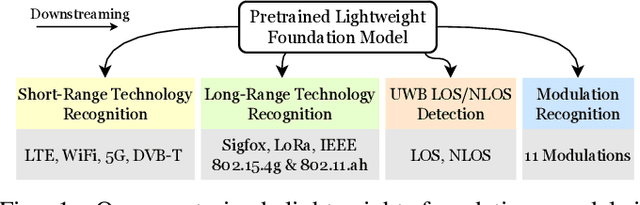
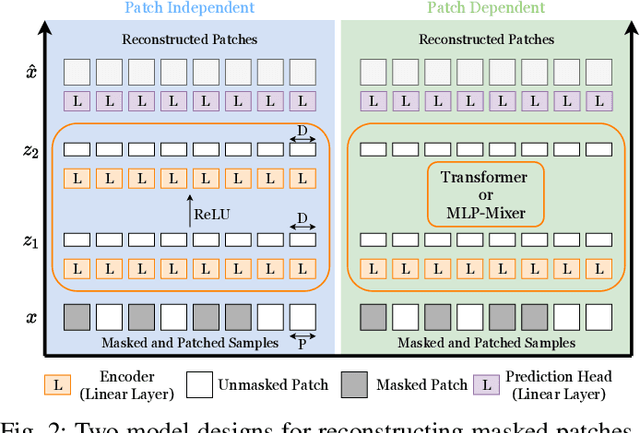
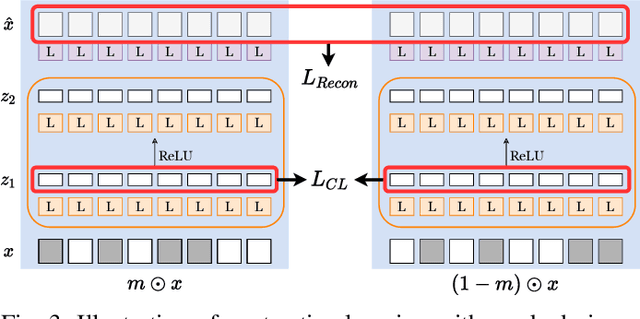
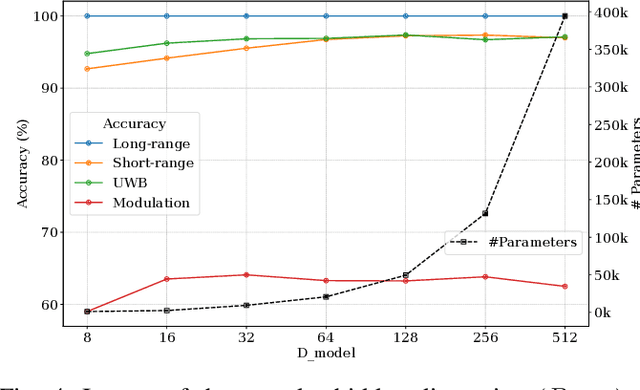
While machine learning is widely used to optimize wireless networks, training a separate model for each task in communication and localization is becoming increasingly unsustainable due to the significant costs associated with training and deployment. Foundation models offer a more scalable alternative by enabling a single model to be adapted across multiple tasks through fine-tuning with limited samples. However, current foundation models mostly rely on large-scale Transformer architectures, resulting in computationally intensive models unsuitable for deployment on typical edge devices. This paper presents a lightweight foundation model based on simple Multi-Layer-Perceptron (MLP) encoders that independently process input patches. Our model supports 4 types of downstream tasks (long-range technology recognition, short-range technology recognition, modulation recognition and line-of-sight-detection) from multiple input types (IQ and CIR) and different sampling rates. We show that, unlike Transformers, which can exhibit performance drops as downstream tasks are added, our MLP model maintains robust generalization performance, achieving over 97% accurate fine-tuning results for previously unseen data classes. These results are achieved despite having only 21K trainable parameters, allowing an inference time of 0.33 ms on common edge devices, making the model suitable for constrained real-time deployments.