 Add to Chrome
 Add to Firefox
 Add to Edge
When 5G MIMO Scaling Breaks: Toward 6G Upper-Mid-Band Extreme MIMO
Jul 31, 2026
The upper-mid band, particularly the 7-8 GHz range within frequency range 3 (FR3), has emerged as a leading spectrum candidate for wide-area sixth-generation (6G) cellular networks. Its shorter wavelength enables hundreds of antenna elements to be integrated within the physical aperture of an existing 5G base-station panel. In principle, the resulting aperture gain can compensate for the increased path loss and enable extreme MIMO (E-MIMO) with 256 or more antenna ports while reusing current cell sites. In practice, however, simply scaling the 5G New Radio (NR) architecture from tens to hundreds of ports encounters fundamental system-level limitations. This paper identifies where 5G-style MIMO scaling breaks and develops a research roadmap for practical upper-mid-band E-MIMO. We first review the evolution of FR3 spectrum, its propagation and channel characteristics, and the emerging 6G system requirements. We then organize the principal challenges into four coupled areas: maintaining effective coverage across all physical channels and protocol states; implementing wideband, energy-efficient RF devices and radio units; developing new low-power array and beamforming architectures; and acquiring sufficiently refined channel state information with manageable sounding and feedback overhead. Representative system studies illustrate the coverage asymmetry between user-specific data transmission and common or channel-acquisition signals, as well as the spectral- and energy-efficiency tradeoffs among fully digital, hybrid, tri-hybrid, dynamic-metasurface, and fluid-antenna architectures. Finally, we discuss how distributed apertures, integrated sensing, AI-assisted channel acquisition, and environment-aware operation can transform fixed-aperture scaling into a deployable 6G E-MIMO architecture.

ElderSim: A Synthetic Data Generation Platform for Human Action Recognition in Eldercare Applications
Oct 28, 2020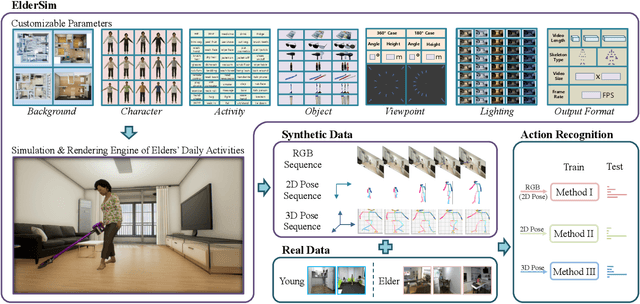
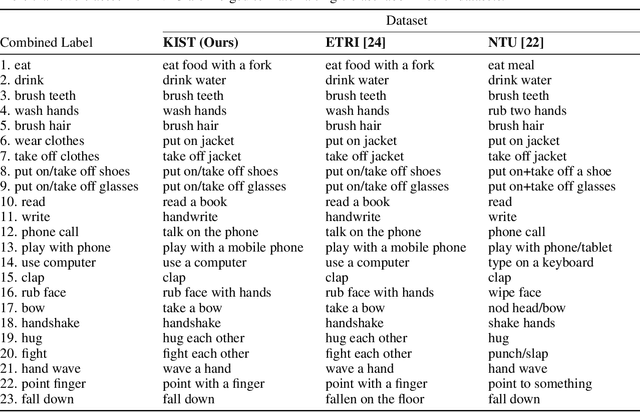
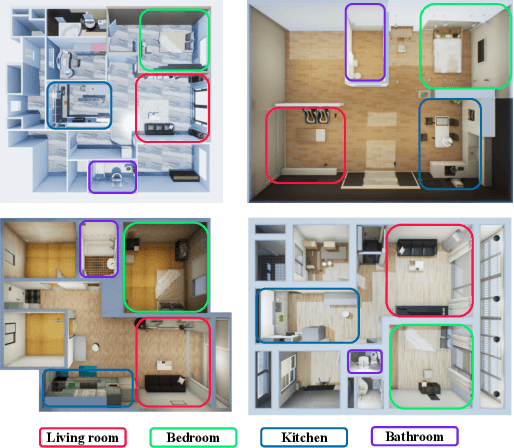

To train deep learning models for vision-based action recognition of elders' daily activities, we need large-scale activity datasets acquired under various daily living environments and conditions. However, most public datasets used in human action recognition either differ from or have limited coverage of elders' activities in many aspects, making it challenging to recognize elders' daily activities well by only utilizing existing datasets. Recently, such limitations of available datasets have actively been compensated by generating synthetic data from realistic simulation environments and using those data to train deep learning models. In this paper, based on these ideas we develop ElderSim, an action simulation platform that can generate synthetic data on elders' daily activities. For 55 kinds of frequent daily activities of the elders, ElderSim generates realistic motions of synthetic characters with various adjustable data-generating options, and provides different output modalities including RGB videos, two- and three-dimensional skeleton trajectories. We then generate KIST SynADL, a large-scale synthetic dataset of elders' activities of daily living, from ElderSim and use the data in addition to real datasets to train three state-of the-art human action recognition models. From the experiments following several newly proposed scenarios that assume different real and synthetic dataset configurations for training, we observe a noticeable performance improvement by augmenting our synthetic data. We also offer guidance with insights for the effective utilization of synthetic data to help recognize elders' daily activities.