 Add to Chrome
 Add to Firefox
 Add to Edge
When 5G MIMO Scaling Breaks: Toward 6G Upper-Mid-Band Extreme MIMO
Jul 31, 2026
The upper-mid band, particularly the 7-8 GHz range within frequency range 3 (FR3), has emerged as a leading spectrum candidate for wide-area sixth-generation (6G) cellular networks. Its shorter wavelength enables hundreds of antenna elements to be integrated within the physical aperture of an existing 5G base-station panel. In principle, the resulting aperture gain can compensate for the increased path loss and enable extreme MIMO (E-MIMO) with 256 or more antenna ports while reusing current cell sites. In practice, however, simply scaling the 5G New Radio (NR) architecture from tens to hundreds of ports encounters fundamental system-level limitations. This paper identifies where 5G-style MIMO scaling breaks and develops a research roadmap for practical upper-mid-band E-MIMO. We first review the evolution of FR3 spectrum, its propagation and channel characteristics, and the emerging 6G system requirements. We then organize the principal challenges into four coupled areas: maintaining effective coverage across all physical channels and protocol states; implementing wideband, energy-efficient RF devices and radio units; developing new low-power array and beamforming architectures; and acquiring sufficiently refined channel state information with manageable sounding and feedback overhead. Representative system studies illustrate the coverage asymmetry between user-specific data transmission and common or channel-acquisition signals, as well as the spectral- and energy-efficiency tradeoffs among fully digital, hybrid, tri-hybrid, dynamic-metasurface, and fluid-antenna architectures. Finally, we discuss how distributed apertures, integrated sensing, AI-assisted channel acquisition, and environment-aware operation can transform fixed-aperture scaling into a deployable 6G E-MIMO architecture.

Uplink Coordinated Pilot Design for 1-bit Massive MIMO in Correlated Channel
Feb 19, 2025In this paper, we propose a coordinated pilot design method to minimize the channel estimation mean squared error (MSE) in 1-bit analog-to-digital converters (ADCs) massive multiple-input multiple-output (MIMO). Under the assumption that the well-known Bussgang linear minimum mean square error (BLMMSE) estimator is used for channel estimation, we first observe that the resulting MSE leads to an intractable optimization problem, as it involves the arcsin function and a complex multiple matrix ratio form. To resolve this, we derive the approximate MSE by assuming the low signal-to-noise ratio (SNR) regime, by which we develop an efficient coordinated pilot design based on a fractional programming technique. The proposed pilot design is distinguishable from the existing work in that it is applicable in general system environments, including correlated channel and multi-cell environments. We demonstrate that the proposed method outperforms the channel estimation accuracy performance compared to the conventional approaches.
Reducing Latency by Eliminating CSIT Feedback: FDD Downlink MIMO Precoding Without CSIT Feedback for Internet-of-Things Communications
Jan 13, 2025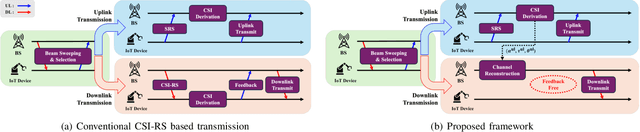
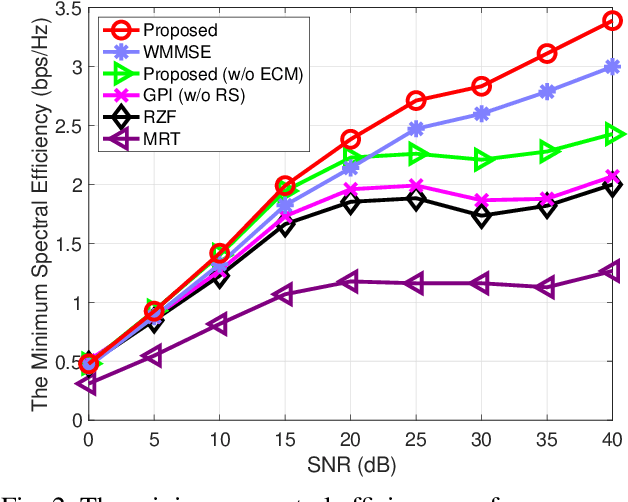
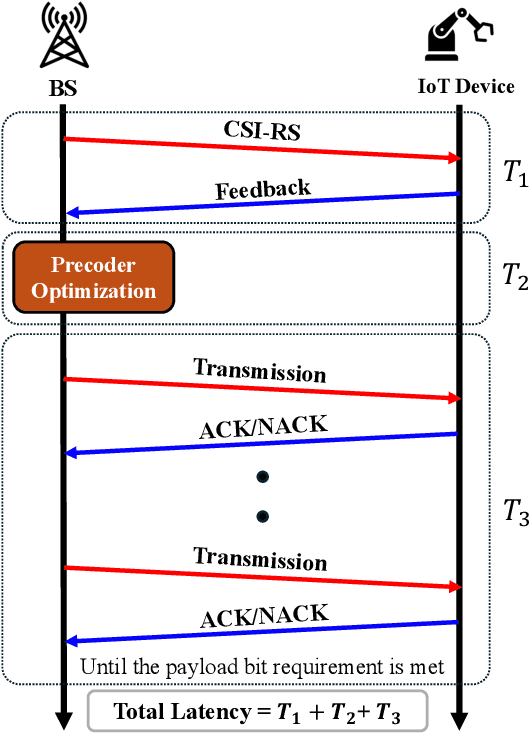
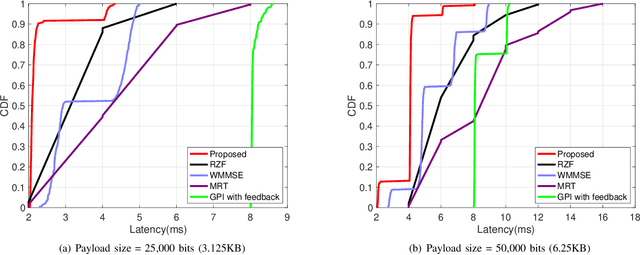
This paper presents a novel framework for low-latency frequency division duplex (FDD) multi-input multi-output (MIMO) transmission with Internet of Things (IoT) communications. Our key idea is eliminating feedback associated with downlink channel state information at the transmitter (CSIT) acquisition. Instead, we propose to reconstruct downlink CSIT from uplink reference signals by exploiting the frequency invariance property on channel parameters. Nonetheless, the frequency disparity between the uplink and downlink makes it impossible to get perfect downlink CSIT, resulting in substantial interference. To address this, we formulate a max-min fairness problem and propose a rate-splitting multiple access (RSMA)-aided efficient precoding method. In particular, to fully harness the potential benefits of RSMA, we propose a method that approximates the error covariance matrix and incorporates it into the precoder optimization process. This approach effectively accounts for the impact of imperfect CSIT, enabling the design of a robust precoder that efficiently handles CSIT inaccuracies. Simulation results demonstrate that our framework outperforms other baseline methods in terms of the minimum spectral efficiency when no direct CSI feedback is used. Moreover, we show that our framework significantly reduces communication latency compared to conventional CSI feedback-based methods, underscoring its effectiveness in enhancing latency performance for IoT communications.