 Add to Chrome
 Add to Firefox
 Add to Edge
Geometry-Aware DRL for Multi-Subband Scheduling in Satellite-Assisted UAM Networks
Aug 18, 2026
In this paper, we investigate downlink scheduling for urban air mobility (UAM) in a cooperative space-air-ground integrated network. Multiple ground stations (GSs) employ narrow three-dimensional beams and share spectrum across multiple subbands, while a satellite provides an orthogonal-band service option. Rapidly time-varying geometry and directional interference require joint decisions on base station association, GS subband assignment, and transmit powers. We formulate a finite-horizon mixed discrete-continuous problem that maximizes sum rate while penalizing handovers and GS overload, using only UAM positions and velocities. To address the combinatorial scheduling problem, we propose GeoSetPPO, a geometry-aware set-attention proximal policy optimization (PPO) method that outputs per-UAM discrete association and subband decisions with permutation-invariant representations. Conditioned on each schedule, GS powers are computed by a per-slot successive convex approximation (SCA) module under per-GS power budgets and minimum signal-to-interference-plus-noise ratio (SINR) constraints. To reduce training cost and improve stability, we adopt a two-stage training strategy that transitions reward evaluation from uniform power to SCA-based power allocation. Simulations demonstrate stable convergence, higher returns than multi-layer perceptron (MLP)- and Transformer-based PPO under the considered training setting, and favorable reward and schedule-feasibility performance relative to algorithm-based and distance-based schedulers. In the larger evaluated network, GeoSetPPO also reduces the scheduling latency from 40.84 ms to 2.90 ms relative to the previous algorithm-based method.

Channel2World: A Wireless Foundation Model for RF Environment Representation
Aug 18, 2026Wireless channels are commonly treated as link-specific observations, although their multipath structure is governed by the surrounding radio-frequency (RF) environment. In this paper, we propose Channel2World, a wireless foundation model that learns a reusable environment-level representation from multiple-input multiple-output (MIMO) channel-position observations. The model aggregates channels collected within the same base-station-centered environment into a wireless world embedding using a Transformer-based encoder. The encoder is pretrained through context-query prediction, where context channels condition user equipment (UE) position and relative path-gain prediction for disjoint query channels. After pretraining, the encoder is frozen and used as a task-agnostic environment-conditioning module for downstream wireless models, enabling adaptation to unseen environments without site-specific fine-tuning. To learn an environment-level latent space that generalizes across deployments, we pretrain Channel2World using ray-tracing data from 26,000 environments, with approximately 5,000 channel measurements per environment. Evaluations on UE localization, beam-domain channel state information (CSI) reconstruction, and RF-observable geometry reconstruction show that the learned embeddings provide effective conditioning in unseen environments. For localization and CSI reconstruction tasks, embedding-based conditioning outperforms or remains competitive with site-specific fine-tuning, although fine-tuning requires task-specific labeled data and additional gradient-based adaptation. The embeddings also support the reconstruction of dominant reflector structures, indicating their utility as reusable environmental priors across tasks.
Toward Quantum-Enhanced ISAC: Active-RIS-Aided Integrated Sensing and Communication with Rydberg Atomic Receivers
Jun 16, 2026In this paper, we investigate an active-RIS (ARIS)-aided integrated sensing and communication (ISAC) system with Rydberg Atomic REceiver (RARE). Leveraging the magnitude-only and real-domain observation structure of RARE, we first derive a unified ISAC model, along with a closed-form Cramer-Rao bound (CRB) for direction-of-arrival (DoA) estimation. Based on this formulation, we propose a joint design of the {base station (BS)} beamforming and ARIS reflection coefficients to minimize the CRB under RARE-specific signal-to-interference-noise-ratio (SINR) and ARIS power constraints. To tackle the resulting highly non-convex problem, we develop an alternating optimization (AO) framework that combines semidefinite relaxation (SDR) for beamforming and a majorization-minimization (MM)-based approach for ARIS design. Numerical results demonstrate that the proposed RARE-aware framework significantly outperforms conventional RF-based designs and achieves performance close to the radar-only benchmark, highlighting the potential of RARE for quantum-enhanced ISAC with ARIS.
A State-of-the-art Survey on Full-duplex Network Design
Feb 08, 2024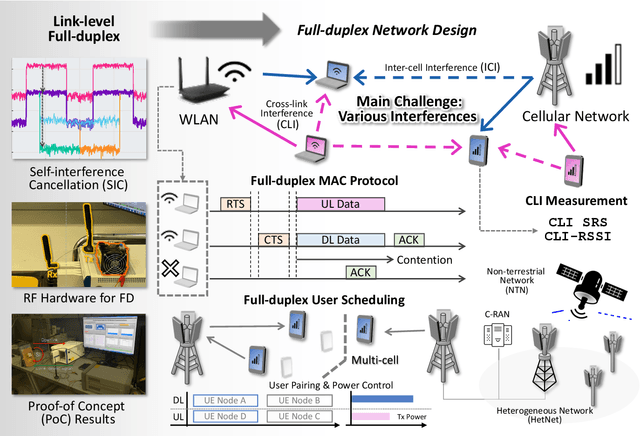
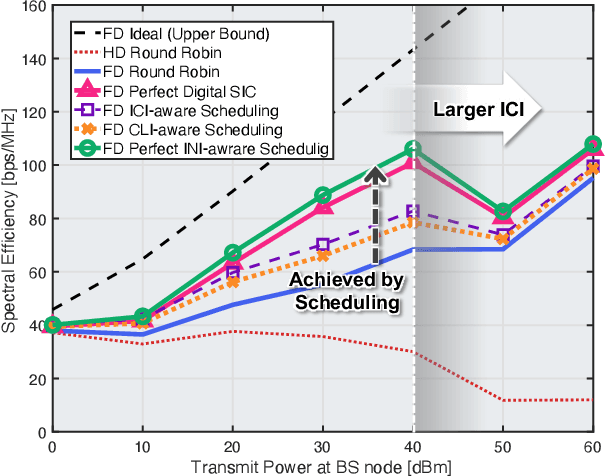
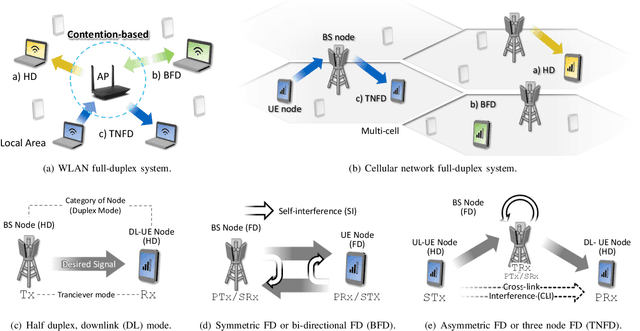
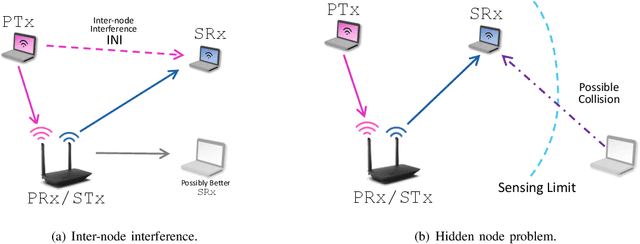
Full-duplex (FD) technology is gaining popularity for integration into a wide range of wireless networks due to its demonstrated potential in recent studies. In contrast to half-duplex (HD) technology, the implementation of FD in networks necessitates considering inter-node interference (INI) from various network perspectives. When deploying FD technology in networks, several critical factors must be taken into account. These include self-interference (SI) and the requisite SI cancellation (SIC) processes, as well as the selection of multiple user equipment (UE) per time slot. Additionally, inter-node interference (INI), including cross-link interference (CLI) and inter-cell interference (ICI), become crucial issues during concurrent uplink (UL) and downlink (DL) transmission and reception, similar to SI. Since most INI is challenging to eliminate, a comprehensive investigation that covers radio resource control (RRC), medium access control (MAC), and the physical layer (PHY) is essential in the context of FD network design, rather than focusing on individual network layers and types. This paper covers state-of-the-art studies, including protocols and documents from 3GPP for FD, MAC protocol, user scheduling, and CLI handling. The methods are also compared through a network-level system simulation based on 3D ray-tracing.
Pointing-and-Acquisition for Optical Wireless in 6G: From Algorithms to Performance Evaluation
Sep 20, 2023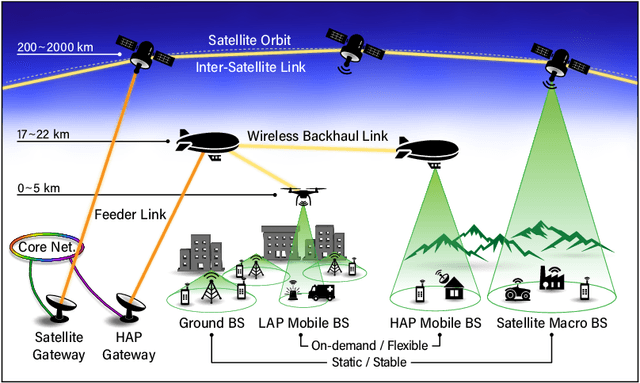
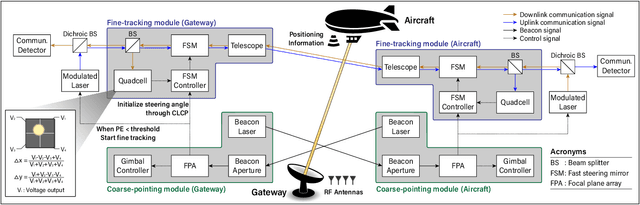
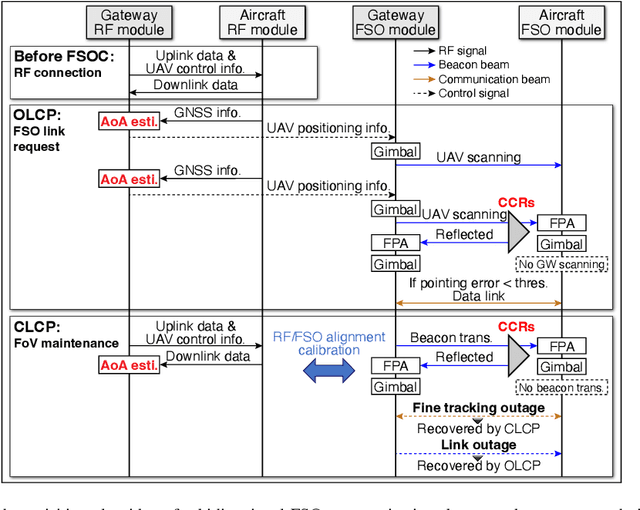
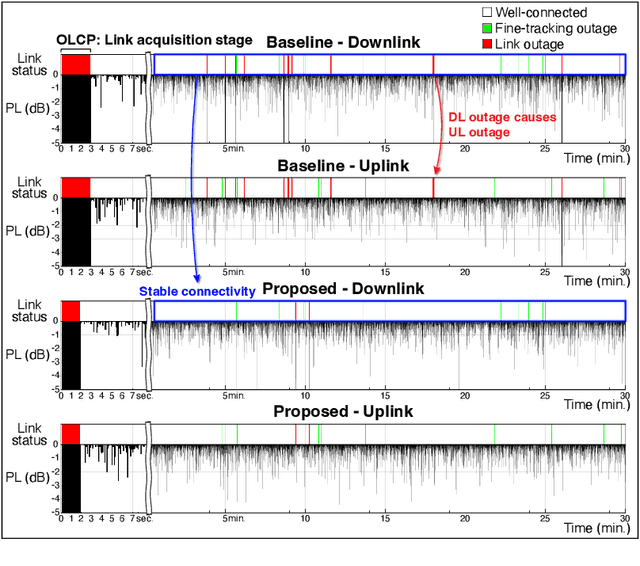
The increasing demand for wireless communication services has led to the development of non-terrestrial networks, which enables various air and space applications. Free-space optical (FSO) communication is considered one of the essential technologies capable of connecting terrestrial and non-terrestrial layers. In this article, we analyze considerations and challenges for FSO communications between gateways and aircraft from a pointing-and-acquisition perspective. Based on the analysis, we first develop a baseline method that utilizes conventional devices and mechanisms. Furthermore, we propose an algorithm that combines angle of arrival (AoA) estimation through supplementary radio frequency (RF) links and beam tracking using retroreflectors. Through extensive simulations, we demonstrate that the proposed method offers superior performance in terms of link acquisition and maintenance.
Performance Analysis of Passive Retro-Reflector Based Tracking in Free-Space Optical Communications with Pointing Errors
Mar 16, 2023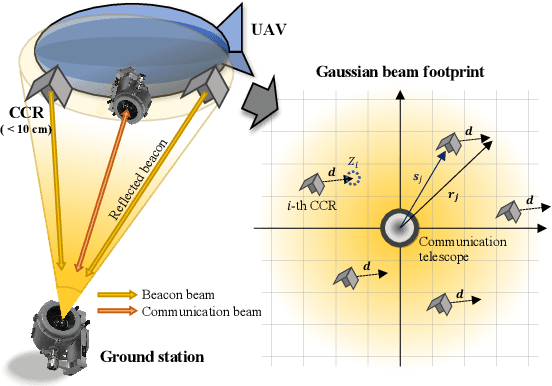
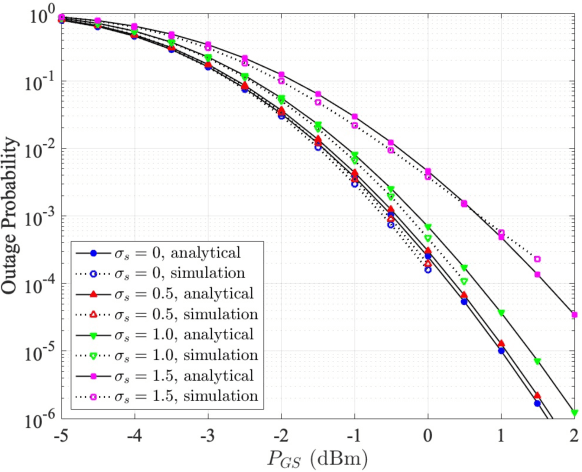
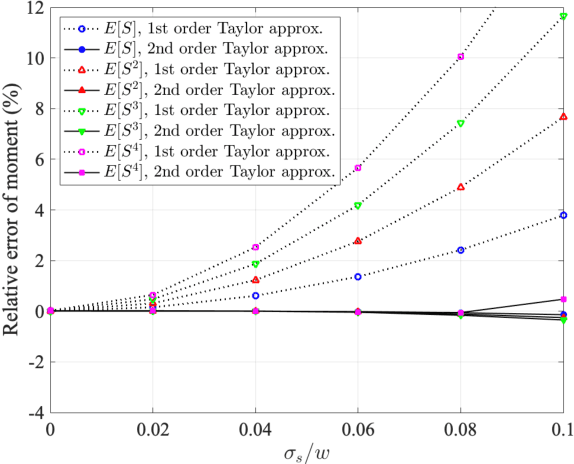
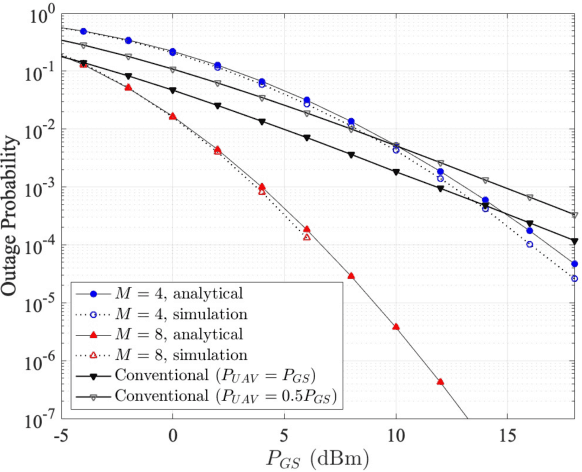
In this correspondence, we propose a diversity-achieving retroreflector-based fine tracking system for free-space optical (FSO) communications. We show that multiple retroreflectors deployed around the communication telescope at the aerial vehicle save the payload capacity and enhance the outage performance of the fine tracking system. Through the analysis of the joint-pointing loss of the multiple retroreflectors, we derive the ordered moments of the received power. Our analysis can be further utilized for studies on multiple input multiple output (MIMO)-FSO. After the moment-based estimation of the received power distribution, we numerically analyze the outage performance. The greatest challenge of retroreflector-based FSO communication is a significant decrease in power. Still, our selected numerical results show that, from an outage perspective, the proposed method can surpass conventional methods.
Free-Space Optical Communications for 6G-enabled Long-Range Wireless Networks: Challenges, Opportunities, and Prototype Validation
Sep 16, 2022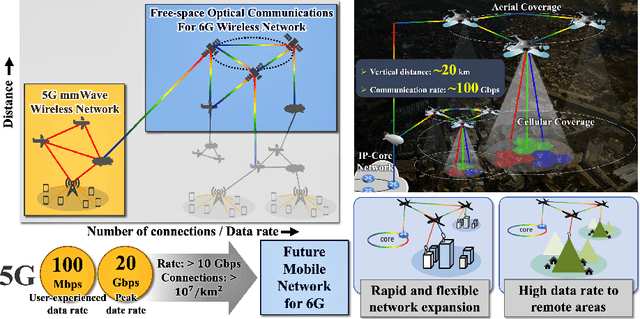
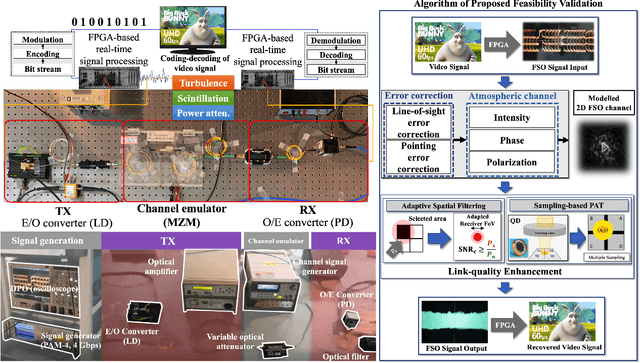
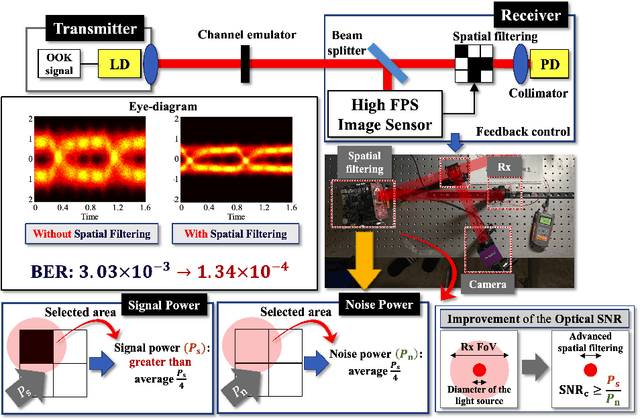
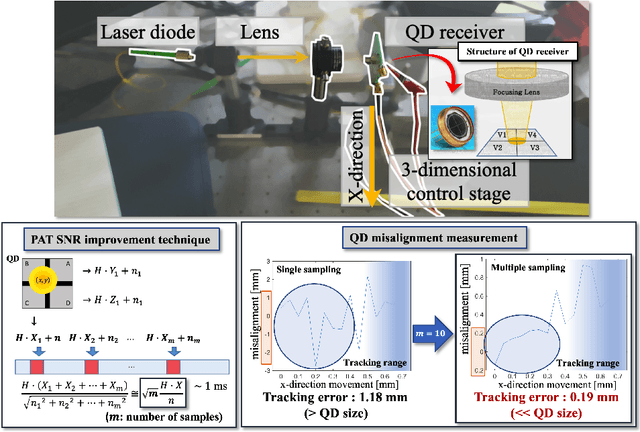
Numerous researchers have studied innovations in future sixth-generation (6G) wireless communications. Indeed, a critical issue that has emerged is to contend with society's insatiable demand for high data rates and massive 6G connectivity. Some scholars consider one innovation to be a breakthrough--the application of free-space optical (FSO) communication. Owing to its exceedingly high carrier frequency/bandwidth and the potential of the unlicensed spectrum domain, FSO communication provides an excellent opportunity to develop ultrafast data links that can be applied in a variety of 6G applications, including heterogeneous networks with enormous connectivity and wireless backhauls for cellular systems. In this study, we perform video signal transmissions via an FPGA-based FSO communication prototype to investigate the feasibility of an FSO link with a distance of up to 20~km. We use a channel emulator to reliably model turbulence, scintillation, and power attenuation of the long-range FSO channel. We use the FPGA-based real-time SDR prototype to process the transmitted and received video signals. Our study also presents the channel-generation process of a given long-distance FSO link. To enhance the link quality, we apply spatial selective filtering to suppress the background noise generated by sunlight. To measure the misalignment of the transceiver, we use sampling-based pointing, acquisition, and tracking to compensate for it by improving the signal-to-noise ratio. For the main video signal transmission testbed, we consider various environments by changing the amount of turbulence and wind speed. We demonstrate that the testbed even permits the successful transmission of ultra-high-definition (UHD: 3840 x 2160 resolution) 60 fps videos under severe turbulence and high wind speeds.
RF Lens Antenna Array-Based One-Shot Coarse Pointing for Hybrid RF/FSO Communications
Oct 05, 2021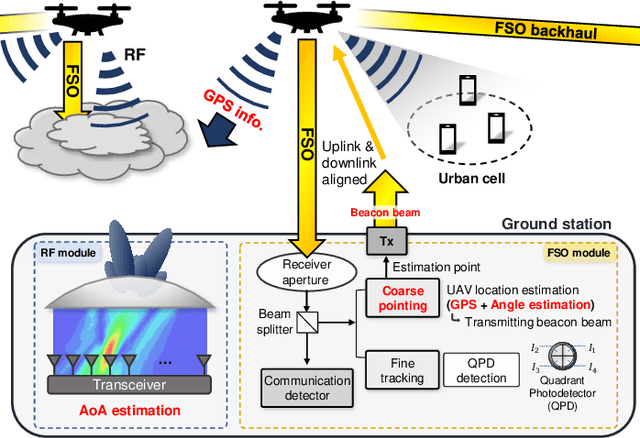
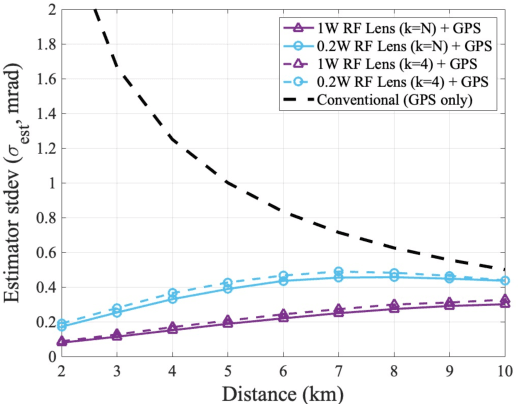
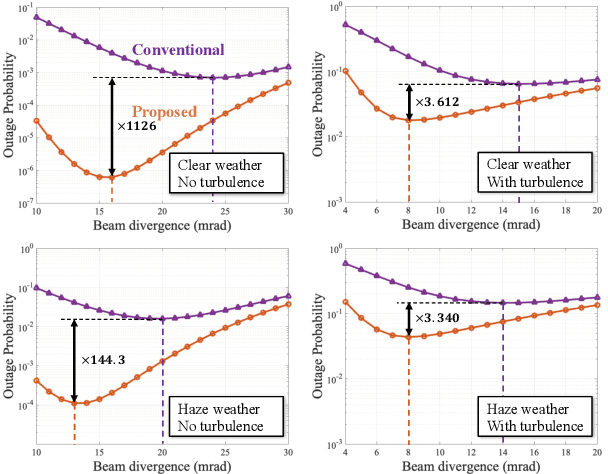
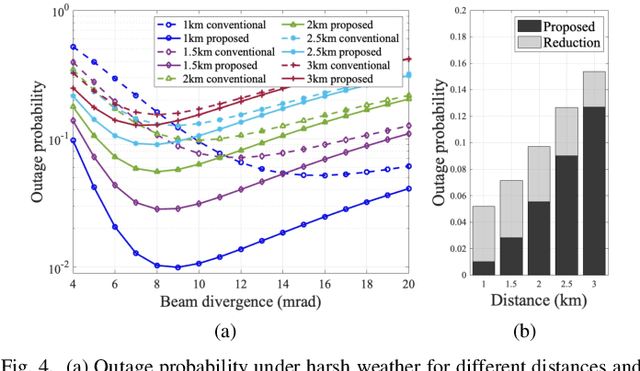
Because of its high directivity, free-space optical (FSO) communication offers a number of advantages. It can, however, give rise to major system difficulties concerning alignment between two terminals. During the link-acquisition step (a.k.a. coarse pointing), a ground station can be prevented from acquiring optical links due to pointing errors and insufficient information about unmanned aerial vehicle locations. We propose, in this letter, a radio-frequency (RF) lens antenna array to increase the performance of coarse pointing in hybrid RF/FSO communications. The proposed algorithm using a novel closed-form angle estimator, compared to conventional methods, reduces the minimum outage probability by over a thousand times.