 Add to Chrome
 Add to Firefox
 Add to Edge
SCREWS: A Modular Framework for Reasoning with Revisions
Sep 20, 2023
Large language models (LLMs) can improve their accuracy on various tasks through iteratively refining and revising their output based on feedback. We observe that these revisions can introduce errors, in which case it is better to roll back to a previous result. Further, revisions are typically homogeneous: they use the same reasoning method that produced the initial answer, which may not correct errors. To enable exploration in this space, we present SCREWS, a modular framework for reasoning with revisions. It is comprised of three main modules: Sampling, Conditional Resampling, and Selection, each consisting of sub-modules that can be hand-selected per task. We show that SCREWS not only unifies several previous approaches under a common framework, but also reveals several novel strategies for identifying improved reasoning chains. We evaluate our framework with state-of-the-art LLMs (ChatGPT and GPT-4) on a diverse set of reasoning tasks and uncover useful new reasoning strategies for each: arithmetic word problems, multi-hop question answering, and code debugging. Heterogeneous revision strategies prove to be important, as does selection between original and revised candidates.

Distilling Multi-Step Reasoning Capabilities of Large Language Models into Smaller Models via Semantic Decompositions
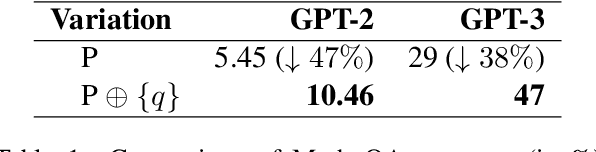
Dec 01, 2022Step-by-step reasoning approaches like chain-of-thought (CoT) have proved to be a very effective technique to induce reasoning capabilities in large language models. However, the success of the CoT approach depends primarily on model size, and often billion parameter-scale models are needed to get CoT to work. In this paper, we propose a knowledge distillation approach, that leverages the step-by-step CoT reasoning capabilities of larger models and distils these reasoning abilities into smaller models. Our approach Decompositional Distillation learns a semantic decomposition of the original problem into a sequence of subproblems and uses it to train two models: a) a problem decomposer that learns to decompose the complex reasoning problem into a sequence of simpler sub-problems and b) a problem solver that uses the intermediate subproblems to solve the overall problem. On a multi-step math word problem dataset (GSM8K), we boost the performance of GPT-2 variants up to 35% when distilled with our approach compared to CoT. We show that using our approach, it is possible to train a GPT-2-large model (775M) that can outperform a 10X larger GPT-3 (6B) model trained using CoT reasoning. Finally, we also demonstrate that our approach of problem decomposition can also be used as an alternative to CoT prompting, which boosts the GPT-3 performance by 40% compared to CoT prompts.
Automatic Generation of Socratic Subquestions for Teaching Math Word Problems
Nov 23, 2022
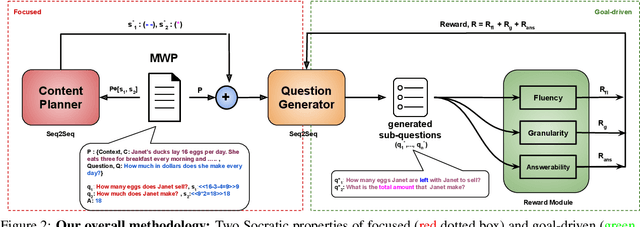
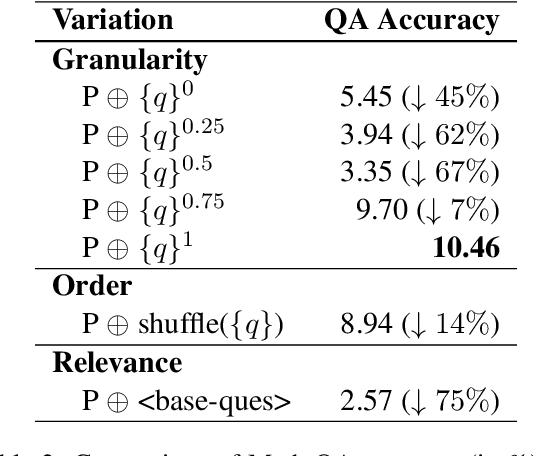
Socratic questioning is an educational method that allows students to discover answers to complex problems by asking them a series of thoughtful questions. Generation of didactically sound questions is challenging, requiring understanding of the reasoning process involved in the problem. We hypothesize that such questioning strategy can not only enhance the human performance, but also assist the math word problem (MWP) solvers. In this work, we explore the ability of large language models (LMs) in generating sequential questions for guiding math word problem-solving. We propose various guided question generation schemes based on input conditioning and reinforcement learning. On both automatic and human quality evaluations, we find that LMs constrained with desirable question properties generate superior questions and improve the overall performance of a math word problem solver. We conduct a preliminary user study to examine the potential value of such question generation models in the education domain. Results suggest that the difficulty level of problems plays an important role in determining whether questioning improves or hinders human performance. We discuss the future of using such questioning strategies in education.
Longtonotes: OntoNotes with Longer Coreference Chains
Oct 07, 2022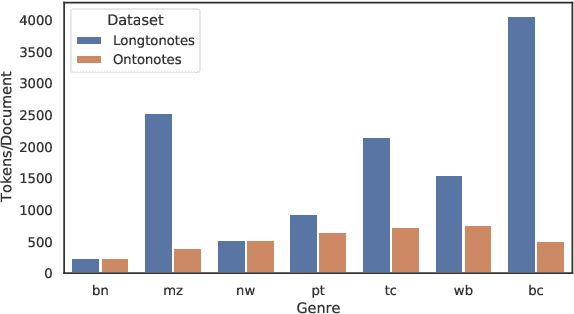
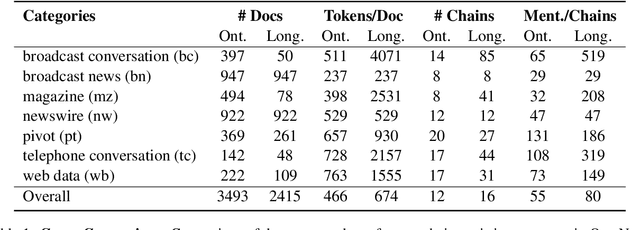
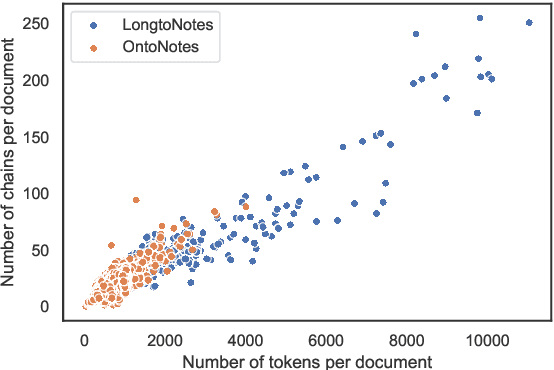
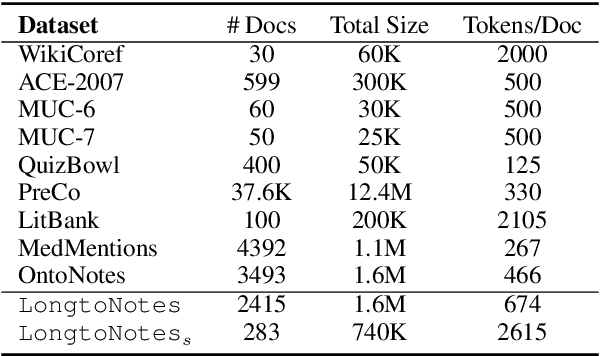
Ontonotes has served as the most important benchmark for coreference resolution. However, for ease of annotation, several long documents in Ontonotes were split into smaller parts. In this work, we build a corpus of coreference-annotated documents of significantly longer length than what is currently available. We do so by providing an accurate, manually-curated, merging of annotations from documents that were split into multiple parts in the original Ontonotes annotation process. The resulting corpus, which we call LongtoNotes contains documents in multiple genres of the English language with varying lengths, the longest of which are up to 8x the length of documents in Ontonotes, and 2x those in Litbank. We evaluate state-of-the-art neural coreference systems on this new corpus, analyze the relationships between model architectures/hyperparameters and document length on performance and efficiency of the models, and demonstrate areas of improvement in long-document coreference modeling revealed by our new corpus. Our data and code is available at: https://github.com/kumar-shridhar/LongtoNotes.
Learning to Drop Out: An Adversarial Approach to Training Sequence VAEs
Sep 26, 2022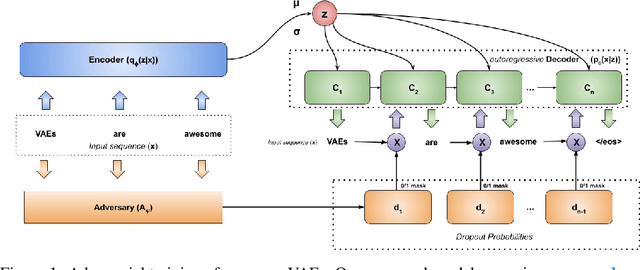
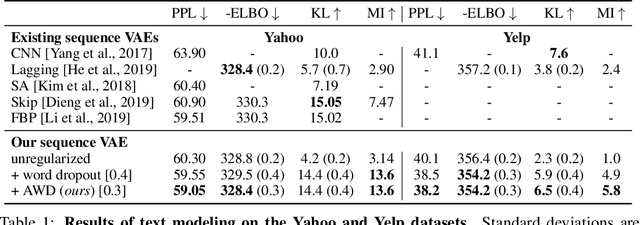
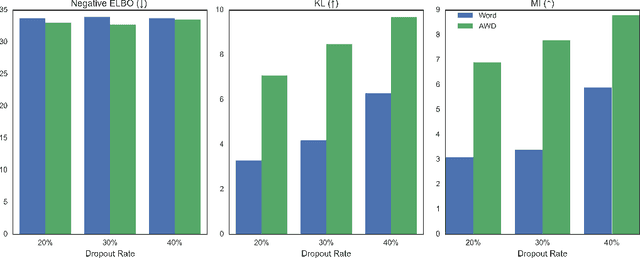
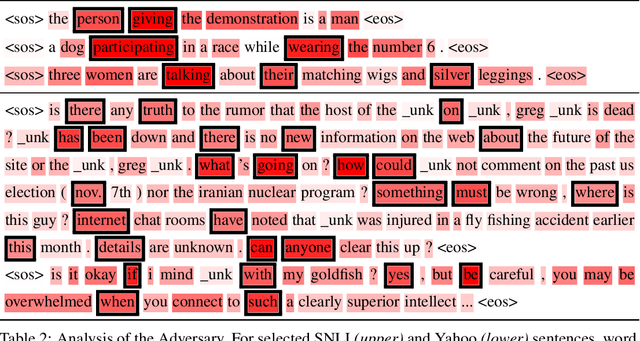
In principle, applying variational autoencoders (VAEs) to sequential data offers a method for controlled sequence generation, manipulation, and structured representation learning. However, training sequence VAEs is challenging: autoregressive decoders can often explain the data without utilizing the latent space, known as posterior collapse. To mitigate this, state-of-the-art models weaken the powerful decoder by applying uniformly random dropout to the decoder input. We show theoretically that this removes pointwise mutual information provided by the decoder input, which is compensated for by utilizing the latent space. We then propose an adversarial training strategy to achieve information-based stochastic dropout. Compared to uniform dropout on standard text benchmark datasets, our targeted approach increases both sequence modeling performance and the information captured in the latent space.
Beyond the Imitation Game: Quantifying and extrapolating the capabilities of language models
Jun 10, 2022Language models demonstrate both quantitative improvement and new qualitative capabilities with increasing scale. Despite their potentially transformative impact, these new capabilities are as yet poorly characterized. In order to inform future research, prepare for disruptive new model capabilities, and ameliorate socially harmful effects, it is vital that we understand the present and near-future capabilities and limitations of language models. To address this challenge, we introduce the Beyond the Imitation Game benchmark (BIG-bench). BIG-bench currently consists of 204 tasks, contributed by 442 authors across 132 institutions. Task topics are diverse, drawing problems from linguistics, childhood development, math, common-sense reasoning, biology, physics, social bias, software development, and beyond. BIG-bench focuses on tasks that are believed to be beyond the capabilities of current language models. We evaluate the behavior of OpenAI's GPT models, Google-internal dense transformer architectures, and Switch-style sparse transformers on BIG-bench, across model sizes spanning millions to hundreds of billions of parameters. In addition, a team of human expert raters performed all tasks in order to provide a strong baseline. Findings include: model performance and calibration both improve with scale, but are poor in absolute terms (and when compared with rater performance); performance is remarkably similar across model classes, though with benefits from sparsity; tasks that improve gradually and predictably commonly involve a large knowledge or memorization component, whereas tasks that exhibit "breakthrough" behavior at a critical scale often involve multiple steps or components, or brittle metrics; social bias typically increases with scale in settings with ambiguous context, but this can be improved with prompting.
One to rule them all: Towards Joint Indic Language Hate Speech Detection
Sep 28, 2021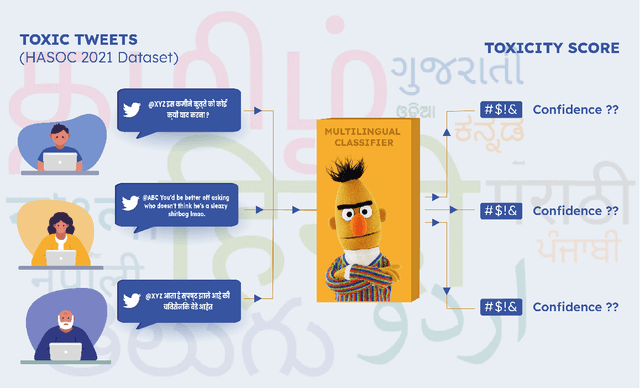
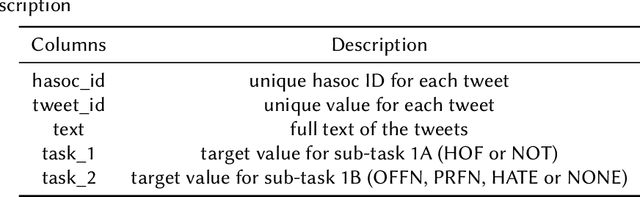
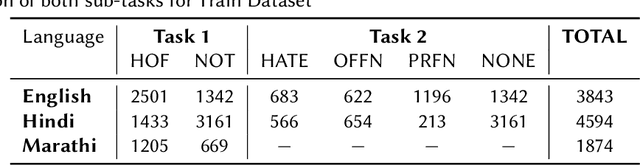
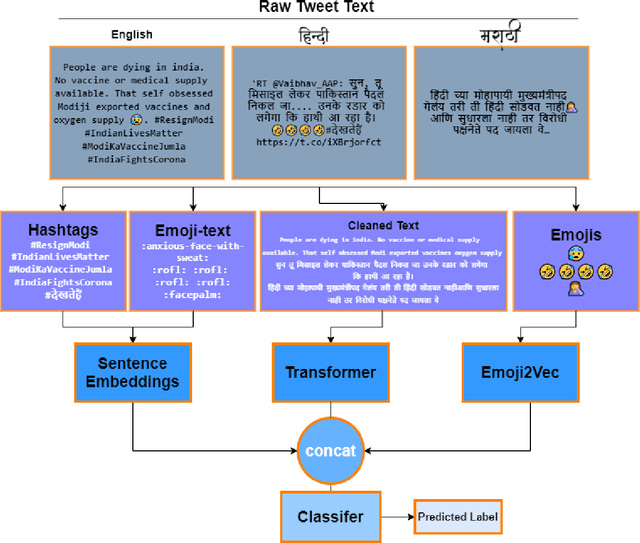
This paper is a contribution to the Hate Speech and Offensive Content Identification in Indo-European Languages (HASOC) 2021 shared task. Social media today is a hotbed of toxic and hateful conversations, in various languages. Recent news reports have shown that current models struggle to automatically identify hate posted in minority languages. Therefore, efficiently curbing hate speech is a critical challenge and problem of interest. We present a multilingual architecture using state-of-the-art transformer language models to jointly learn hate and offensive speech detection across three languages namely, English, Hindi, and Marathi. On the provided testing corpora, we achieve Macro F1 scores of 0.7996, 0.7748, 0.8651 for sub-task 1A and 0.6268, 0.5603 during the fine-grained classification of sub-task 1B. These results show the efficacy of exploiting a multilingual training scheme.
Translational Equivariance in Kernelizable Attention
Feb 15, 2021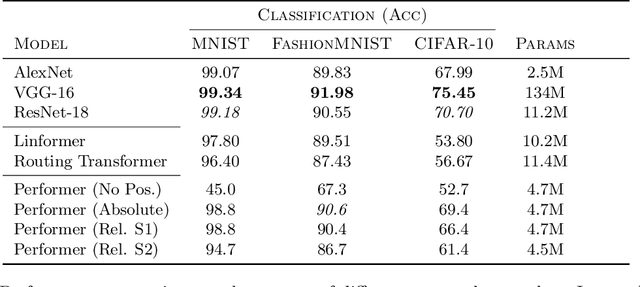
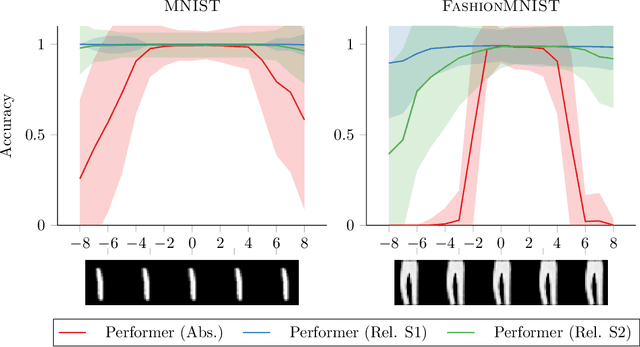
While Transformer architectures have show remarkable success, they are bound to the computation of all pairwise interactions of input element and thus suffer from limited scalability. Recent work has been successful by avoiding the computation of the complete attention matrix, yet leads to problems down the line. The absence of an explicit attention matrix makes the inclusion of inductive biases relying on relative interactions between elements more challenging. An extremely powerful inductive bias is translational equivariance, which has been conjectured to be responsible for much of the success of Convolutional Neural Networks on image recognition tasks. In this work we show how translational equivariance can be implemented in efficient Transformers based on kernelizable attention - Performers. Our experiments highlight that the devised approach significantly improves robustness of Performers to shifts of input images compared to their naive application. This represents an important step on the path of replacing Convolutional Neural Networks with more expressive Transformer architectures and will help to improve sample efficiency and robustness in this realm.
Indic-Transformers: An Analysis of Transformer Language Models for Indian Languages
Nov 04, 2020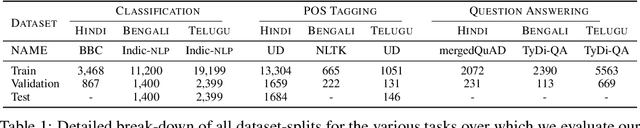
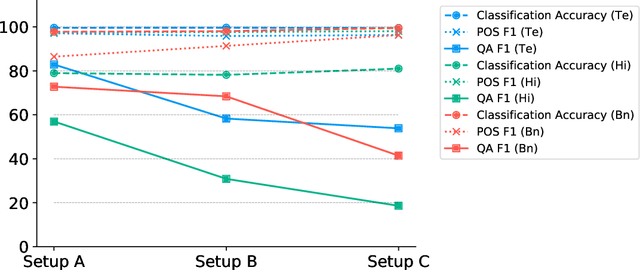
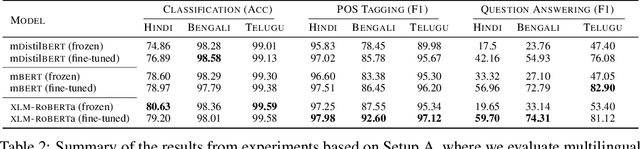

Language models based on the Transformer architecture have achieved state-of-the-art performance on a wide range of NLP tasks such as text classification, question-answering, and token classification. However, this performance is usually tested and reported on high-resource languages, like English, French, Spanish, and German. Indian languages, on the other hand, are underrepresented in such benchmarks. Despite some Indian languages being included in training multilingual Transformer models, they have not been the primary focus of such work. In order to evaluate the performance on Indian languages specifically, we analyze these language models through extensive experiments on multiple downstream tasks in Hindi, Bengali, and Telugu language. Here, we compare the efficacy of fine-tuning model parameters of pre-trained models against that of training a language model from scratch. Moreover, we empirically argue against the strict dependency between the dataset size and model performance, but rather encourage task-specific model and method selection. We achieve state-of-the-art performance on Hindi and Bengali languages for text classification task. Finally, we present effective strategies for handling the modeling of Indian languages and we release our model checkpoints for the community : https://huggingface.co/neuralspace-reverie.
End to End Binarized Neural Networks for Text Classification
Oct 11, 2020
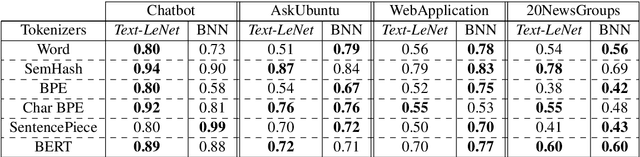
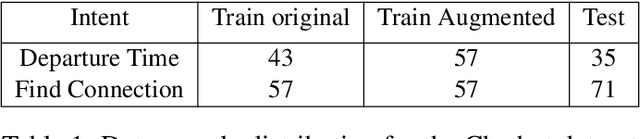
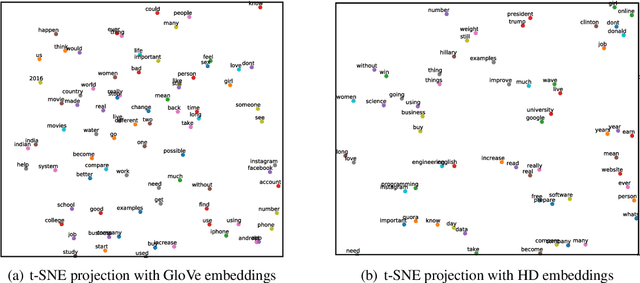
Deep neural networks have demonstrated their superior performance in almost every Natural Language Processing task, however, their increasing complexity raises concerns. In particular, these networks require high expenses on computational hardware, and training budget is a concern for many. Even for a trained network, the inference phase can be too demanding for resource-constrained devices, thus limiting its applicability. The state-of-the-art transformer models are a vivid example. Simplifying the computations performed by a network is one way of relaxing the complexity requirements. In this paper, we propose an end to end binarized neural network architecture for the intent classification task. In order to fully utilize the potential of end to end binarization, both input representations (vector embeddings of tokens statistics) and the classifier are binarized. We demonstrate the efficiency of such architecture on the intent classification of short texts over three datasets and for text classification with a larger dataset. The proposed architecture achieves comparable to the state-of-the-art results on standard intent classification datasets while utilizing ~ 20-40% lesser memory and training time. Furthermore, the individual components of the architecture, such as binarized vector embeddings of documents or binarized classifiers, can be used separately with not necessarily fully binary architectures.