 Add to Chrome
 Add to Firefox
 Add to Edge
Improving Deep Representation Learning via Auxiliary Learnable Target Coding
May 30, 2023
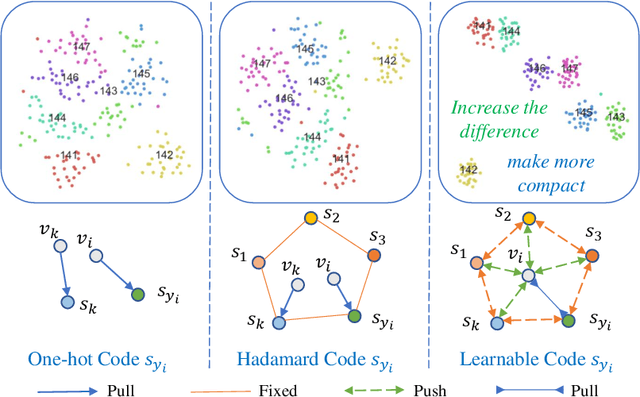
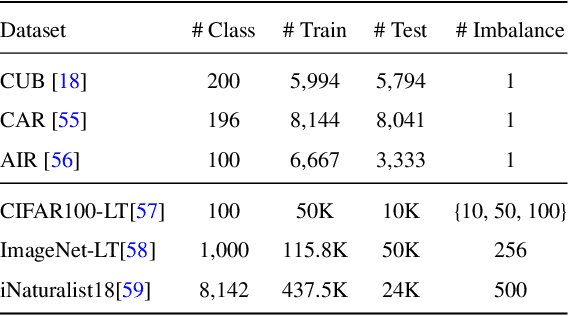
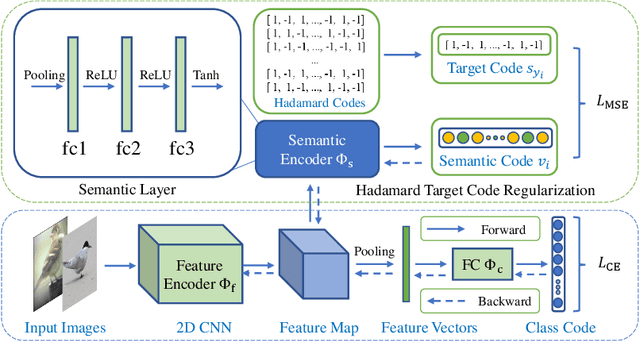
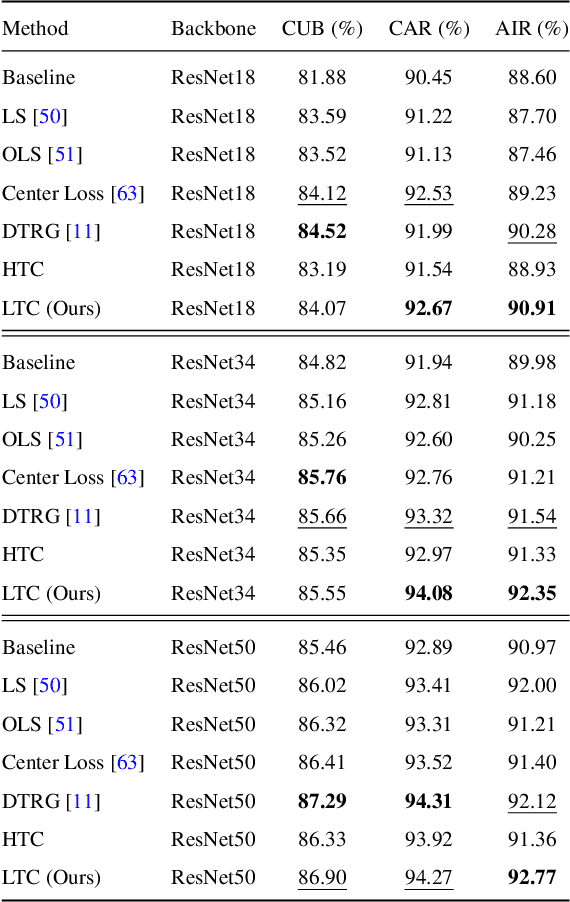
Deep representation learning is a subfield of machine learning that focuses on learning meaningful and useful representations of data through deep neural networks. However, existing methods for semantic classification typically employ pre-defined target codes such as the one-hot and the Hadamard codes, which can either fail or be less flexible to model inter-class correlation. In light of this, this paper introduces a novel learnable target coding as an auxiliary regularization of deep representation learning, which can not only incorporate latent dependency across classes but also impose geometric properties of target codes into representation space. Specifically, a margin-based triplet loss and a correlation consistency loss on the proposed target codes are designed to encourage more discriminative representations owing to enlarging between-class margins in representation space and favoring equal semantic correlation of learnable target codes respectively. Experimental results on several popular visual classification and retrieval benchmarks can demonstrate the effectiveness of our method on improving representation learning, especially for imbalanced data.

ShuffleMix: Improving Representations via Channel-Wise Shuffle of Interpolated Hidden States
May 30, 2023
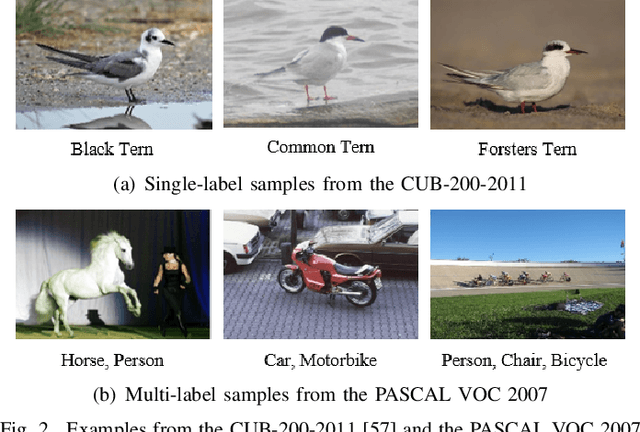
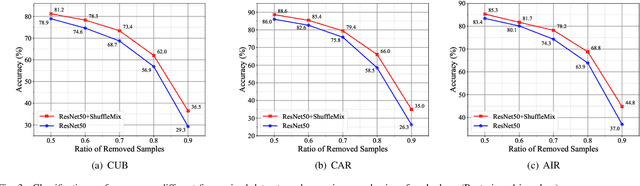
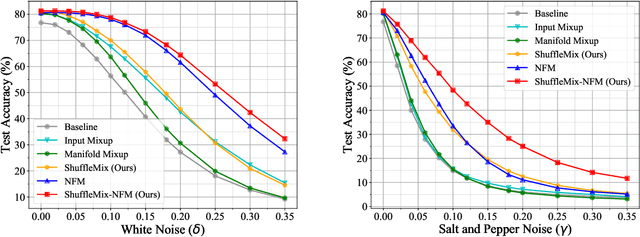
Mixup style data augmentation algorithms have been widely adopted in various tasks as implicit network regularization on representation learning to improve model generalization, which can be achieved by a linear interpolation of labeled samples in input or feature space as well as target space. Inspired by good robustness of alternative dropout strategies against over-fitting on limited patterns of training samples, this paper introduces a novel concept of ShuffleMix -- Shuffle of Mixed hidden features, which can be interpreted as a kind of dropout operation in feature space. Specifically, our ShuffleMix method favors a simple linear shuffle of randomly selected feature channels for feature mixup in-between training samples to leverage semantic interpolated supervision signals, which can be extended to a generalized shuffle operation via additionally combining linear interpolations of intra-channel features. Compared to its direct competitor of feature augmentation -- the Manifold Mixup, the proposed ShuffleMix can gain superior generalization, owing to imposing more flexible and smooth constraints on generating samples and achieving regularization effects of channel-wise feature dropout. Experimental results on several public benchmarking datasets of single-label and multi-label visual classification tasks can confirm the effectiveness of our method on consistently improving representations over the state-of-the-art mixup augmentation.
Manifold-Aware Self-Training for Unsupervised Domain Adaptation on Regressing 6D Object Pose
May 18, 2023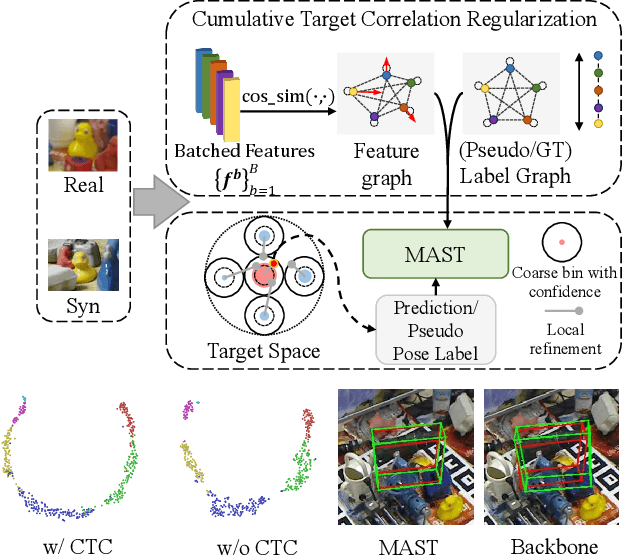

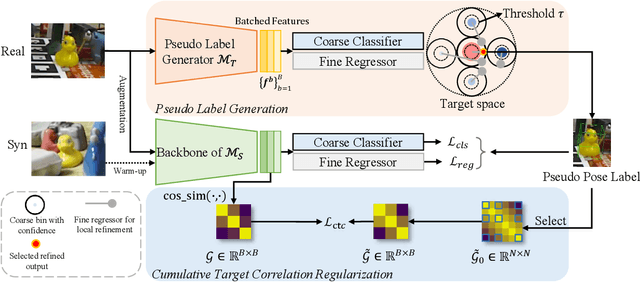
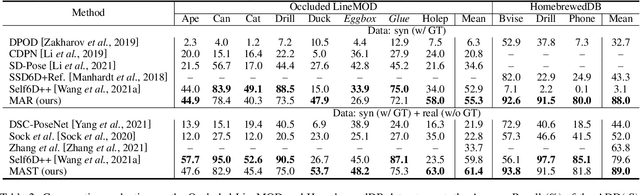
Domain gap between synthetic and real data in visual regression (\eg 6D pose estimation) is bridged in this paper via global feature alignment and local refinement on the coarse classification of discretized anchor classes in target space, which imposes a piece-wise target manifold regularization into domain-invariant representation learning. Specifically, our method incorporates an explicit self-supervised manifold regularization, revealing consistent cumulative target dependency across domains, to a self-training scheme (\eg the popular Self-Paced Self-Training) to encourage more discriminative transferable representations of regression tasks. Moreover, learning unified implicit neural functions to estimate relative direction and distance of targets to their nearest class bins aims to refine target classification predictions, which can gain robust performance against inconsistent feature scaling sensitive to UDA regressors. Experiment results on three public benchmarks of the challenging 6D pose estimation task can verify the effectiveness of our method, consistently achieving superior performance to the state-of-the-art for UDA on 6D pose estimation.
Universal Domain Adaptation from Foundation Models
May 18, 2023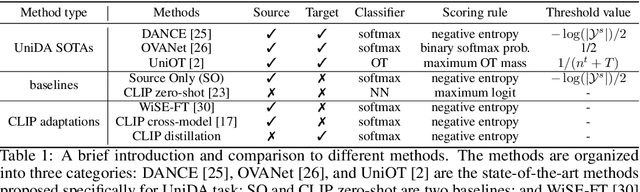
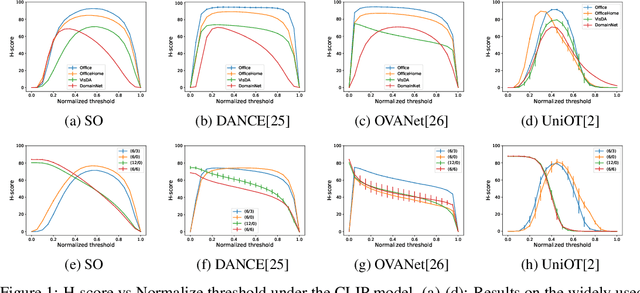
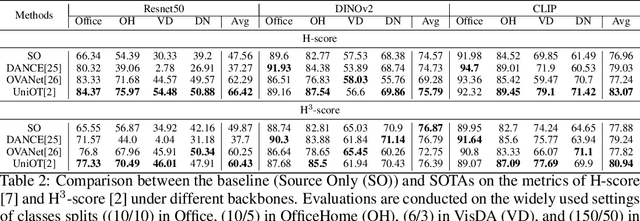
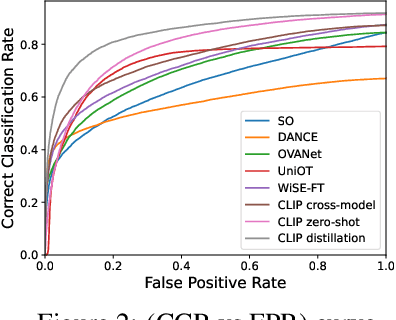
Foundation models (e.g., CLIP or DINOv2) have shown their impressive learning and transferring capabilities on a wide range of visual tasks, by training on a large corpus of data and adapting to specific downstream tasks. It is, however, interesting that foundation models have not been fully explored for universal domain adaptation (UniDA), which is to learn models using labeled data in a source domain and unlabeled data in a target one, such that the learned models can successfully adapt to the target data. In this paper, we make comprehensive empirical studies of state-of-the-art UniDA methods using foundation models. We first demonstrate that, while foundation models greatly improve the performance of the baseline methods that train the models on the source data alone, existing UniDA methods generally fail to improve over the baseline. This suggests that new research efforts are very necessary for UniDA using foundation models. To this end, we propose a very simple method of target data distillation on the CLIP model, and achieves consistent improvement over the baseline across all the UniDA benchmarks. Our studies are under a newly proposed evaluation metric of universal classification rate (UCR), which is threshold- and ratio-free and addresses the threshold-sensitive issue encountered when using the existing H-score metric.
STFAR: Improving Object Detection Robustness at Test-Time by Self-Training with Feature Alignment Regularization
Mar 31, 2023Domain adaptation helps generalizing object detection models to target domain data with distribution shift. It is often achieved by adapting with access to the whole target domain data. In a more realistic scenario, target distribution is often unpredictable until inference stage. This motivates us to explore adapting an object detection model at test-time, a.k.a. test-time adaptation (TTA). In this work, we approach test-time adaptive object detection (TTAOD) from two perspective. First, we adopt a self-training paradigm to generate pseudo labeled objects with an exponential moving average model. The pseudo labels are further used to supervise adapting source domain model. As self-training is prone to incorrect pseudo labels, we further incorporate aligning feature distributions at two output levels as regularizations to self-training. To validate the performance on TTAOD, we create benchmarks based on three standard object detection datasets and adapt generic TTA methods to object detection task. Extensive evaluations suggest our proposed method sets the state-of-the-art on test-time adaptive object detection task.
Fantasia3D: Disentangling Geometry and Appearance for High-quality Text-to-3D Content Creation
Mar 28, 2023Automatic 3D content creation has achieved rapid progress recently due to the availability of pre-trained, large language models and image diffusion models, forming the emerging topic of text-to-3D content creation. Existing text-to-3D methods commonly use implicit scene representations, which couple the geometry and appearance via volume rendering and are suboptimal in terms of recovering finer geometries and achieving photorealistic rendering; consequently, they are less effective for generating high-quality 3D assets. In this work, we propose a new method of Fantasia3D for high-quality text-to-3D content creation. Key to Fantasia3D is the disentangled modeling and learning of geometry and appearance. For geometry learning, we rely on a hybrid scene representation, and propose to encode surface normal extracted from the representation as the input of the image diffusion model. For appearance modeling, we introduce the spatially varying bidirectional reflectance distribution function (BRDF) into the text-to-3D task, and learn the surface material for photorealistic rendering of the generated surface. Our disentangled framework is more compatible with popular graphics engines, supporting relighting, editing, and physical simulation of the generated 3D assets. We conduct thorough experiments that show the advantages of our method over existing ones under different text-to-3D task settings. Project page and source codes: https://fantasia3d.github.io/.
A New Benchmark: On the Utility of Synthetic Data with Blender for Bare Supervised Learning and Downstream Domain Adaptation
Mar 23, 2023Deep learning in computer vision has achieved great success with the price of large-scale labeled training data. However, exhaustive data annotation is impracticable for each task of all domains of interest, due to high labor costs and unguaranteed labeling accuracy. Besides, the uncontrollable data collection process produces non-IID training and test data, where undesired duplication may exist. All these nuisances may hinder the verification of typical theories and exposure to new findings. To circumvent them, an alternative is to generate synthetic data via 3D rendering with domain randomization. We in this work push forward along this line by doing profound and extensive research on bare supervised learning and downstream domain adaptation. Specifically, under the well-controlled, IID data setting enabled by 3D rendering, we systematically verify the typical, important learning insights, e.g., shortcut learning, and discover the new laws of various data regimes and network architectures in generalization. We further investigate the effect of image formation factors on generalization, e.g., object scale, material texture, illumination, camera viewpoint, and background in a 3D scene. Moreover, we use the simulation-to-reality adaptation as a downstream task for comparing the transferability between synthetic and real data when used for pre-training, which demonstrates that synthetic data pre-training is also promising to improve real test results. Lastly, to promote future research, we develop a new large-scale synthetic-to-real benchmark for image classification, termed S2RDA, which provides more significant challenges for transfer from simulation to reality. The code and datasets are available at https://github.com/huitangtang/On_the_Utility_of_Synthetic_Data.
Revisiting Realistic Test-Time Training: Sequential Inference and Adaptation by Anchored Clustering Regularized Self-Training
Mar 20, 2023Deploying models on target domain data subject to distribution shift requires adaptation. Test-time training (TTT) emerges as a solution to this adaptation under a realistic scenario where access to full source domain data is not available, and instant inference on the target domain is required. Despite many efforts into TTT, there is a confusion over the experimental settings, thus leading to unfair comparisons. In this work, we first revisit TTT assumptions and categorize TTT protocols by two key factors. Among the multiple protocols, we adopt a realistic sequential test-time training (sTTT) protocol, under which we develop a test-time anchored clustering (TTAC) approach to enable stronger test-time feature learning. TTAC discovers clusters in both source and target domains and matches the target clusters to the source ones to improve adaptation. When source domain information is strictly absent (i.e. source-free) we further develop an efficient method to infer source domain distributions for anchored clustering. Finally, self-training~(ST) has demonstrated great success in learning from unlabeled data and we empirically figure out that applying ST alone to TTT is prone to confirmation bias. Therefore, a more effective TTT approach is introduced by regularizing self-training with anchored clustering, and the improved model is referred to as TTAC++. We demonstrate that, under all TTT protocols, TTAC++ consistently outperforms the state-of-the-art methods on five TTT datasets, including corrupted target domain, selected hard samples, synthetic-to-real adaptation and adversarially attacked target domain. We hope this work will provide a fair benchmarking of TTT methods, and future research should be compared within respective protocols.
HelixSurf: A Robust and Efficient Neural Implicit Surface Learning of Indoor Scenes with Iterative Intertwined Regularization
Mar 01, 2023Recovery of an underlying scene geometry from multiview images stands as a long-time challenge in computer vision research. The recent promise leverages neural implicit surface learning and differentiable volume rendering, and achieves both the recovery of scene geometry and synthesis of novel views, where deep priors of neural models are used as an inductive smoothness bias. While promising for object-level surfaces, these methods suffer when coping with complex scene surfaces. In the meanwhile, traditional multi-view stereo can recover the geometry of scenes with rich textures, by globally optimizing the local, pixel-wise correspondences across multiple views. We are thus motivated to make use of the complementary benefits from the two strategies, and propose a method termed Helix-shaped neural implicit Surface learning or HelixSurf; HelixSurf uses the intermediate prediction from one strategy as the guidance to regularize the learning of the other one, and conducts such intertwined regularization iteratively during the learning process. We also propose an efficient scheme for differentiable volume rendering in HelixSurf. Experiments on surface reconstruction of indoor scenes show that our method compares favorably with existing methods and is orders of magnitude faster, even when some of existing methods are assisted with auxiliary training data. The source code is available at https://github.com/Gorilla-Lab-SCUT/HelixSurf.
Unsupervised Domain Adaptation via Distilled Discriminative Clustering
Feb 23, 2023Unsupervised domain adaptation addresses the problem of classifying data in an unlabeled target domain, given labeled source domain data that share a common label space but follow a different distribution. Most of the recent methods take the approach of explicitly aligning feature distributions between the two domains. Differently, motivated by the fundamental assumption for domain adaptability, we re-cast the domain adaptation problem as discriminative clustering of target data, given strong privileged information provided by the closely related, labeled source data. Technically, we use clustering objectives based on a robust variant of entropy minimization that adaptively filters target data, a soft Fisher-like criterion, and additionally the cluster ordering via centroid classification. To distill discriminative source information for target clustering, we propose to jointly train the network using parallel, supervised learning objectives over labeled source data. We term our method of distilled discriminative clustering for domain adaptation as DisClusterDA. We also give geometric intuition that illustrates how constituent objectives of DisClusterDA help learn class-wisely pure, compact feature distributions. We conduct careful ablation studies and extensive experiments on five popular benchmark datasets, including a multi-source domain adaptation one. Based on commonly used backbone networks, DisClusterDA outperforms existing methods on these benchmarks. It is also interesting to observe that in our DisClusterDA framework, adding an additional loss term that explicitly learns to align class-level feature distributions across domains does harm to the adaptation performance, though more careful studies in different algorithmic frameworks are to be conducted.