 Add to Chrome
 Add to Firefox
 Add to Edge
Go-with-the-Track: Video Compositing and Motion Control with Point Tracking
Jun 18, 2026
Filmmaking demands precise motion control and reference image compositing -- capabilities that existing methods treat separately. Point-track-conditioned image-to-video models restrict content insertion to the first frame, while reference-to-video models lack fine-grained spatial-temporal control over how reference content integrates across frames. We present Go-with-the-Track, which unifies both capabilities by jointly conditioning on multiple reference images and reference-anchored point-tracks -- extending conventional point-tracks to explicitly establish correspondences between generated frames and reference images, thus enabling precise compositing and motion control throughout the video. To achieve this, we introduce spatially-aware point-track embeddings that encode the full sequence of point-track coordinates using a coordinate-wise MLP followed by temporal pooling. This representation captures the spatial characteristics of each point-track (serving as a unique identifier), while the embedding similarity correlates directly with spatial proximity, enhancing the model's ability to distinguish and associate point-tracks. We inject these point-track embeddings into a video diffusion transformer via a lightweight adapter, resolving the pixel-to-patch resolution mismatch while avoiding the substantial motion detail loss inherent in naive point-track subsampling. We use a hybrid training strategy to train jointly on dynamic, static, and synthetic scene video datasets to boost motion controllability. Experiments demonstrate that Go-with-the-Track achieves superior motion and reference control in a single model and enables new capabilities: multi-reference conditioned video generation with point-track driven compositing, as well as camera control for both static and dynamic scenes. Project Page: https://eyeline-labs.github.io/Go-with-the-Track/

Vista4D: Video Reshooting with 4D Point Clouds
Apr 23, 2026We present Vista4D, a robust and flexible video reshooting framework that grounds the input video and target cameras in a 4D point cloud. Specifically, given an input video, our method re-synthesizes the scene with the same dynamics from a different camera trajectory and viewpoint. Existing video reshooting methods often struggle with depth estimation artifacts of real-world dynamic videos, while also failing to preserve content appearance and failing to maintain precise camera control for challenging new trajectories. We build a 4D-grounded point cloud representation with static pixel segmentation and 4D reconstruction to explicitly preserve seen content and provide rich camera signals, and we train with reconstructed multiview dynamic data for robustness against point cloud artifacts during real-world inference. Our results demonstrate improved 4D consistency, camera control, and visual quality compared to state-of-the-art baselines under a variety of videos and camera paths. Moreover, our method generalizes to real-world applications such as dynamic scene expansion and 4D scene recomposition. See our project page for results, code, and models: https://eyeline-labs.github.io/Vista4D
Ctrl-X: Controlling Structure and Appearance for Text-To-Image Generation Without Guidance
Jun 11, 2024
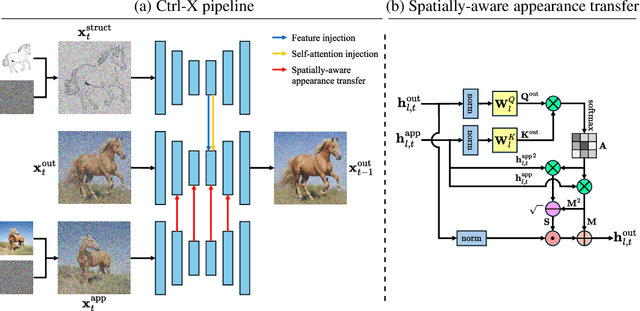
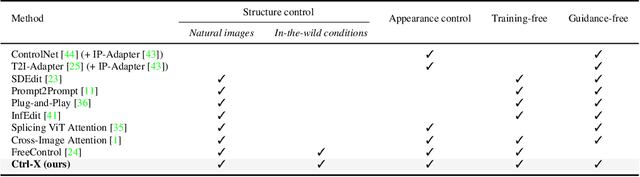
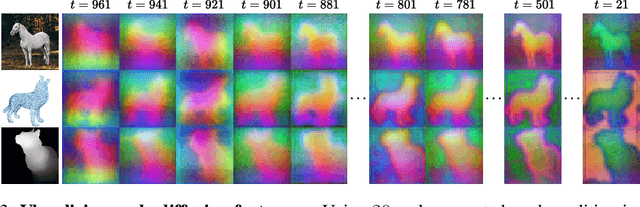
Recent controllable generation approaches such as FreeControl and Diffusion Self-guidance bring fine-grained spatial and appearance control to text-to-image (T2I) diffusion models without training auxiliary modules. However, these methods optimize the latent embedding for each type of score function with longer diffusion steps, making the generation process time-consuming and limiting their flexibility and use. This work presents Ctrl-X, a simple framework for T2I diffusion controlling structure and appearance without additional training or guidance. Ctrl-X designs feed-forward structure control to enable the structure alignment with a structure image and semantic-aware appearance transfer to facilitate the appearance transfer from a user-input image. Extensive qualitative and quantitative experiments illustrate the superior performance of Ctrl-X on various condition inputs and model checkpoints. In particular, Ctrl-X supports novel structure and appearance control with arbitrary condition images of any modality, exhibits superior image quality and appearance transfer compared to existing works, and provides instant plug-and-play functionality to any T2I and text-to-video (T2V) diffusion model. See our project page for an overview of the results: https://genforce.github.io/ctrl-x
FreeControl: Training-Free Spatial Control of Any Text-to-Image Diffusion Model with Any Condition
Dec 12, 2023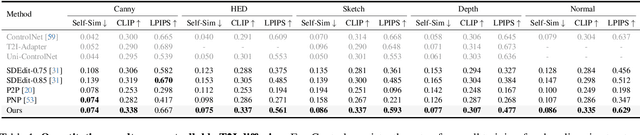
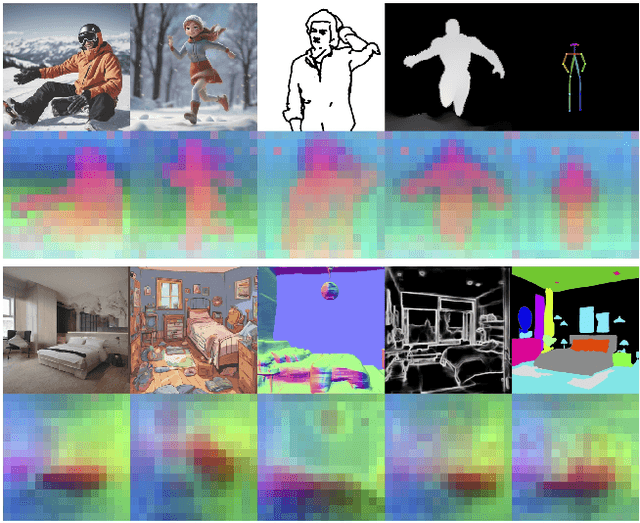
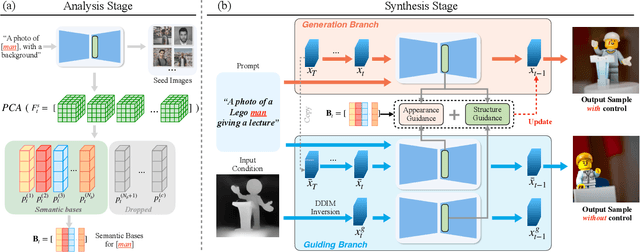
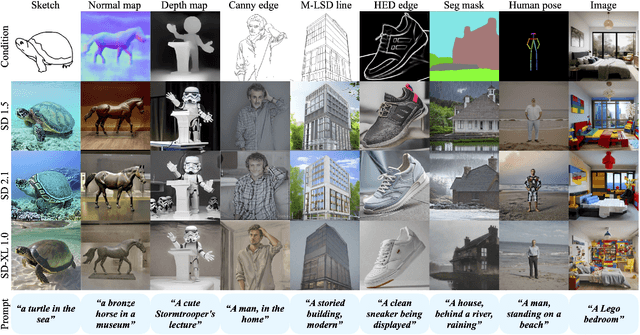
Recent approaches such as ControlNet offer users fine-grained spatial control over text-to-image (T2I) diffusion models. However, auxiliary modules have to be trained for each type of spatial condition, model architecture, and checkpoint, putting them at odds with the diverse intents and preferences a human designer would like to convey to the AI models during the content creation process. In this work, we present FreeControl, a training-free approach for controllable T2I generation that supports multiple conditions, architectures, and checkpoints simultaneously. FreeControl designs structure guidance to facilitate the structure alignment with a guidance image, and appearance guidance to enable the appearance sharing between images generated using the same seed. Extensive qualitative and quantitative experiments demonstrate the superior performance of FreeControl across a variety of pre-trained T2I models. In particular, FreeControl facilitates convenient training-free control over many different architectures and checkpoints, allows the challenging input conditions on which most of the existing training-free methods fail, and achieves competitive synthesis quality with training-based approaches.