 Add to Chrome
 Add to Firefox
 Add to Edge
Resolution Meets Reduction: Efficient Visual Context for 3D Radiology Report Generation
Aug 09, 2026
Vision-language models offer a promising path toward automating radiology report generation, but applying them to full 3D CT volumes poses substantial computational challenges. Modern foundation vision encoders (VEs) can produce tens of thousands of vision tokens per scan, making the visual sequence passed to the large language model (LLM) a primary computational bottleneck. Vision-to-language projectors can compress this sequence to reduce computation, but may discard clinically relevant detail; conversely, effective compression can accommodate higher-resolution inputs while keeping the downstream token count fixed. How this vision-token budget should be allocated across input field of view, spatial resolution, and vision-to-language projection therefore remains an open design question. We systematically evaluate four heterogeneous VEs (CNN- and ViT-based), five token-reducing projectors at up to 64x compression alongside a non-reducing MLP projector baseline, and five instruction-tuned LLMs (1.7B--4B) on two large-scale CT report datasets (CT-RATE and Merlin). At matched LLM token budgets, anatomy-guided region of interest cropping is the most consistent strategy, improving clinical macro F1 in 19 of 20 settings by +3.7 points on average for the 3D ViT Primus encoder and +1.1 for the slice-based 2D ViT Curia encoder. Increasing input resolution further is strongly projector-dependent: the PerceiverResampler, paired with higher-resolution Curia features, yields the strongest configuration in the resolution study on both datasets. Our best configurations achieve state-of-the-art clinical macro F1 on the test sets, reaching 49.5 on CT-RATE and 49.0 on Merlin. Code and models will be published upon publication.

Rethinking Post-Hoc Calibration in Semantic Segmentation
Jul 02, 2026Reliable confidence estimates are essential in semantic segmentation, especially in safety-critical settings where overconfident errors can mislead downstream decisions. Yet modern segmentation models often remain miscalibrated. Post-hoc calibration offers a practical way to correct confidence estimates without retraining the segmentation model, but its use in dense prediction raises structural issues that are often overlooked. We study two such issues. First, adding a constant to all logits leaves the softmax probabilities unchanged, but several standard calibrators can still depend on this arbitrary offset. As a result, two logit representations encoding the same predictive distribution may yield different calibrated probabilities. We define translation-invariant (TI) calibrators as those whose outputs are unchanged under such shifts, characterize which common calibrators satisfy this property, and construct TI counterparts of shift-sensitive calibrators to isolate the effect of removing representation dependence. Second, post-hoc calibration is typically fitted by minimizing a likelihood-based objective, whereas segmentation models are trained with task-specific metrics such as Dice. This mismatch can cause calibration to alter class orderings and degrade the deployed segmentation map. We study decision-preserving calibration under argmax- and order-preservation constraints. Since enforcing these constraints collapses affine softmax calibrators to temperature scaling, we introduce class-conditional affine calibrators that can be made argmax- or order-preserving while retaining greater expressivity, allowing us to quantify the calibration-segmentation trade-off induced by decision preservation. Across natural-image and medical segmentation benchmarks, and under corruption-based covariate shift, matched comparisons show that TI variants generally improve calibration metrics, while decision-preserving variants prevent segmentation degradation and retain strong calibration performance. These results provide practical design principles for well-defined post-hoc calibration pipelines in semantic segmentation.
Finally Outshining the Random Baseline: A Simple and Effective Solution for Active Learning in 3D Biomedical Imaging
Jan 20, 2026Active learning (AL) has the potential to drastically reduce annotation costs in 3D biomedical image segmentation, where expert labeling of volumetric data is both time-consuming and expensive. Yet, existing AL methods are unable to consistently outperform improved random sampling baselines adapted to 3D data, leaving the field without a reliable solution. We introduce Class-stratified Scheduled Power Predictive Entropy (ClaSP PE), a simple and effective query strategy that addresses two key limitations of standard uncertainty-based AL methods: class imbalance and redundancy in early selections. ClaSP PE combines class-stratified querying to ensure coverage of underrepresented structures and log-scale power noising with a decaying schedule to enforce query diversity in early-stage AL and encourage exploitation later. In our evaluation on 24 experimental settings using four 3D biomedical datasets within the comprehensive nnActive benchmark, ClaSP PE is the only method that generally outperforms improved random baselines in terms of both segmentation quality with statistically significant gains, whilst remaining annotation efficient. Furthermore, we explicitly simulate the real-world application by testing our method on four previously unseen datasets without manual adaptation, where all experiment parameters are set according to predefined guidelines. The results confirm that ClaSP PE robustly generalizes to novel tasks without requiring dataset-specific tuning. Within the nnActive framework, we present compelling evidence that an AL method can consistently outperform random baselines adapted to 3D segmentation, in terms of both performance and annotation efficiency in a realistic, close-to-production scenario. Our open-source implementation and clear deployment guidelines make it readily applicable in practice. Code is at https://github.com/MIC-DKFZ/nnActive.
SURE-VQA: Systematic Understanding of Robustness Evaluation in Medical VQA Tasks
Nov 29, 2024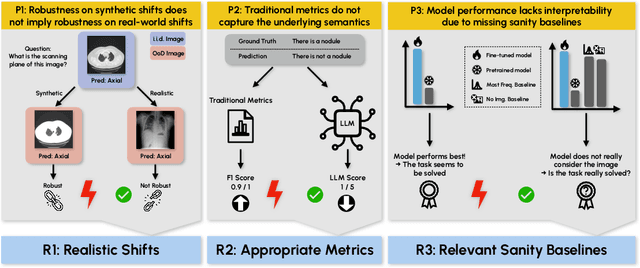
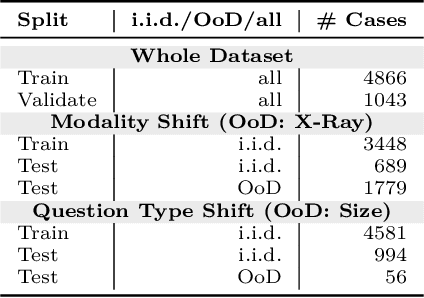
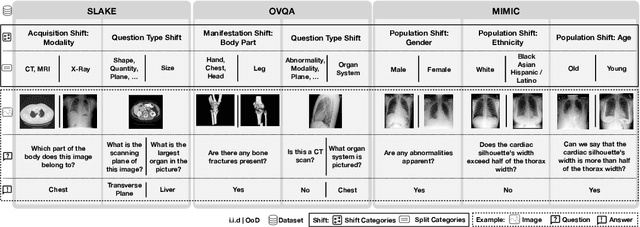
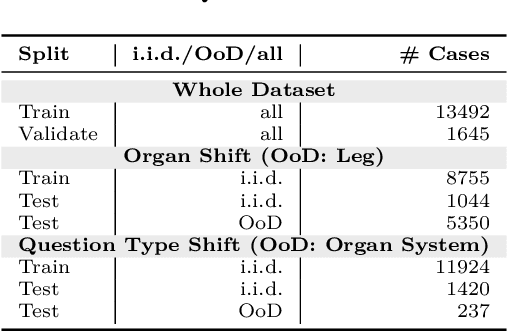
Vision-Language Models (VLMs) have great potential in medical tasks, like Visual Question Answering (VQA), where they could act as interactive assistants for both patients and clinicians. Yet their robustness to distribution shifts on unseen data remains a critical concern for safe deployment. Evaluating such robustness requires a controlled experimental setup that allows for systematic insights into the model's behavior. However, we demonstrate that current setups fail to offer sufficiently thorough evaluations, limiting their ability to accurately assess model robustness. To address this gap, our work introduces a novel framework, called SURE-VQA, centered around three key requirements to overcome the current pitfalls and systematically analyze the robustness of VLMs: 1) Since robustness on synthetic shifts does not necessarily translate to real-world shifts, robustness should be measured on real-world shifts that are inherent to the VQA data; 2) Traditional token-matching metrics often fail to capture underlying semantics, necessitating the use of large language models (LLMs) for more accurate semantic evaluation; 3) Model performance often lacks interpretability due to missing sanity baselines, thus meaningful baselines should be reported that allow assessing the multimodal impact on the VLM. To demonstrate the relevance of this framework, we conduct a study on the robustness of various fine-tuning methods across three medical datasets with four different types of distribution shifts. Our study reveals several important findings: 1) Sanity baselines that do not utilize image data can perform surprisingly well; 2) We confirm LoRA as the best-performing PEFT method; 3) No PEFT method consistently outperforms others in terms of robustness to shifts. Code is provided at https://github.com/IML-DKFZ/sure-vqa.
ValUES: A Framework for Systematic Validation of Uncertainty Estimation in Semantic Segmentation
Jan 16, 2024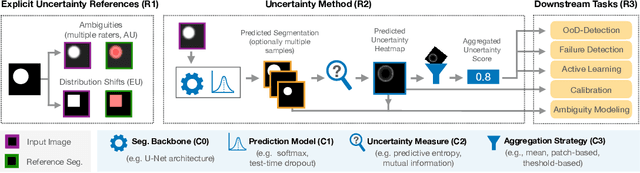
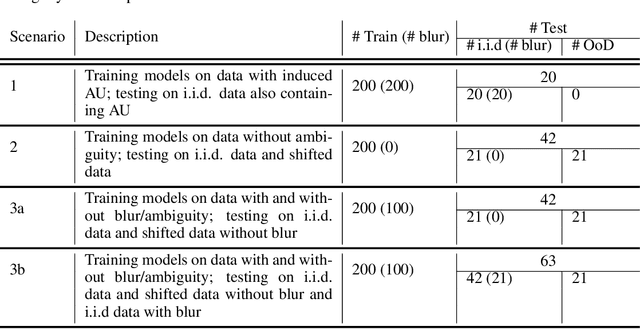
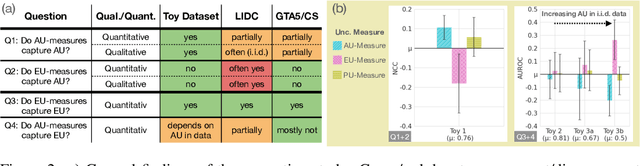
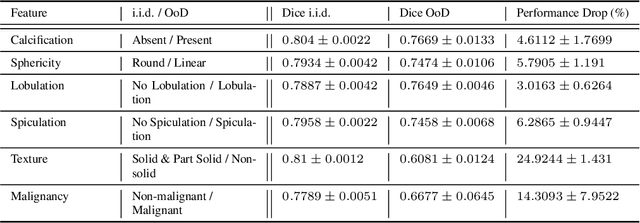
Uncertainty estimation is an essential and heavily-studied component for the reliable application of semantic segmentation methods. While various studies exist claiming methodological advances on the one hand, and successful application on the other hand, the field is currently hampered by a gap between theory and practice leaving fundamental questions unanswered: Can data-related and model-related uncertainty really be separated in practice? Which components of an uncertainty method are essential for real-world performance? Which uncertainty method works well for which application? In this work, we link this research gap to a lack of systematic and comprehensive evaluation of uncertainty methods. Specifically, we identify three key pitfalls in current literature and present an evaluation framework that bridges the research gap by providing 1) a controlled environment for studying data ambiguities as well as distribution shifts, 2) systematic ablations of relevant method components, and 3) test-beds for the five predominant uncertainty applications: OoD-detection, active learning, failure detection, calibration, and ambiguity modeling. Empirical results on simulated as well as real-world data demonstrate how the proposed framework is able to answer the predominant questions in the field revealing for instance that 1) separation of uncertainty types works on simulated data but does not necessarily translate to real-world data, 2) aggregation of scores is a crucial but currently neglected component of uncertainty methods, 3) While ensembles are performing most robustly across the different downstream tasks and settings, test-time augmentation often constitutes a light-weight alternative. Code is at: https://github.com/IML-DKFZ/values