 Add to Chrome
 Add to Firefox
 Add to Edge
Resolution Meets Reduction: Efficient Visual Context for 3D Radiology Report Generation
Aug 09, 2026
Vision-language models offer a promising path toward automating radiology report generation, but applying them to full 3D CT volumes poses substantial computational challenges. Modern foundation vision encoders (VEs) can produce tens of thousands of vision tokens per scan, making the visual sequence passed to the large language model (LLM) a primary computational bottleneck. Vision-to-language projectors can compress this sequence to reduce computation, but may discard clinically relevant detail; conversely, effective compression can accommodate higher-resolution inputs while keeping the downstream token count fixed. How this vision-token budget should be allocated across input field of view, spatial resolution, and vision-to-language projection therefore remains an open design question. We systematically evaluate four heterogeneous VEs (CNN- and ViT-based), five token-reducing projectors at up to 64x compression alongside a non-reducing MLP projector baseline, and five instruction-tuned LLMs (1.7B--4B) on two large-scale CT report datasets (CT-RATE and Merlin). At matched LLM token budgets, anatomy-guided region of interest cropping is the most consistent strategy, improving clinical macro F1 in 19 of 20 settings by +3.7 points on average for the 3D ViT Primus encoder and +1.1 for the slice-based 2D ViT Curia encoder. Increasing input resolution further is strongly projector-dependent: the PerceiverResampler, paired with higher-resolution Curia features, yields the strongest configuration in the resolution study on both datasets. Our best configurations achieve state-of-the-art clinical macro F1 on the test sets, reaching 49.5 on CT-RATE and 49.0 on Merlin. Code and models will be published upon publication.

A Unified Framework for Foreground and Anonymization Area Segmentation in CT and MRI Data
Jan 08, 2025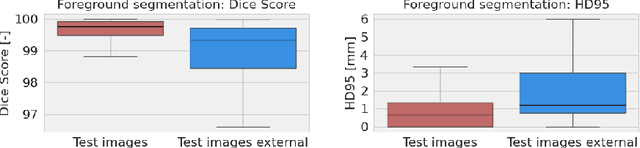

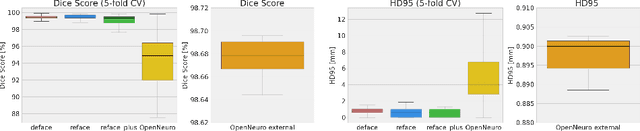
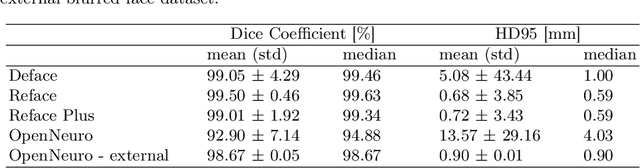
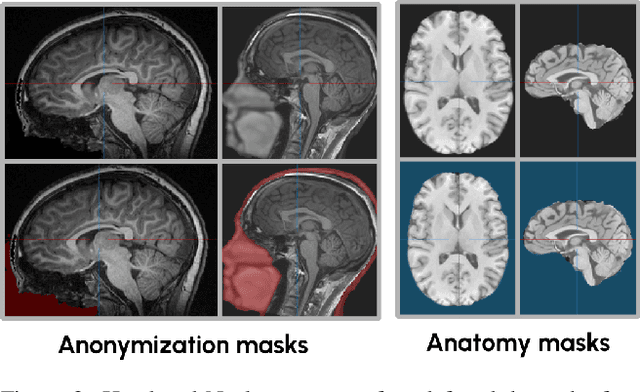
This study presents an open-source toolkit to address critical challenges in preprocessing data for self-supervised learning (SSL) for 3D medical imaging, focusing on data privacy and computational efficiency. The toolkit comprises two main components: a segmentation network that delineates foreground regions to optimize data sampling and thus reduce training time, and a segmentation network that identifies anonymized regions, preventing erroneous supervision in reconstruction-based SSL methods. Experimental results demonstrate high robustness, with mean Dice scores exceeding 98.5 across all anonymization methods and surpassing 99.5 for foreground segmentation tasks, highlighting the efficacy of the toolkit in supporting SSL applications in 3D medical imaging for both CT and MRI images. The weights and code is available at https://github.com/MIC-DKFZ/Foreground-and-Anonymization-Area-Segmentation.
An OpenMind for 3D medical vision self-supervised learning
Dec 22, 2024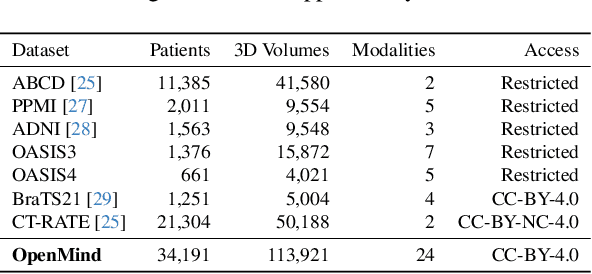
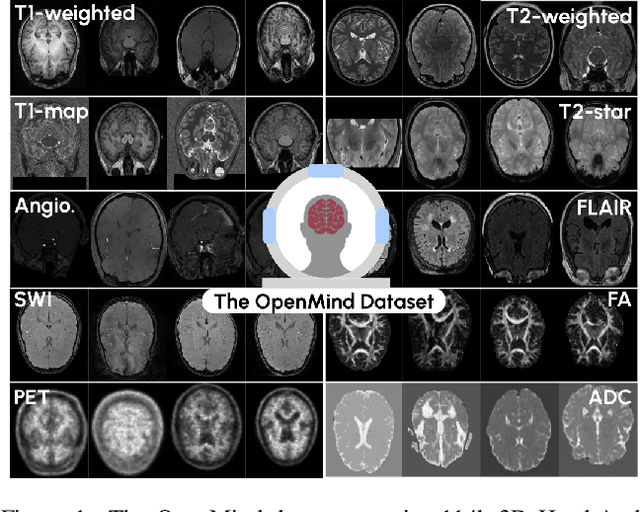
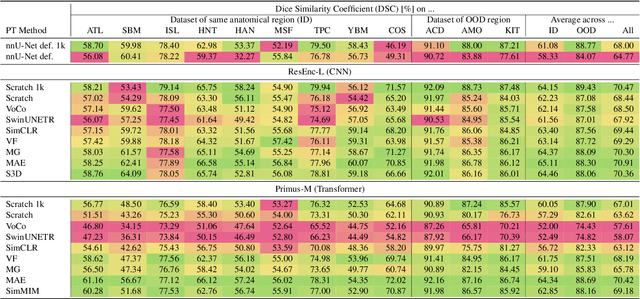
The field of 3D medical vision self-supervised learning lacks consistency and standardization. While many methods have been developed it is impossible to identify the current state-of-the-art, due to i) varying and small pre-training datasets, ii) varying architectures, and iii) being evaluated on differing downstream datasets. In this paper we bring clarity to this field and lay the foundation for further method advancements: We a) publish the largest publicly available pre-training dataset comprising 114k 3D brain MRI volumes and b) benchmark existing SSL methods under common architectures and c) provide the code of our framework publicly to facilitate rapid adoption and reproduction. This pre-print \textit{only describes} the dataset contribution (a); Data, benchmark, and codebase will be made available shortly.