 Add to Chrome
 Add to Firefox
 Add to Edge
Rethinking Post-Hoc Calibration in Semantic Segmentation
Jul 02, 2026
Reliable confidence estimates are essential in semantic segmentation, especially in safety-critical settings where overconfident errors can mislead downstream decisions. Yet modern segmentation models often remain miscalibrated. Post-hoc calibration offers a practical way to correct confidence estimates without retraining the segmentation model, but its use in dense prediction raises structural issues that are often overlooked. We study two such issues. First, adding a constant to all logits leaves the softmax probabilities unchanged, but several standard calibrators can still depend on this arbitrary offset. As a result, two logit representations encoding the same predictive distribution may yield different calibrated probabilities. We define translation-invariant (TI) calibrators as those whose outputs are unchanged under such shifts, characterize which common calibrators satisfy this property, and construct TI counterparts of shift-sensitive calibrators to isolate the effect of removing representation dependence. Second, post-hoc calibration is typically fitted by minimizing a likelihood-based objective, whereas segmentation models are trained with task-specific metrics such as Dice. This mismatch can cause calibration to alter class orderings and degrade the deployed segmentation map. We study decision-preserving calibration under argmax- and order-preservation constraints. Since enforcing these constraints collapses affine softmax calibrators to temperature scaling, we introduce class-conditional affine calibrators that can be made argmax- or order-preserving while retaining greater expressivity, allowing us to quantify the calibration-segmentation trade-off induced by decision preservation. Across natural-image and medical segmentation benchmarks, and under corruption-based covariate shift, matched comparisons show that TI variants generally improve calibration metrics, while decision-preserving variants prevent segmentation degradation and retain strong calibration performance. These results provide practical design principles for well-defined post-hoc calibration pipelines in semantic segmentation.

Spatiotemporal graph neural process for reconstruction, extrapolation, and classification of cardiac trajectories
Sep 16, 2025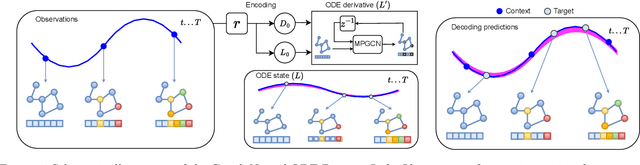
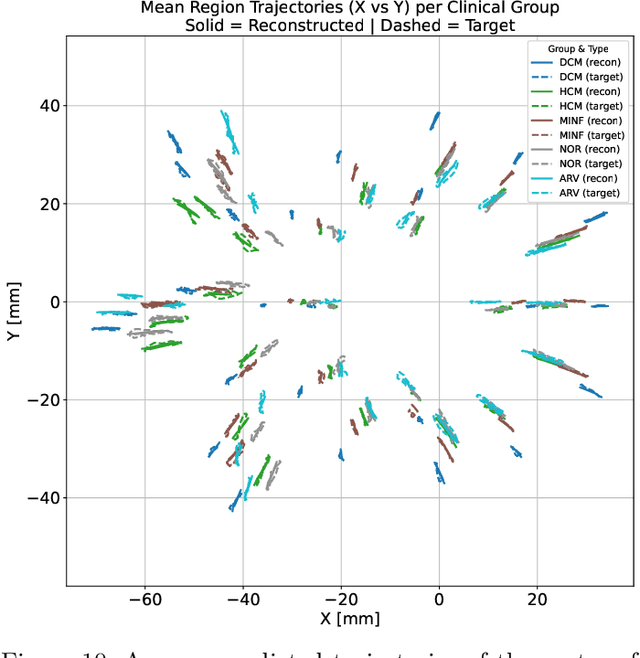
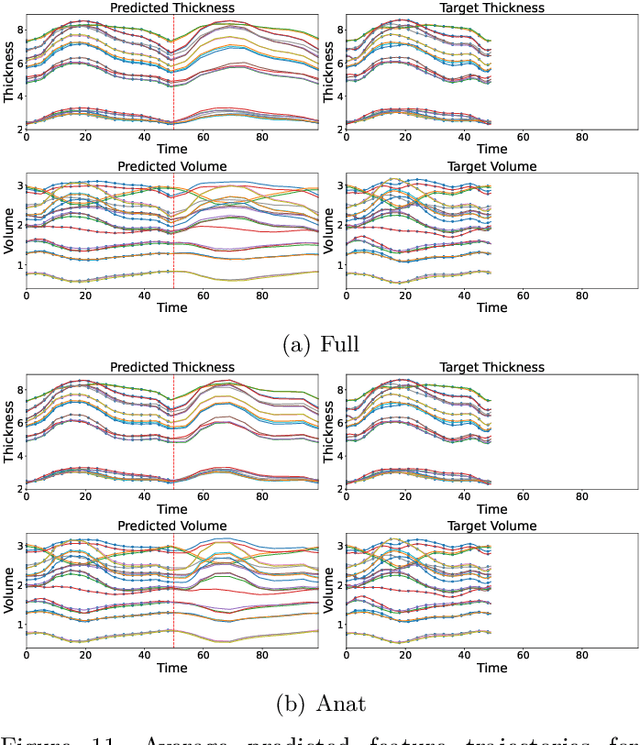
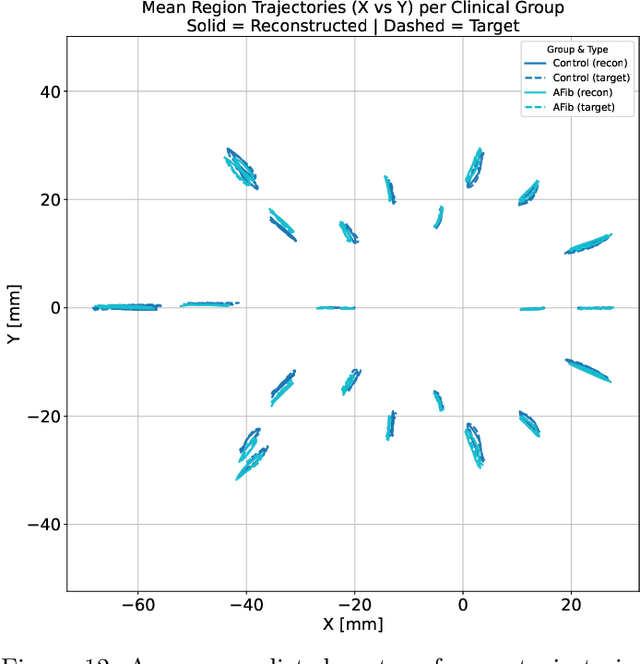
We present a probabilistic framework for modeling structured spatiotemporal dynamics from sparse observations, focusing on cardiac motion. Our approach integrates neural ordinary differential equations (NODEs), graph neural networks (GNNs), and neural processes into a unified model that captures uncertainty, temporal continuity, and anatomical structure. We represent dynamic systems as spatiotemporal multiplex graphs and model their latent trajectories using a GNN-parameterized vector field. Given the sparse context observations at node and edge levels, the model infers a distribution over latent initial states and control variables, enabling both interpolation and extrapolation of trajectories. We validate the method on three synthetic dynamical systems (coupled pendulum, Lorenz attractor, and Kuramoto oscillators) and two real-world cardiac imaging datasets - ACDC (N=150) and UK Biobank (N=526) - demonstrating accurate reconstruction, extrapolation, and disease classification capabilities. The model accurately reconstructs trajectories and extrapolates future cardiac cycles from a single observed cycle. It achieves state-of-the-art results on the ACDC classification task (up to 99% accuracy), and detects atrial fibrillation in UK Biobank subjects with competitive performance (up to 67% accuracy). This work introduces a flexible approach for analyzing cardiac motion and offers a foundation for graph-based learning in structured biomedical spatiotemporal time-series data.