 Add to Chrome
 Add to Firefox
 Add to Edge
The Grammar Does the Work: Functional vs. Lexical Dependency Length Minimization Across Universal Dependencies
Jul 02, 2026
Dependency length minimization (DLM) is a well-documented processing universal, but previous studies report a single mean dependency distance (MDD) per language, obscuring variation across syntactic relation types. We analyze 122 languages in UD and SUD (version 2.17), showing that DLM operates on two distinct levels. Grammar-driven optimization targets functional dependencies (det, case, aux), which are universally short (mean 1.71, $σ$ = 0.33) and invariant across typologically diverse languages. Processing-driven optimization operates on lexical dependencies (nsubj, obj, obl), which are longer (mean 2.87), highly variable ($σ$ = 0.63), and constrained by word-order typology. This asymmetry holds in SUD despite reversed head direction (r = 0.92). We conclude that ''the grammar does the work'' of minimization by scaffolding sentences with local functional attachments, leaving processing pressures to determine the ordering of lexical heads.

AfriSUD: A Dependency Treebank Collection for Evaluating Models on African Languages
Jun 10, 2026Despite their linguistic diversity and global significance, African languages remain underrepresented in research and resources to support NLP. We aim to bridge this gap by introducing AfriSUD, the first large-scale collection of syntactically annotated treebanks for nine diverse African languages spanning major language families and regions across Sub-Saharan Africa. Using the Surface-Syntactic Universal Dependencies (SUD) framework, our community-led effort provides high-quality, native-speaker verified data that capture typological key features such as agglutination and tone. We evaluate a range of models on AfriSUD for part-of-speech tagging and dependency parsing including non-transformer baselines, multilingual pretrained encoders, and LLMs. Our results reveal a significant syntax gap, where models still show clear limitations across the nine languages, suggesting that existing architectures may not fully capture the structural diversity of African-language syntax.
Citation-Driven Multi-View Training for Patent Embeddings: QaECTER and Sophia-Bench
Apr 24, 2026Patent retrieval underpins critical decisions in innovation, examination, and IP strategy, yet progress has been hampered by the absence of benchmarks that reflect the diversity of real world search scenarios. We address this gap with two contributions. First, we introduce Sophiabench, a large-scale patent retrieval benchmark comprising 10,000 queries and 75,000 corpus documents stratified across ten years, eight IPC technology sections, and twelve filing jurisdictions. Unlike prior benchmarks, Sophia-bench tests retrieval using 12 different query types-from structured patent fields to AI-generated summaries-and evaluates results against citation-based ground truth enhanced with a novel domain-relevance metric (InScope). Together, these enable systematic measurement of how well models perform across query types, technology domains, and jurisdictions. Second, we introduce QaECTER, a 344M-parameter embedding model trained on patent citation graphs and multi-view self-alignment. Despite its compact size, QaECTER establishes a new state of the art for patent retrieval. It outperforms the \#1 model on the English retrieval text embedding benchmark (RTEB), a model 23x larger, as well as all existing patent specific models across every query type, IPC section, and jurisdiction on Sophia-bench, with gains of up to 7.2% average NDCG@10 over the next-best model. These results are confirmed on an independent external benchmark, where QaECTER surpasses all prior models without requiring task-specific instruction prompts. Both the benchmark and the model are designed for practical deployment in large-scale patent search systems.
PatentEval: Understanding Errors in Patent Generation
Jun 05, 2024
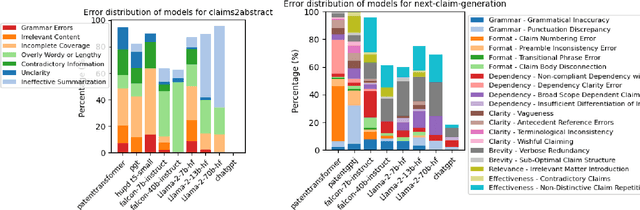
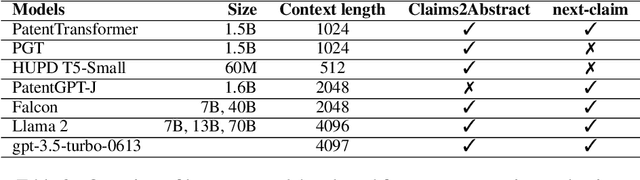
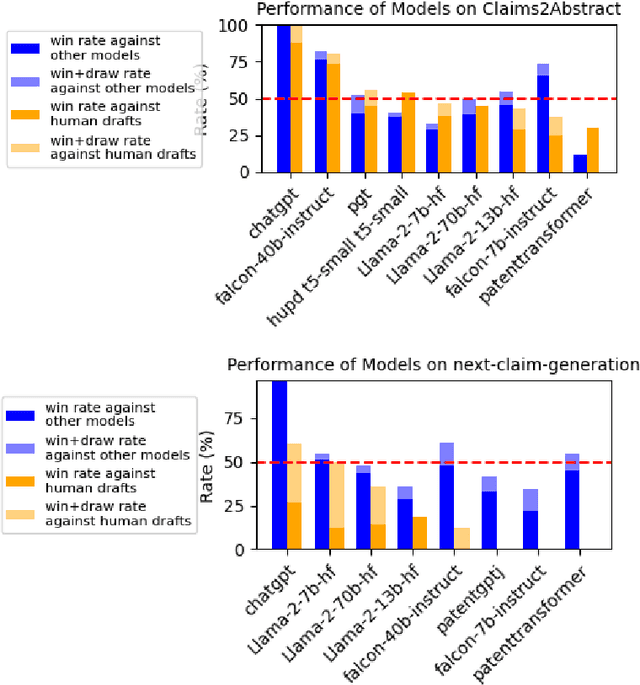
In this work, we introduce a comprehensive error typology specifically designed for evaluating two distinct tasks in machine-generated patent texts: claims-to-abstract generation, and the generation of the next claim given previous ones. We have also developed a benchmark, PatentEval, for systematically assessing language models in this context. Our study includes a comparative analysis, annotated by humans, of various models. These range from those specifically adapted during training for tasks within the patent domain to the latest general-purpose large language models (LLMs). Furthermore, we explored and evaluated some metrics to approximate human judgments in patent text evaluation, analyzing the extent to which these metrics align with expert assessments. These approaches provide valuable insights into the capabilities and limitations of current language models in the specialized field of patent text generation.
PatFig: Generating Short and Long Captions for Patent Figures
Sep 15, 2023
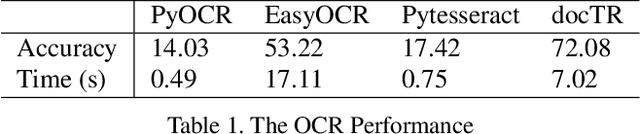
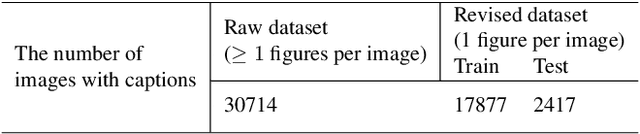
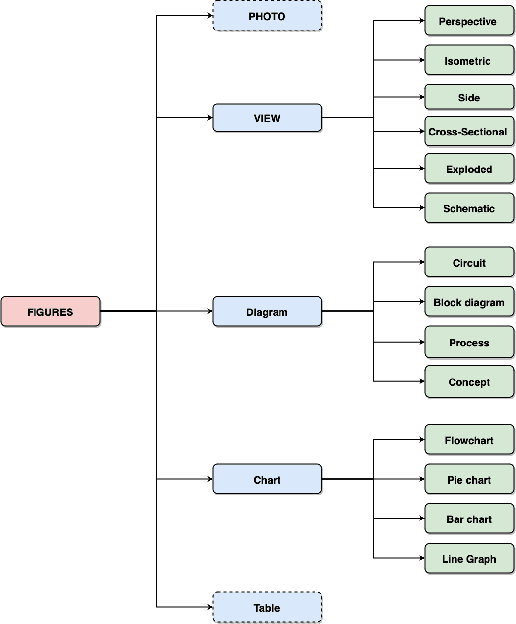
This paper introduces Qatent PatFig, a novel large-scale patent figure dataset comprising 30,000+ patent figures from over 11,000 European patent applications. For each figure, this dataset provides short and long captions, reference numerals, their corresponding terms, and the minimal claim set that describes the interactions between the components of the image. To assess the usability of the dataset, we finetune an LVLM model on Qatent PatFig to generate short and long descriptions, and we investigate the effects of incorporating various text-based cues at the prediction stage of the patent figure captioning process.