 Add to Chrome
 Add to Firefox
 Add to Edge
Citation-Driven Multi-View Training for Patent Embeddings: QaECTER and Sophia-Bench
Apr 24, 2026
Patent retrieval underpins critical decisions in innovation, examination, and IP strategy, yet progress has been hampered by the absence of benchmarks that reflect the diversity of real world search scenarios. We address this gap with two contributions. First, we introduce Sophiabench, a large-scale patent retrieval benchmark comprising 10,000 queries and 75,000 corpus documents stratified across ten years, eight IPC technology sections, and twelve filing jurisdictions. Unlike prior benchmarks, Sophia-bench tests retrieval using 12 different query types-from structured patent fields to AI-generated summaries-and evaluates results against citation-based ground truth enhanced with a novel domain-relevance metric (InScope). Together, these enable systematic measurement of how well models perform across query types, technology domains, and jurisdictions. Second, we introduce QaECTER, a 344M-parameter embedding model trained on patent citation graphs and multi-view self-alignment. Despite its compact size, QaECTER establishes a new state of the art for patent retrieval. It outperforms the \#1 model on the English retrieval text embedding benchmark (RTEB), a model 23x larger, as well as all existing patent specific models across every query type, IPC section, and jurisdiction on Sophia-bench, with gains of up to 7.2% average NDCG@10 over the next-best model. These results are confirmed on an independent external benchmark, where QaECTER surpasses all prior models without requiring task-specific instruction prompts. Both the benchmark and the model are designed for practical deployment in large-scale patent search systems.

PatentEval: Understanding Errors in Patent Generation
Jun 05, 2024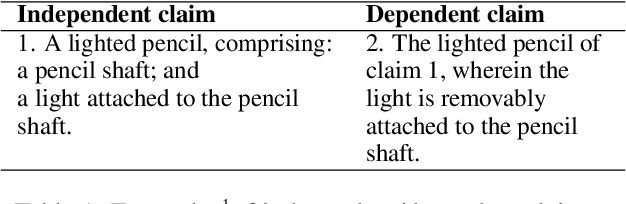
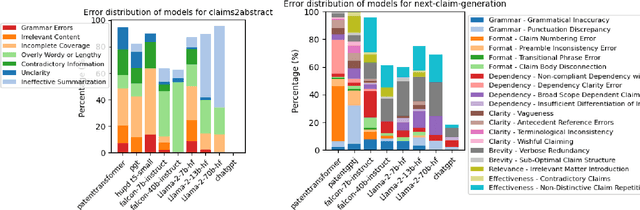
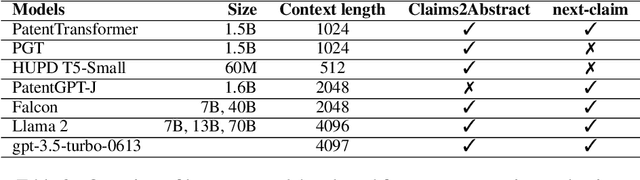
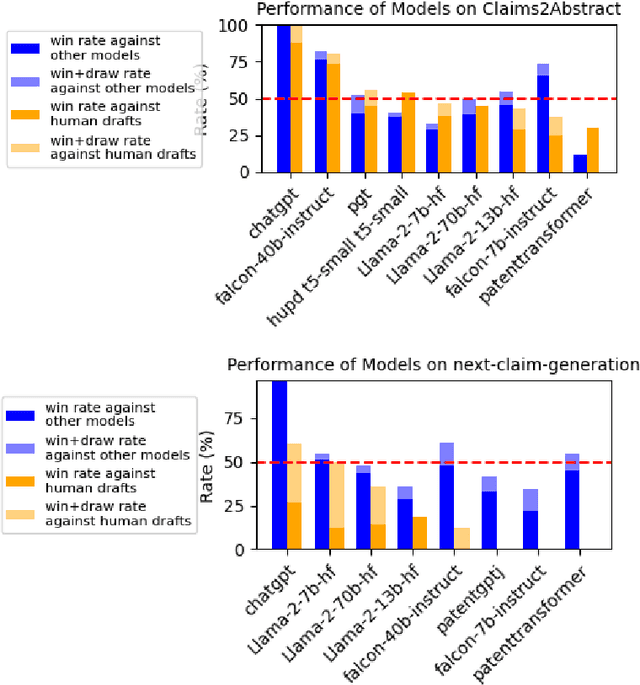
In this work, we introduce a comprehensive error typology specifically designed for evaluating two distinct tasks in machine-generated patent texts: claims-to-abstract generation, and the generation of the next claim given previous ones. We have also developed a benchmark, PatentEval, for systematically assessing language models in this context. Our study includes a comparative analysis, annotated by humans, of various models. These range from those specifically adapted during training for tasks within the patent domain to the latest general-purpose large language models (LLMs). Furthermore, we explored and evaluated some metrics to approximate human judgments in patent text evaluation, analyzing the extent to which these metrics align with expert assessments. These approaches provide valuable insights into the capabilities and limitations of current language models in the specialized field of patent text generation.