 Add to Chrome
 Add to Firefox
 Add to Edge
LeRobot: An Open-Source Library for End-to-End Robot Learning
Feb 26, 2026
Robotics is undergoing a significant transformation powered by advances in high-level control techniques based on machine learning, giving rise to the field of robot learning. Recent progress in robot learning has been accelerated by the increasing availability of affordable teleoperation systems, large-scale openly available datasets, and scalable learning-based methods. However, development in the field of robot learning is often slowed by fragmented, closed-source tools designed to only address specific sub-components within the robotics stack. In this paper, we present \texttt{lerobot}, an open-source library that integrates across the entire robot learning stack, from low-level middleware communication for motor controls to large-scale dataset collection, storage and streaming. The library is designed with a strong focus on real-world robotics, supporting accessible hardware platforms while remaining extensible to new embodiments. It also supports efficient implementations for various state-of-the-art robot learning algorithms from multiple prominent paradigms, as well as a generalized asynchronous inference stack. Unlike traditional pipelines which heavily rely on hand-crafted techniques, \texttt{lerobot} emphasizes scalable learning approaches that improve directly with more data and compute. Designed for accessibility, scalability, and openness, \texttt{lerobot} lowers the barrier to entry for researchers and practitioners to robotics while providing a platform for reproducible, state-of-the-art robot learning.

PatFig: Generating Short and Long Captions for Patent Figures
Sep 15, 2023
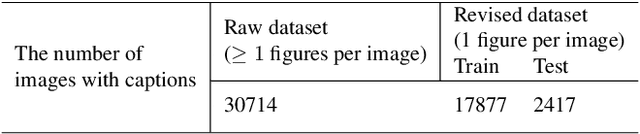
This paper introduces Qatent PatFig, a novel large-scale patent figure dataset comprising 30,000+ patent figures from over 11,000 European patent applications. For each figure, this dataset provides short and long captions, reference numerals, their corresponding terms, and the minimal claim set that describes the interactions between the components of the image. To assess the usability of the dataset, we finetune an LVLM model on Qatent PatFig to generate short and long descriptions, and we investigate the effects of incorporating various text-based cues at the prediction stage of the patent figure captioning process.