 Add to Chrome
 Add to Firefox
 Add to Edge
AfriSUD: A Dependency Treebank Collection for Evaluating Models on African Languages
Jun 10, 2026
Despite their linguistic diversity and global significance, African languages remain underrepresented in research and resources to support NLP. We aim to bridge this gap by introducing AfriSUD, the first large-scale collection of syntactically annotated treebanks for nine diverse African languages spanning major language families and regions across Sub-Saharan Africa. Using the Surface-Syntactic Universal Dependencies (SUD) framework, our community-led effort provides high-quality, native-speaker verified data that capture typological key features such as agglutination and tone. We evaluate a range of models on AfriSUD for part-of-speech tagging and dependency parsing including non-transformer baselines, multilingual pretrained encoders, and LLMs. Our results reveal a significant syntax gap, where models still show clear limitations across the nine languages, suggesting that existing architectures may not fully capture the structural diversity of African-language syntax.

Coconstructions in spoken data: UD annotation guidelines and first results
Mar 30, 2026The paper proposes annotation guidelines for syntactic dependencies that span across speaker turns - including collaborative coconstructions proper, wh-question answers, and backchannels - in spoken language treebanks within the Universal Dependencies framework. Two representations are proposed: a speaker-based representation following the segmentation into speech turns, and a dependency-based representation with dependencies across speech turns. New propositions are also put forward to distinguish between reformulations and repairs, and to promote elements in unfinished phrases.
Sparse Logistic Regression with High-order Features for Automatic Grammar Rule Extraction from Treebanks
Mar 26, 2024
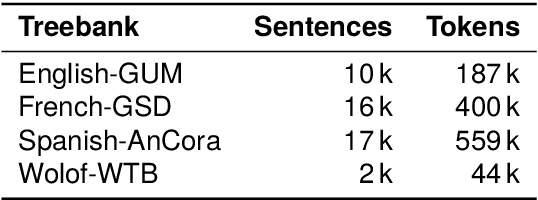

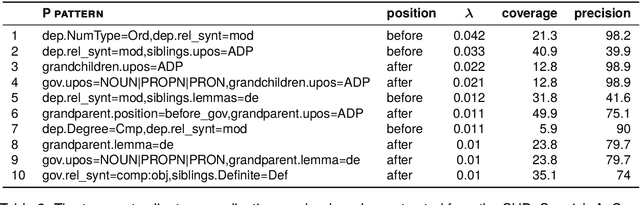
Descriptive grammars are highly valuable, but writing them is time-consuming and difficult. Furthermore, while linguists typically use corpora to create them, grammar descriptions often lack quantitative data. As for formal grammars, they can be challenging to interpret. In this paper, we propose a new method to extract and explore significant fine-grained grammar patterns and potential syntactic grammar rules from treebanks, in order to create an easy-to-understand corpus-based grammar. More specifically, we extract descriptions and rules across different languages for two linguistic phenomena, agreement and word order, using a large search space and paying special attention to the ranking order of the extracted rules. For that, we use a linear classifier to extract the most salient features that predict the linguistic phenomena under study. We associate statistical information to each rule, and we compare the ranking of the model's results to those of other quantitative and statistical measures. Our method captures both well-known and less well-known significant grammar rules in Spanish, French, and Wolof.