 Add to Chrome
 Add to Firefox
 Add to Edge
Cooperative Long Rope Skipping via Multi-Agent Reinforcement Learning
Jun 06, 2026
Humans exhibit remarkable motor agility, enabling a wide range of dynamic skills such as running and jumping, which highlights the great potential of humanoid robots for athletic locomotion. Among athletic sports, long rope skipping requires two rope turners to cooperatively swing the rope while adapting to a player under different jumping rhythms, making it a meaningful yet challenging task for humanoid robots. Although existing methods for humanoid sports have achieved success in single-agent and interaction-free settings, such as running, dancing, and parkour, task scenarios that require precise coordination among multiple participants remain largely unexplored. To this end, we propose Marope, a multi-agent reinforcement learning (MARL) framework for cooperative long rope skipping with multiple humanoid robots. Specifically, Marope adopts a hierarchical reinforcement learning framework for policy training. At the lower level, it learns decentralized rope manipulation policies through MARL, while at the upper level, a centralized scheduling policy is trained to coordinate the execution of the lower-level policies. To improve generalization across different player behavioral styles, Marope further incorporates diverse jumping policies into cooperative game training. We evaluate our approach on Unitree G1 humanoid robots in both simulation and real-world settings. Experimental results demonstrate that Marope outperforms various baselines, achieving more efficient and stable rope manipulation as well as more robust and adaptable cooperation with varied players.

Compute Allocation in Evolutionary Search: From Depth-Breadth to Multi-Armed Bandits
May 28, 2026LLM-guided evolutionary search (Evolve systems) has reached state-of-the-art results on mathematical and combinatorial tasks, yet most existing systems report only the best of many runs and leave the run-to-run distribution undocumented. We ask how a fixed budget of LLM calls should be allocated, and how reliably a single run reaches the reported numbers. Sweeping the depth-breadth grid over five models and three tasks, we identify two empirical regularities: a fitness-compute envelope along which capability ordering largely collapses on effective FLOPs, and a bilinear depth-breadth fit with task-specific interaction; both are gated by model-task capability. Motivated by these regularities, we propose BaSE (Bandit-based Self-Evolving), a multi-armed bandit that allocates LLM calls across parallel trajectories. Without changing the model, prompt, or evaluator, BaSE improves mean fitness by 12.3% over the strongest island-protocol baseline across 8 (model, task) cells, with the largest gains on high-variance settings: a reliability gain from allocation alone.
ClinicalReTrial: A Self-Evolving AI Agent for Clinical Trial Protocol Optimization
Jan 01, 2026Clinical trial failure remains a central bottleneck in drug development, where minor protocol design flaws can irreversibly compromise outcomes despite promising therapeutics. Although cutting-edge AI methods achieve strong performance in predicting trial success, they are inherently reactive for merely diagnosing risk without offering actionable remedies once failure is anticipated. To fill this gap, this paper proposes ClinicalReTrial, a self-evolving AI agent framework that addresses this gap by casting clinical trial reasoning as an iterative protocol redesign problem. Our method integrates failure diagnosis, safety-aware modification, and candidate evaluation in a closed-loop, reward-driven optimization framework. Serving the outcome prediction model as a simulation environment, ClinicalReTrial enables low-cost evaluation of protocol modifications and provides dense reward signals for continuous self-improvement. To support efficient exploration, the framework maintains hierarchical memory that captures iteration-level feedback within trials and distills transferable redesign patterns across trials. Empirically, ClinicalReTrial improves 83.3% of trial protocols with a mean success probability gain of 5.7%, and retrospective case studies demonstrate strong alignment between the discovered redesign strategies and real-world clinical trial modifications.
SeizureTransformer: Scaling U-Net with Transformer for Simultaneous Time-Step Level Seizure Detection from Long EEG Recordings
Apr 02, 2025Epilepsy is a common neurological disorder that affects around 65 million people worldwide. Detecting seizures quickly and accurately is vital, given the prevalence and severity of the associated complications. Recently, deep learning-based automated seizure detection methods have emerged as solutions; however, most existing methods require extensive post-processing and do not effectively handle the crucial long-range patterns in EEG data. In this work, we propose SeizureTransformer, a simple model comprised of (i) a deep encoder comprising 1D convolutions (ii) a residual CNN stack and a transformer encoder to embed previous output into high-level representation with contextual information, and (iii) streamlined decoder which converts these features into a sequence of probabilities, directly indicating the presence or absence of seizures at every time step. Extensive experiments on public and private EEG seizure detection datasets demonstrate that our model significantly outperforms existing approaches (ranked in the first place in the 2025 "seizure detection challenge" organized in the International Conference on Artificial Intelligence in Epilepsy and Other Neurological Disorders), underscoring its potential for real-time, precise seizure detection.
Understanding the Impact of Graph Reduction on Adversarial Robustness in Graph Neural Networks
Dec 08, 2024As Graph Neural Networks (GNNs) become increasingly popular for learning from large-scale graph data across various domains, their susceptibility to adversarial attacks when using graph reduction techniques for scalability remains underexplored. In this paper, we present an extensive empirical study to investigate the impact of graph reduction techniques, specifically graph coarsening and sparsification, on the robustness of GNNs against adversarial attacks. Through extensive experiments involving multiple datasets and GNN architectures, we examine the effects of four sparsification and six coarsening methods on the poisoning attacks. Our results indicate that, while graph sparsification can mitigate the effectiveness of certain poisoning attacks, such as Mettack, it has limited impact on others, like PGD. Conversely, graph coarsening tends to amplify the adversarial impact, significantly reducing classification accuracy as the reduction ratio decreases. Additionally, we provide a novel analysis of the causes driving these effects and examine how defensive GNN models perform under graph reduction, offering practical insights for designing robust GNNs within graph acceleration systems.
On the Robustness of Graph Reduction Against GNN Backdoor
Jul 02, 2024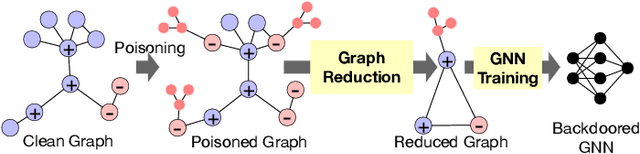
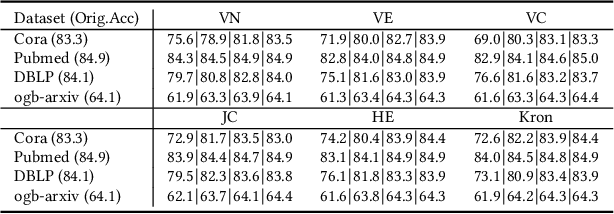
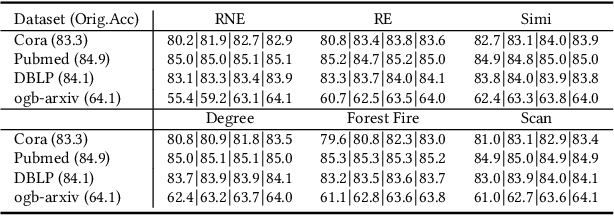
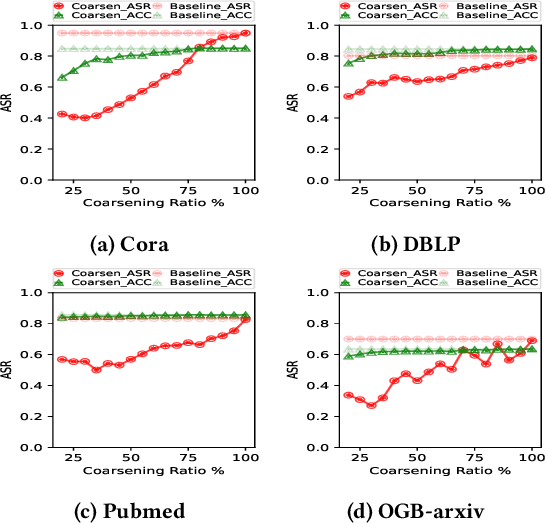
Graph Neural Networks (GNNs) are gaining popularity across various domains due to their effectiveness in learning graph-structured data. Nevertheless, they have been shown to be susceptible to backdoor poisoning attacks, which pose serious threats to real-world applications. Meanwhile, graph reduction techniques, including coarsening and sparsification, which have long been employed to improve the scalability of large graph computational tasks, have recently emerged as effective methods for accelerating GNN training on large-scale graphs. However, the current development and deployment of graph reduction techniques for large graphs overlook the potential risks of data poisoning attacks against GNNs. It is not yet clear how graph reduction interacts with existing backdoor attacks. This paper conducts a thorough examination of the robustness of graph reduction methods in scalable GNN training in the presence of state-of-the-art backdoor attacks. We performed a comprehensive robustness analysis across six coarsening methods and six sparsification methods for graph reduction, under three GNN backdoor attacks against three GNN architectures. Our findings indicate that the effectiveness of graph reduction methods in mitigating attack success rates varies significantly, with some methods even exacerbating the attacks. Through detailed analyses of triggers and poisoned nodes, we interpret our findings and enhance our understanding of how graph reduction interacts with backdoor attacks. These results highlight the critical need for incorporating robustness considerations in graph reduction for GNN training, ensuring that enhancements in computational efficiency do not compromise the security of GNN systems.