 Add to Chrome
 Add to Firefox
 Add to Edge
Foreseeing the Invisible: Amodal Reconstruction of Leaf Fossil Images
Aug 05, 2026
Fossil leaves are rarely preserved whole -- sedimentary rock hides, breaks, and erodes the lamina, yet paleobotany depends on the complete shape and outline of the leaf. We cast the recovery of the missing tissue as amodal reconstruction and present AmodalDINO, a multi-head dense-prediction model that predicts four masks from a single RGB image: visible leaf, amodal complete leaf, amodal main vein, and fine veins. Unlike essentially all prior amodal work, AmodalDINO is given no visible mask. It predicts the visible and amodal regions jointly, so it needs no upstream instance segmenter at runtime. Two simple but effective changes adapt the model to the amodal segmentation task: fully fine-tune a DINOv3 ViT-L/16 at a small learning rate instead of freezing it, and attach auxiliary venation heads alongside the leaf heads. These two changes enable the model to learn the structural shape prior of leaves. Trained only on synthetic leaf fossil images, AmodalDINO reaches 95.0% Dice / 90.5% IoU on the validation set and transfers well to real fossil specimens. Stripped to two heads, the same recipe can run on two benchmark datasets, reaching 85.05 full mIoU / 66.65 occluded mIoU on KINS and 80.90 / 38.15 on COCOA-cls. The model is also practical: by quantizing to 4-bit weights, it runs entirely offline in a browser, matching the original model with an IoU of 0.910. We also add ruler-based calibration to estimate surface area, and a generative visualization of living leaves on local devices.

Anchored Spectral Estimator for Rigid Motion Synchronization
Apr 15, 2026A rigid motion in $\mathbb{R}^d$ consists of a proper rotation and a translation, and it can be represented as a matrix in $\mathbb{R}^{(d+1)\times (d+1)}$. The problem of rigid motion synchronization aims to estimate a collection of rigid motions $G^*_1, \dots, G^*_n$ from noisy observations of their comparisons ${G^*_i}^{-1} G^*_j$. Such problems naturally arise in diverse applications across signal processing, robotics, and computer vision, and have thus attracted intense research attention in recent years. Motivated by geometric considerations, this paper develops a novel spectral approach for rigid motion synchronization, called the anchored spectral estimator (ASE). Theoretically, we establish uniform estimation error bounds for the estimators produced by ASE. Empirically, we show that ASE outperforms the widely used two-stage approach, which first estimates the rotations and then the translations. Further numerical experiments on the multiple point-set registration problem are presented to demonstrate the superiority of ASE over state-of-the-art methods.
SeizureTransformer: Scaling U-Net with Transformer for Simultaneous Time-Step Level Seizure Detection from Long EEG Recordings
Apr 02, 2025Epilepsy is a common neurological disorder that affects around 65 million people worldwide. Detecting seizures quickly and accurately is vital, given the prevalence and severity of the associated complications. Recently, deep learning-based automated seizure detection methods have emerged as solutions; however, most existing methods require extensive post-processing and do not effectively handle the crucial long-range patterns in EEG data. In this work, we propose SeizureTransformer, a simple model comprised of (i) a deep encoder comprising 1D convolutions (ii) a residual CNN stack and a transformer encoder to embed previous output into high-level representation with contextual information, and (iii) streamlined decoder which converts these features into a sequence of probabilities, directly indicating the presence or absence of seizures at every time step. Extensive experiments on public and private EEG seizure detection datasets demonstrate that our model significantly outperforms existing approaches (ranked in the first place in the 2025 "seizure detection challenge" organized in the International Conference on Artificial Intelligence in Epilepsy and Other Neurological Disorders), underscoring its potential for real-time, precise seizure detection.
Manboformer: Learning Gaussian Representations via Spatial-temporal Attention Mechanism
Mar 06, 2025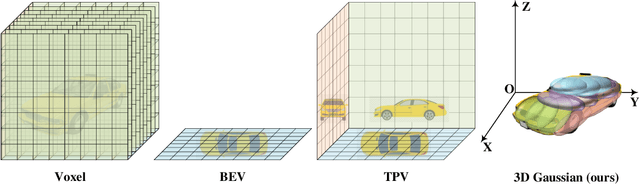
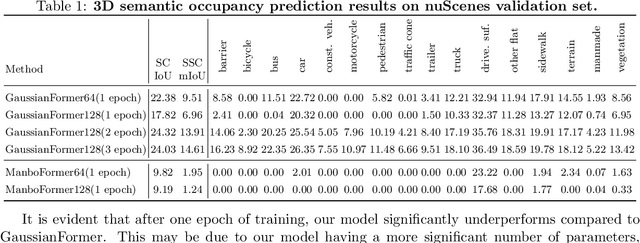
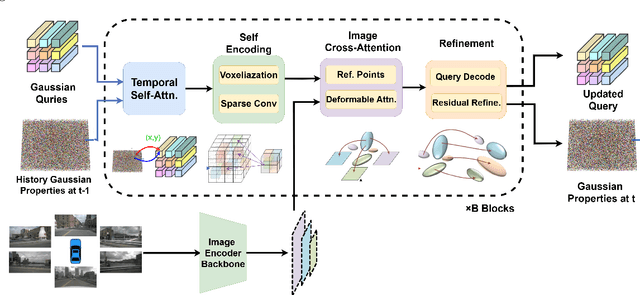
Compared with voxel-based grid prediction, in the field of 3D semantic occupation prediction for autonomous driving, GaussianFormer proposed using 3D Gaussian to describe scenes with sparse 3D semantic Gaussian based on objects is another scheme with lower memory requirements. Each 3D Gaussian function represents a flexible region of interest and its semantic features, which are iteratively refined by the attention mechanism. In the experiment, it is found that the Gaussian function required by this method is larger than the query resolution of the original dense grid network, resulting in impaired performance. Therefore, we consider optimizing GaussianFormer by using unused temporal information. We learn the Spatial-Temporal Self-attention Mechanism from the previous grid-given occupation network and improve it to GaussianFormer. The experiment was conducted with the NuScenes dataset, and the experiment is currently underway.
Coded Speech Quality Measurement by a Non-Intrusive PESQ-DNN
Apr 18, 2023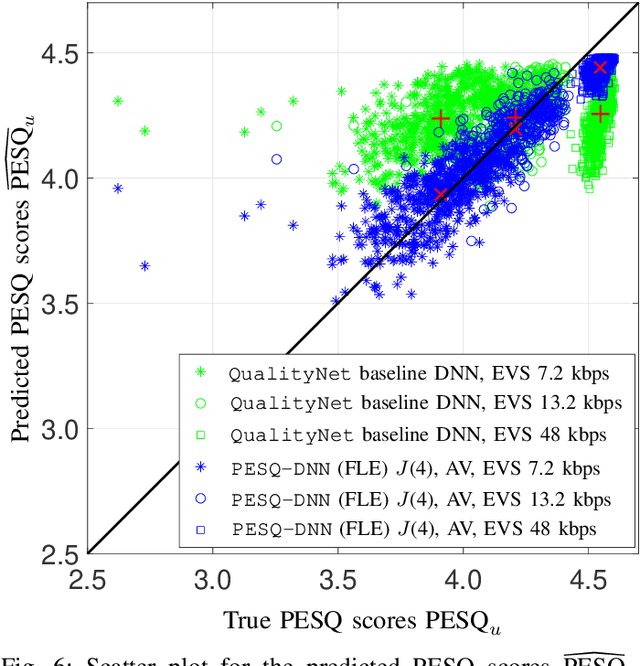
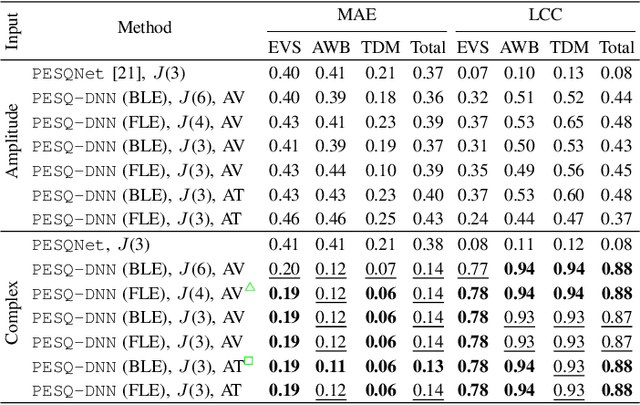
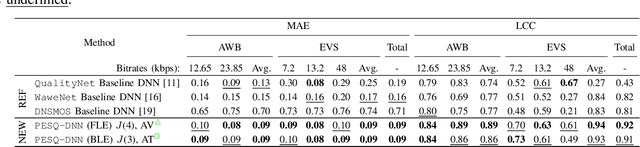
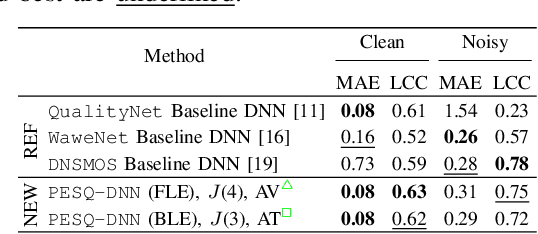
Wideband codecs such as AMR-WB or EVS are widely used in (mobile) speech communication. Evaluation of coded speech quality is often performed subjectively by an absolute category rating (ACR) listening test. However, the ACR test is impractical for online monitoring of speech communication networks. Perceptual evaluation of speech quality (PESQ) is one of the widely used metrics instrumentally predicting the results of an ACR test. However, the PESQ algorithm requires an original reference signal, which is usually unavailable in network monitoring, thus limiting its applicability. NISQA is a new non-intrusive neural-network-based speech quality measure, focusing on super-wideband speech signals. In this work, however, we aim at predicting the well-known PESQ metric using a non-intrusive PESQ-DNN model. We illustrate the potential of this model by predicting the PESQ scores of wideband-coded speech obtained from AMR-WB or EVS codecs operating at different bitrates in noisy, tandeming, and error-prone transmission conditions. We compare our methods with the state-of-the-art network topologies of QualityNet, WaweNet, and DNSMOS -- all applied to PESQ prediction -- by measuring the mean absolute error (MAE) and the linear correlation coefficient (LCC). The proposed PESQ-DNN offers the best total MAE and LCC of 0.11 and 0.92, respectively, in conditions without frame loss, and still is best when including frame loss. Note that our model could be similarly used to non-intrusively predict POLQA or other (intrusive) metrics. Upon article acceptance, code will be provided at GitHub.
Principled Pruning of Bayesian Neural Networks through Variational Free Energy Minimization
Oct 17, 2022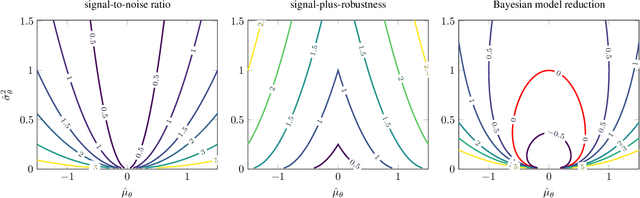
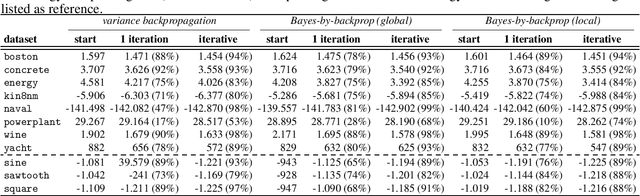
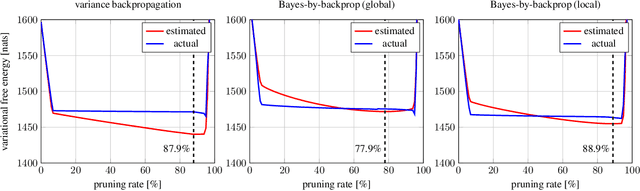
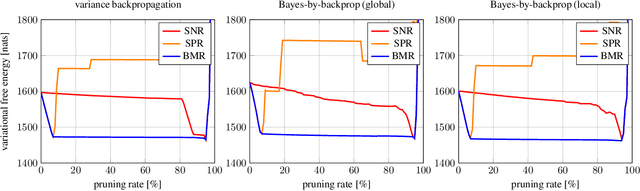
Bayesian model reduction provides an efficient approach for comparing the performance of all nested sub-models of a model, without re-evaluating any of these sub-models. Until now, Bayesian model reduction has been applied mainly in the computational neuroscience community. In this paper, we formulate and apply Bayesian model reduction to perform principled pruning of Bayesian neural networks, based on variational free energy minimization. This novel parameter pruning scheme solves the shortcomings of many current state-of-the-art pruning methods that are used by the signal processing community. The proposed approach has a clear stopping criterion and minimizes the same objective that is used during training. Next to these theoretical benefits, our experiments indicate better model performance in comparison to state-of-the-art pruning schemes.