 Add to Chrome
 Add to Firefox
 Add to Edge
Flow Augmentation and Knowledge Distillation for Lightweight Face Presentation Attack Detection
May 13, 2026
Face presentation attack detection (FacePAD) remains challenging under diverse spoofing representation, including 2D print and replay, 3D mask-based spoofing, makeup-induced appearance manipulation, and physical occlusions, as well as under varying capture conditions. Motion cues are highly discriminative for FacePAD but typically require explicit optical flow estimation, which introduces substantial computational overhead and limits real-time deployment. In this work, we leverage optical flow to enhance motion representation during training while eliminating the need for flow computation at inference. We propose a dual-branch teacher model that fuses appearance cues from RGB frames with motion cues derived from colorwheel-encoded optical flow, enabling effective modeling of micro-motions and temporal consistency. To enable efficient deployment, we introduce a knowledge distillation framework that transfers motion-aware knowledge from the flow-augmented teacher to a lightweight RGB-only student via logit distillation. As a result, the student implicitly learns motion-sensitive representations without requiring explicit flow estimation or additional feature extraction blocks at inference. Extensive experiments demonstrate strong performance across multiple benchmarks, achieving 0.0% HTER on Replay-Attack and Replay-Mobile, 0.94% HTER on ROSE-Youtu, 5.65% HTER on SiW-Mv2, and 0.42% ACER on OULU-NPU. The distilled student achieves performance comparable to or better than the teacher while significantly reducing parameters and FLOPs, achieving 52 FPS on an NVIDIA Jetson Orin Nano, indicating its suitability for real-time and resource-constrained FacePAD deployment.

Rethinking Residual Errors in Compensation-based LLM Quantization
Apr 09, 2026Methods based on weight compensation, which iteratively apply quantization and weight compensation to minimize the output error, have recently demonstrated remarkable success in quantizing Large Language Models (LLMs). The representative work, GPTQ, introduces several key techniques that make such iterative methods practical for LLMs with billions of parameters. GPTAQ extends this approach by introducing an asymmetric calibration process that aligns the output of each quantized layer with its full-precision counterpart, incorporating a residual error into the weight compensation framework. In this work, we revisit the formulation of the residual error. We identify a sub-optimal calibration objective in existing methods: during the intra-layer calibration process, they align the quantized output with the output from compensated weights, rather than the true output from the original full-precision model. Therefore, we redefine the objective to precisely align the quantized model's output with the original output of the full-precision model at each step. We then reveal that the residual error originates not only from the output difference of the preceding layer but also from the discrepancy between the compensated and original weights within each layer, which we name the 'compensation-aware error'. By inheriting the neuron decomposition technique from GPTAQ, we can efficiently incorporate this compensation-aware error into the weight update process. Extensive experiments on various LLMs and quantization settings demonstrate that our proposed enhancements integrate seamlessly with both GPTQ and GPTAQ, significantly improving their quantization performance. Our code is publicly available at https://github.com/list0830/ResComp.
DFVEdit: Conditional Delta Flow Vector for Zero-shot Video Editing
Jun 26, 2025The advent of Video Diffusion Transformers (Video DiTs) marks a milestone in video generation. However, directly applying existing video editing methods to Video DiTs often incurs substantial computational overhead, due to resource-intensive attention modification or finetuning. To alleviate this problem, we present DFVEdit, an efficient zero-shot video editing method tailored for Video DiTs. DFVEdit eliminates the need for both attention modification and fine-tuning by directly operating on clean latents via flow transformation. To be more specific, we observe that editing and sampling can be unified under the continuous flow perspective. Building upon this foundation, we propose the Conditional Delta Flow Vector (CDFV) -- a theoretically unbiased estimation of DFV -- and integrate Implicit Cross Attention (ICA) guidance as well as Embedding Reinforcement (ER) to further enhance editing quality. DFVEdit excels in practical efficiency, offering at least 20x inference speed-up and 85\% memory reduction on Video DiTs compared to attention-engineering-based editing methods. Extensive quantitative and qualitative experiments demonstrate that DFVEdit can be seamlessly applied to popular Video DiTs (e.g., CogVideoX and Wan2.1), attaining state-of-the-art performance on structural fidelity, spatial-temporal consistency, and editing quality.
ViM-VQ: Efficient Post-Training Vector Quantization for Visual Mamba
Mar 12, 2025Visual Mamba networks (ViMs) extend the selective space state model (Mamba) to various vision tasks and demonstrate significant potential. Vector quantization (VQ), on the other hand, decomposes network weights into codebooks and assignments, significantly reducing memory usage and computational latency to enable ViMs deployment on edge devices. Although existing VQ methods have achieved extremely low-bit quantization (e.g., 3-bit, 2-bit, and 1-bit) in convolutional neural networks and Transformer-based networks, directly applying these methods to ViMs results in unsatisfactory accuracy. We identify several key challenges: 1) The weights of Mamba-based blocks in ViMs contain numerous outliers, significantly amplifying quantization errors. 2) When applied to ViMs, the latest VQ methods suffer from excessive memory consumption, lengthy calibration procedures, and suboptimal performance in the search for optimal codewords. In this paper, we propose ViM-VQ, an efficient post-training vector quantization method tailored for ViMs. ViM-VQ consists of two innovative components: 1) a fast convex combination optimization algorithm that efficiently updates both the convex combinations and the convex hulls to search for optimal codewords, and 2) an incremental vector quantization strategy that incrementally confirms optimal codewords to mitigate truncation errors. Experimental results demonstrate that ViM-VQ achieves state-of-the-art performance in low-bit quantization across various visual tasks.
SSVQ: Unleashing the Potential of Vector Quantization with Sign-Splitting
Mar 11, 2025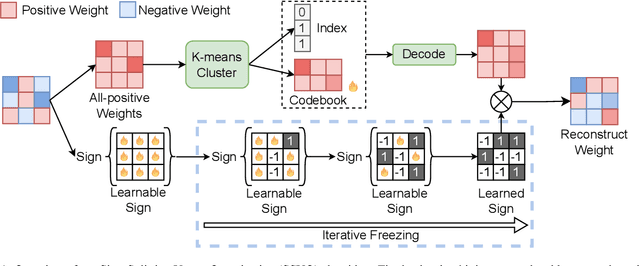
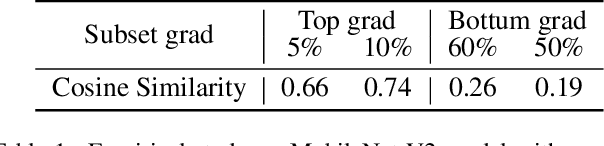
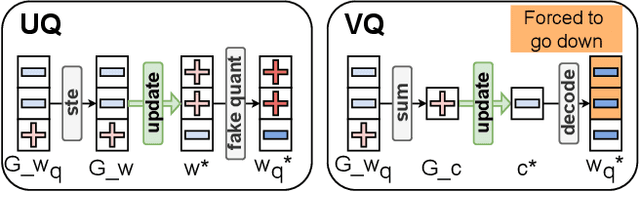

Vector Quantization (VQ) has emerged as a prominent weight compression technique, showcasing substantially lower quantization errors than uniform quantization across diverse models, particularly in extreme compression scenarios. However, its efficacy during fine-tuning is limited by the constraint of the compression format, where weight vectors assigned to the same codeword are restricted to updates in the same direction. Consequently, many quantized weights are compelled to move in directions contrary to their local gradient information. To mitigate this issue, we introduce a novel VQ paradigm, Sign-Splitting VQ (SSVQ), which decouples the sign bit of weights from the codebook. Our approach involves extracting the sign bits of uncompressed weights and performing clustering and compression on all-positive weights. We then introduce latent variables for the sign bit and jointly optimize both the signs and the codebook. Additionally, we implement a progressive freezing strategy for the learnable sign to ensure training stability. Extensive experiments on various modern models and tasks demonstrate that SSVQ achieves a significantly superior compression-accuracy trade-off compared to conventional VQ. Furthermore, we validate our algorithm on a hardware accelerator, showing that SSVQ achieves a 3$\times$ speedup over the 8-bit compressed model by reducing memory access.
MVQ:Towards Efficient DNN Compression and Acceleration with Masked Vector Quantization
Dec 13, 2024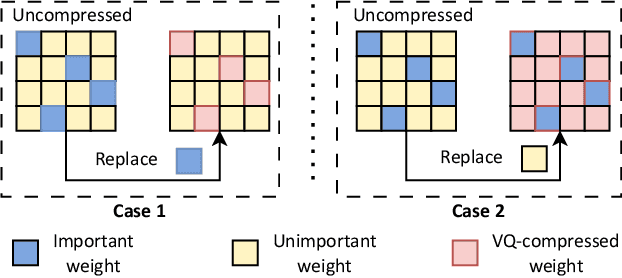
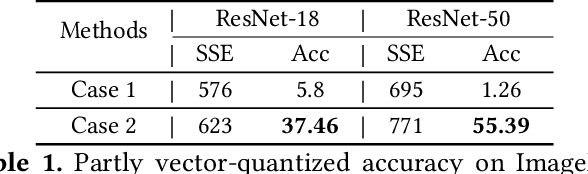
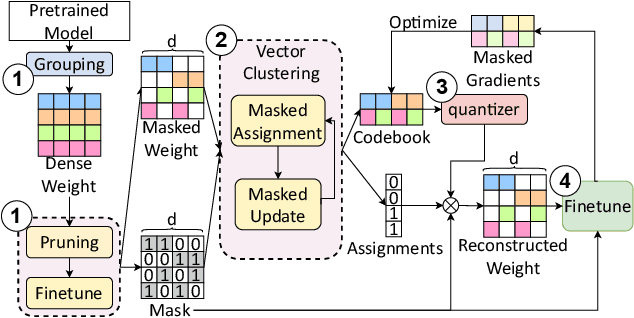

Vector quantization(VQ) is a hardware-friendly DNN compression method that can reduce the storage cost and weight-loading datawidth of hardware accelerators. However, conventional VQ techniques lead to significant accuracy loss because the important weights are not well preserved. To tackle this problem, a novel approach called MVQ is proposed, which aims at better approximating important weights with a limited number of codewords. At the algorithm level, our approach removes the less important weights through N:M pruning and then minimizes the vector clustering error between the remaining weights and codewords by the masked k-means algorithm. Only distances between the unpruned weights and the codewords are computed, which are then used to update the codewords. At the architecture level, our accelerator implements vector quantization on an EWS (Enhanced weight stationary) CNN accelerator and proposes a sparse systolic array design to maximize the benefits brought by masked vector quantization.\\ Our algorithm is validated on various models for image classification, object detection, and segmentation tasks. Experimental results demonstrate that MVQ not only outperforms conventional vector quantization methods at comparable compression ratios but also reduces FLOPs. Under ASIC evaluation, our MVQ accelerator boosts energy efficiency by 2.3$\times$ and reduces the size of the systolic array by 55\% when compared with the base EWS accelerator. Compared to the previous sparse accelerators, MVQ achieves 1.73$\times$ higher energy efficiency.
Efficiency Meets Fidelity: A Novel Quantization Framework for Stable Diffusion
Dec 09, 2024
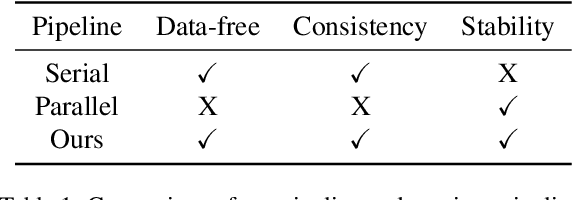

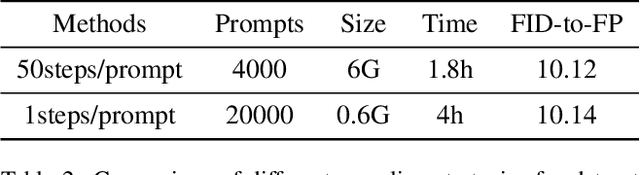
Text-to-image generation of Stable Diffusion models has achieved notable success due to its remarkable generation ability. However, the repetitive denoising process is computationally intensive during inference, which renders Diffusion models less suitable for real-world applications that require low latency and scalability. Recent studies have employed post-training quantization (PTQ) and quantization-aware training (QAT) methods to compress Diffusion models. Nevertheless, prior research has often neglected to examine the consistency between results generated by quantized models and those from floating-point models. This consistency is crucial in fields such as content creation, design, and edge deployment, as it can significantly enhance both efficiency and system stability for practitioners. To ensure that quantized models generate high-quality and consistent images, we propose an efficient quantization framework for Stable Diffusion models. Our approach features a Serial-to-Parallel calibration pipeline that addresses the consistency of both the calibration and inference processes, as well as ensuring training stability. Based on this pipeline, we further introduce a mix-precision quantization strategy, multi-timestep activation quantization, and time information precalculation techniques to ensure high-fidelity generation in comparison to floating-point models. Through extensive experiments with Stable Diffusion v1-4, v2-1, and XL 1.0, we have demonstrated that our method outperforms the current state-of-the-art techniques when tested on prompts from the COCO validation dataset and the Stable-Diffusion-Prompts dataset. Under W4A8 quantization settings, our approach enhances both distribution similarity and visual similarity by 45%-60%.
VQ4ALL: Efficient Neural Network Representation via a Universal Codebook
Dec 09, 2024
The rapid growth of the big neural network models puts forward new requirements for lightweight network representation methods. The traditional methods based on model compression have achieved great success, especially VQ technology which realizes the high compression ratio of models by sharing code words. However, because each layer of the network needs to build a code table, the traditional top-down compression technology lacks attention to the underlying commonalities, resulting in limited compression rate and frequent memory access. In this paper, we propose a bottom-up method to share the universal codebook among multiple neural networks, which not only effectively reduces the number of codebooks but also further reduces the memory access and chip area by storing static code tables in the built-in ROM. Specifically, we introduce VQ4ALL, a VQ-based method that utilizes codewords to enable the construction of various neural networks and achieve efficient representations. The core idea of our method is to adopt a kernel density estimation approach to extract a universal codebook and then progressively construct different low-bit networks by updating differentiable assignments. Experimental results demonstrate that VQ4ALL achieves compression rates exceeding 16 $\times$ while preserving high accuracy across multiple network architectures, highlighting its effectiveness and versatility.
FreeMask: Rethinking the Importance of Attention Masks for Zero-Shot Video Editing
Sep 30, 2024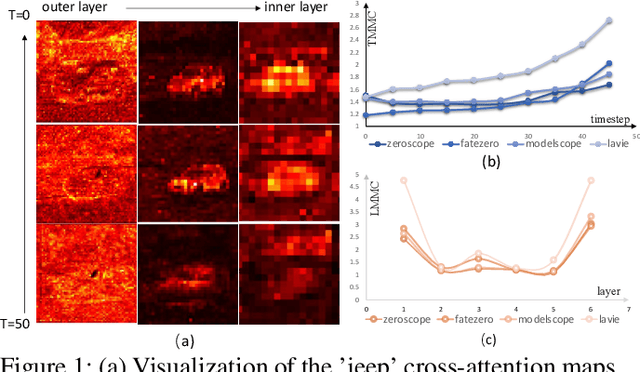


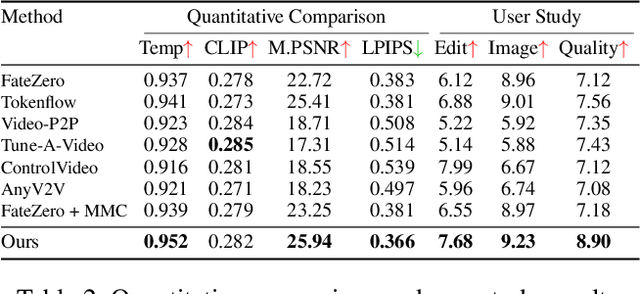
Text-to-video diffusion models have made remarkable advancements. Driven by their ability to generate temporally coherent videos, research on zero-shot video editing using these fundamental models has expanded rapidly. To enhance editing quality, structural controls are frequently employed in video editing. Among these techniques, cross-attention mask control stands out for its effectiveness and efficiency. However, when cross-attention masks are naively applied to video editing, they can introduce artifacts such as blurring and flickering. Our experiments uncover a critical factor overlooked in previous video editing research: cross-attention masks are not consistently clear but vary with model structure and denoising timestep. To address this issue, we propose the metric Mask Matching Cost (MMC) that quantifies this variability and propose FreeMask, a method for selecting optimal masks tailored to specific video editing tasks. Using MMC-selected masks, we further improve the masked fusion mechanism within comprehensive attention features, e.g., temp, cross, and self-attention modules. Our approach can be seamlessly integrated into existing zero-shot video editing frameworks with better performance, requiring no control assistance or parameter fine-tuning but enabling adaptive decoupling of unedited semantic layouts with mask precision control. Extensive experiments demonstrate that FreeMask achieves superior semantic fidelity, temporal consistency, and editing quality compared to state-of-the-art methods.
Stepwise Weighted Spike Coding for Deep Spiking Neural Networks
Aug 30, 2024Spiking Neural Networks (SNNs) seek to mimic the spiking behavior of biological neurons and are expected to play a key role in the advancement of neural computing and artificial intelligence. The efficiency of SNNs is often determined by the neural coding schemes. Existing coding schemes either cause huge delays and energy consumption or necessitate intricate neuron models and training techniques. To address these issues, we propose a novel Stepwise Weighted Spike (SWS) coding scheme to enhance the encoding of information in spikes. This approach compresses the spikes by weighting the significance of the spike in each step of neural computation, achieving high performance and low energy consumption. A Ternary Self-Amplifying (TSA) neuron model with a silent period is proposed for supporting SWS-based computing, aimed at minimizing the residual error resulting from stepwise weighting in neural computation. Our experimental results show that the SWS coding scheme outperforms the existing neural coding schemes in very deep SNNs, and significantly reduces operations and latency.