 Add to Chrome
 Add to Firefox
 Add to Edge
Rethinking Residual Errors in Compensation-based LLM Quantization
Apr 09, 2026
Methods based on weight compensation, which iteratively apply quantization and weight compensation to minimize the output error, have recently demonstrated remarkable success in quantizing Large Language Models (LLMs). The representative work, GPTQ, introduces several key techniques that make such iterative methods practical for LLMs with billions of parameters. GPTAQ extends this approach by introducing an asymmetric calibration process that aligns the output of each quantized layer with its full-precision counterpart, incorporating a residual error into the weight compensation framework. In this work, we revisit the formulation of the residual error. We identify a sub-optimal calibration objective in existing methods: during the intra-layer calibration process, they align the quantized output with the output from compensated weights, rather than the true output from the original full-precision model. Therefore, we redefine the objective to precisely align the quantized model's output with the original output of the full-precision model at each step. We then reveal that the residual error originates not only from the output difference of the preceding layer but also from the discrepancy between the compensated and original weights within each layer, which we name the 'compensation-aware error'. By inheriting the neuron decomposition technique from GPTAQ, we can efficiently incorporate this compensation-aware error into the weight update process. Extensive experiments on various LLMs and quantization settings demonstrate that our proposed enhancements integrate seamlessly with both GPTQ and GPTAQ, significantly improving their quantization performance. Our code is publicly available at https://github.com/list0830/ResComp.

SSVQ: Unleashing the Potential of Vector Quantization with Sign-Splitting
Mar 11, 2025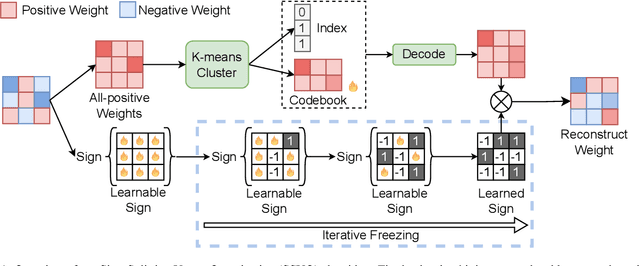
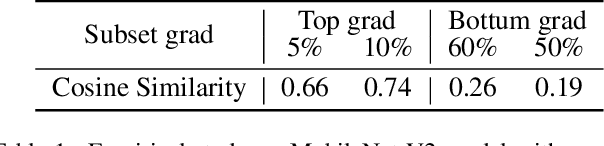
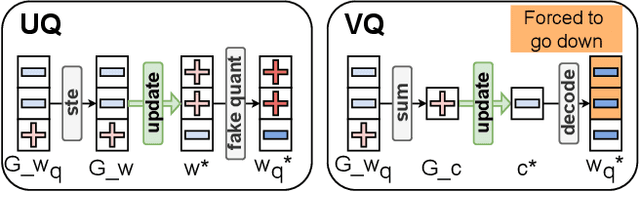

Vector Quantization (VQ) has emerged as a prominent weight compression technique, showcasing substantially lower quantization errors than uniform quantization across diverse models, particularly in extreme compression scenarios. However, its efficacy during fine-tuning is limited by the constraint of the compression format, where weight vectors assigned to the same codeword are restricted to updates in the same direction. Consequently, many quantized weights are compelled to move in directions contrary to their local gradient information. To mitigate this issue, we introduce a novel VQ paradigm, Sign-Splitting VQ (SSVQ), which decouples the sign bit of weights from the codebook. Our approach involves extracting the sign bits of uncompressed weights and performing clustering and compression on all-positive weights. We then introduce latent variables for the sign bit and jointly optimize both the signs and the codebook. Additionally, we implement a progressive freezing strategy for the learnable sign to ensure training stability. Extensive experiments on various modern models and tasks demonstrate that SSVQ achieves a significantly superior compression-accuracy trade-off compared to conventional VQ. Furthermore, we validate our algorithm on a hardware accelerator, showing that SSVQ achieves a 3$\times$ speedup over the 8-bit compressed model by reducing memory access.