 Add to Chrome
 Add to Firefox
 Add to Edge
Exploiting Expertise of Non-Expert and Diverse Agents in Social Bandit Learning: A Free Energy Approach
Mar 12, 2026
Personalized AI-based services involve a population of individual reinforcement learning agents. However, most reinforcement learning algorithms focus on harnessing individual learning and fail to leverage the social learning capabilities commonly exhibited by humans and animals. Social learning integrates individual experience with observing others' behavior, presenting opportunities for improved learning outcomes. In this study, we focus on a social bandit learning scenario where a social agent observes other agents' actions without knowledge of their rewards. The agents independently pursue their own policy without explicit motivation to teach each other. We propose a free energy-based social bandit learning algorithm over the policy space, where the social agent evaluates others' expertise levels without resorting to any oracle or social norms. Accordingly, the social agent integrates its direct experiences in the environment and others' estimated policies. The theoretical convergence of our algorithm to the optimal policy is proven. Empirical evaluations validate the superiority of our social learning method over alternative approaches in various scenarios. Our algorithm strategically identifies the relevant agents, even in the presence of random or suboptimal agents, and skillfully exploits their behavioral information. In addition to societies including expert agents, in the presence of relevant but non-expert agents, our algorithm significantly enhances individual learning performance, where most related methods fail. Importantly, it also maintains logarithmic regret.

kooplearn: A Scikit-Learn Compatible Library of Algorithms for Evolution Operator Learning
Dec 24, 2025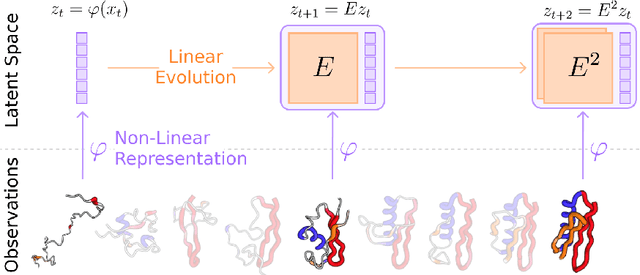
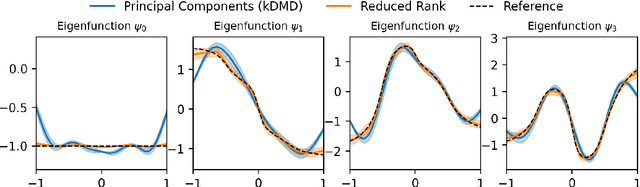
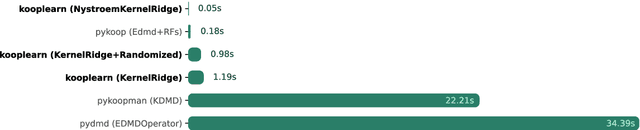
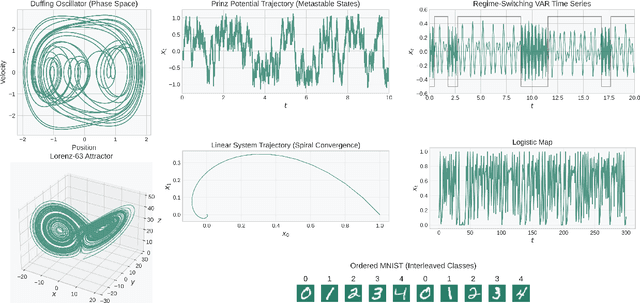
kooplearn is a machine-learning library that implements linear, kernel, and deep-learning estimators of dynamical operators and their spectral decompositions. kooplearn can model both discrete-time evolution operators (Koopman/Transfer) and continuous-time infinitesimal generators. By learning these operators, users can analyze dynamical systems via spectral methods, derive data-driven reduced-order models, and forecast future states and observables. kooplearn's interface is compliant with the scikit-learn API, facilitating its integration into existing machine learning and data science workflows. Additionally, kooplearn includes curated benchmark datasets to support experimentation, reproducibility, and the fair comparison of learning algorithms. The software is available at https://github.com/Machine-Learning-Dynamical-Systems/kooplearn.
An Empirical Bernstein Inequality for Dependent Data in Hilbert Spaces and Applications
Jul 10, 2025Learning from non-independent and non-identically distributed data poses a persistent challenge in statistical learning. In this study, we introduce data-dependent Bernstein inequalities tailored for vector-valued processes in Hilbert space. Our inequalities apply to both stationary and non-stationary processes and exploit the potential rapid decay of correlations between temporally separated variables to improve estimation. We demonstrate the utility of these bounds by applying them to covariance operator estimation in the Hilbert-Schmidt norm and to operator learning in dynamical systems, achieving novel risk bounds. Finally, we perform numerical experiments to illustrate the practical implications of these bounds in both contexts.
BioLCNet: Reward-modulated Locally Connected Spiking Neural Networks
Sep 12, 2021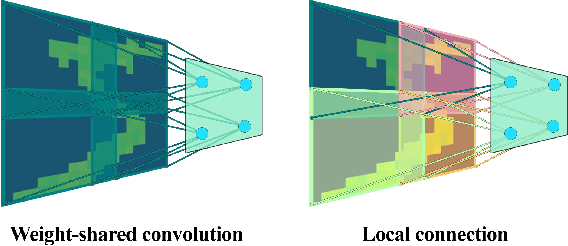
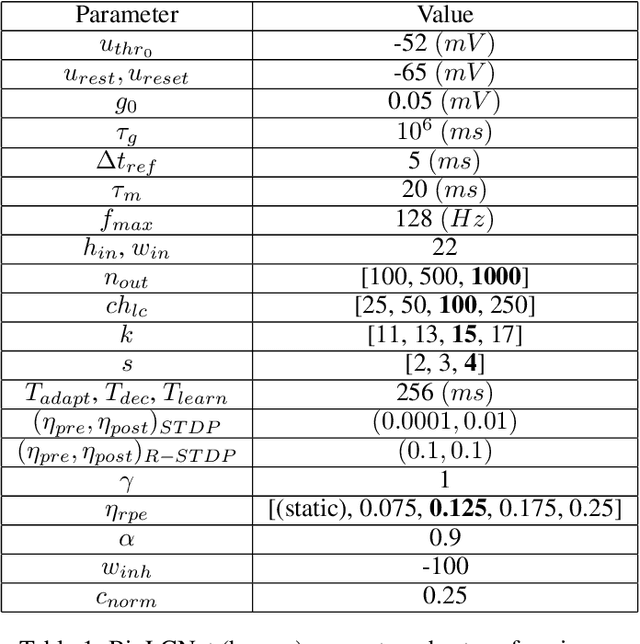
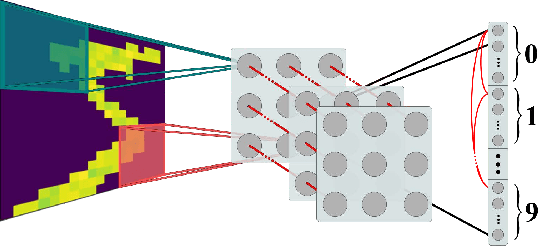

Recent studies have shown that convolutional neural networks (CNNs) are not the only feasible solution for image classification. Furthermore, weight sharing and backpropagation used in CNNs do not correspond to the mechanisms present in the primate visual system. To propose a more biologically plausible solution, we designed a locally connected spiking neural network (SNN) trained using spike-timing-dependent plasticity (STDP) and its reward-modulated variant (R-STDP) learning rules. The use of spiking neurons and local connections along with reinforcement learning (RL) led us to the nomenclature BioLCNet for our proposed architecture. Our network consists of a rate-coded input layer followed by a locally connected hidden layer and a decoding output layer. A spike population-based voting scheme is adopted for decoding in the output layer. We used the MNIST dataset to obtain image classification accuracy and to assess the robustness of our rewarding system to varying target responses.